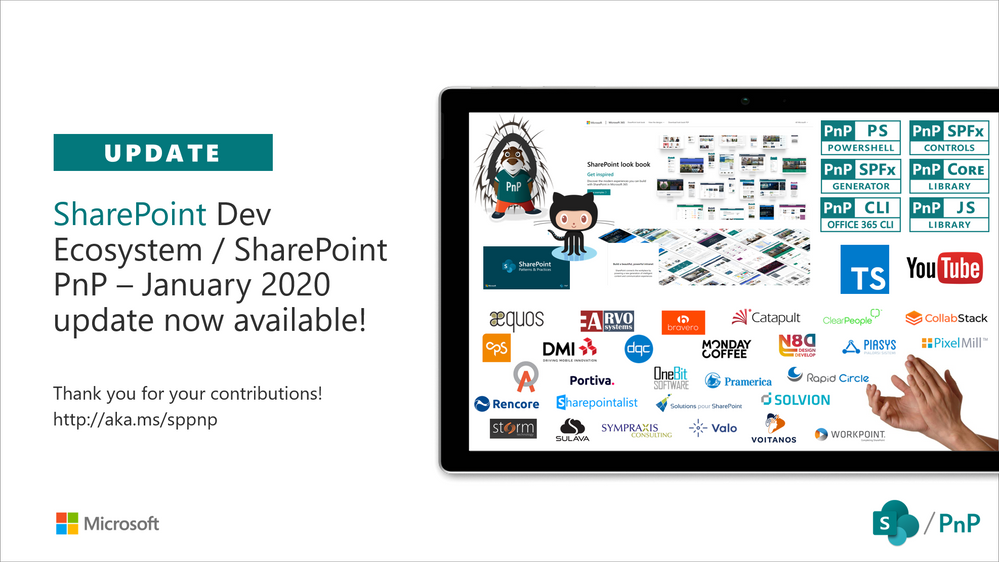
Latest monthly summary of SharePoint Development guidance for SharePoint Online and on-premises is now available from the SharePoint Dev Blog. Check the latest news, samples and other guidance from this summary.

In this session of SharePoint Dev Weekly, hosts – Vesa Juvonen (Microsoft), Waldek Mastykarz (Rencore), discuss the latest news and topics around SharePoint development.
In addition to drawing attention to the latest advancements being delivered by the SharePoint Community and Microsoft, Vesa and Waldek’s discussion this week focused on: Predictions for 2020.
This episode was recorded on Tuesday, January 7, 2020.
![Securing ALL your cloud apps with Microsoft]()
This post is authored by @Boris_Kacevich
For most customers, cloud apps run the workplace. While we see an average of 129 IT-managed applications, Discovery data from our Cloud Access Security Broker (CASB) shows that the total number of apps accessed by employees in large organizations often exceeds 1,000.
Now, let’s think back to 1985. Windows 1.0 launched and provided the ability to display content in different spaces at the same time, a revolution in the OS space at the time. Fast forward back to 2019 and today the average employee switches between 35 job-critical applications more than 1,100 times every day. Sound like a lot? Take a look at how many cloud applications are open in your browser right now while you are reading this blog.
There is no debate today that our working environment and the tools we use in order to maintain our productivity continue to change rapidly. As the cloud transformation continues, it enables organizations to optimize their employee productivity by giving them the ability to choose the tools that are right for them across apps, devices and more.
But this flexibility and power of choice comes with great responsibility. The freedom to use any cloud app introduces a requirement to consider what you are doing with it and the risk you may bring to a business. According to LogicMonitor’s cloud report, 83% of business workloads will have migrated to the cloud by 2020, although most agree that the information is migrating much faster than this, while the security controls that are able to protect it lag behind. This is a clear risk as evidenced by the Box information leakage which was caused by insufficient control of the uploaded data.
But expecting users to take responsibility for this is simply not going to work and is not an option for most organizations. The right security controls need to be put in place to ensure that no sensitive information leaks out of the organization, even when flexibility is provided for the adoption of cloud apps.
To help you with this, we have compiled some general best practices to help protect your organization in this world of flexibility:
- Set up single sign-on for adopted apps in your organization to enable a better authentication experience for users and enforce appropriate elevated assessments with conditional access and MFA
- Minimize and control permission scopes given to users and OAuth apps being used in your organization to limit the potential impact of a breach
- Control the information being upload to cloud services – limit the type of documents being uploaded, classify uploaded documents and encrypt them when required
- Limit external sharing permissions by enabling controls for things like the creation of public links or sharing with external users
- Leverage cross service UEBA capabilities to detect potentially compromised accounts or insider threats
- Manage ALL users and devices, do not allow unmanaged guest users or un-monitored usage from un-managed devices.
- Monitor and control all your environments continuously, do not rely only on periodic reports and audits. Detecting policy violations in real time or near real time minimizes the risk for a wide exposure.
As Microsoft Cloud App Security became a leading CASB in the market, we took the approach of protecting all cloud apps, not just our own, recognizing that this was the correct set of outcomes for customers. It is important that as a multi-mode CASB, we provide rich visibility, control over data, and sophisticated analytics to identify and combat cyberthreats across ALL your cloud services.

So let’s beyond the realm of theory and bring this to life by exploring a few scenarios.
Protect your sensitive information
According to Varonis more than 30% of companies have more than 1000 sensitive folders which are accessible by everyone. Microsoft Cloud App Security enables granular control and DLP capabilities over the content shared on leading apps like G Suite, Box, Dropbox and Salesforce, protecting sensitive client information on platforms like ServiceNow, making sure there are no S3 AWS buckets left open and exposed to the wide world and preventing users from sharing sensitive files with external users in Webex chat rooms. Information exposure control via a unified labeling mechanism is also available for non-MSFT apps like G Suite and Box via a native integration with Microsoft Azure Information Protection.
Protect against insider threats and anomalous behaviors
According to the Insider Threat Report 2018, 90% of organizations feel vulnerable to insider threat attacks, whether they are malicious, accidental or due to compromised accounts. Microsoft Cloud App Security provides advanced UEBA capabilities to detect anomalous behaviors by users, detecting abuse of privileged accounts or performing activities from an unusual location, client or device. The native integration with Azure Active Directory enables further enrichment of user identity and improves detection capabilities across used non-MSFT apps. These detection capabilities are enabled out of the box for apps like Salesforce, ServiceNow, G Suite, Google Cloud Platform, Box, Dropbox, Okta and WebEx teams.
Protect against threats, malware and ransomware
Microsoft Cloud App Security utilizes the MSFT security eco-system and deep integration with the Intelligent security graph to provide wide coverage of potential threats from Tor-based access, to potential Ransomware and Malware attacks back to potentially leaked credentials. The protection is available across all connected services that are available in Microsoft Cloud App Security.
Gain investigation capabilities into complex environments
In today’s complex environments, whether it is the usage of multiple cloud apps or the use of a one with complex structure like Salesforce it is not enough to have periodic audits on per app basis. To get the broader picture, stay up to date and be able to control incidents across your entire environment it is critical to have full visibility of what is happening across all of the apps in your environment. The ability to control the activities, set clear policies and automate the process is crucial to maintain a secure and controlled workplace. Microsoft Cloud App Security enables a cross app unified policy and investigation capabilities to get clear visibility and control over user activities in the connected apps.
Get real-time controls for user access and sessions from managed and un-managed devices
Microsoft Cloud App Security enables granular access and session controls for all governed users in the system. Controlling risky access and session enables admins to limit app access, block downloads and restrict activities like copy/paste in web-based cloud apps. Microsoft Cloud App Security also enables to control the access and session from unmanaged devices while the user tries to access enterprise managed apps. These controls are enabled for more than 25 leading SaaS apps like Box, Concur, GitHub, G Suite, Confluence, Salesforce, Slack, Workday and also available for any cloud web-based app using SAML and SSO.
Protect against malicious OAuth apps in leading SaaS platforms
Microsoft Cloud App Security enables IT to gain an overview of authorized applications across their cloud services Office 365, Salesforce and G-Suite. The capabilities allow them to continuously monitor new app permissions and provides controls to prevent and remediate malicious OAuth apps from gaining access to the corporate data.
Going beyond the top Cloud apps we can recognize a large amount of growing productivity, Finance, HR and CRM apps like Workplace by Facebook, SAP Concur, Citrix Sharefile, Atlassian Confluence and Zoom that are being adopted by organizations or more specifically by the users in these organizations.
Being able to scale protection and align with the growth of this eco-system is one of Microsoft Cloud App Security’ top missions in the upcoming future.
You can learn more about Microsoft Cloud App Security here, and please let @Boris_Kacevich know any questions you have!
Thank you
@Adam Hall on behalf of the entire MCAS team
For most customers, cloud apps run the workplace. While we see an average of 129 IT-managed applications, Discovery data from our Cloud Access Security Broker (CASB) shows that the total number of apps accessed by employees in large organizations often exceeds 1,000.
Now, let’s think back to 1985. Windows 1.0 launched and provided the ability to display content in different spaces at the same time, a revolution in the OS space at the time. Fast forward back to 2019 and today the average employee switches between 35 job-critical applications more than 1,100 times every day. Sound like a lot? Take a look at how many cloud applications are open in your browser right now while you are reading this blog.
There is no debate today that our working environment and the tools we use in order to maintain our productivity continue to change rapidly. As the cloud transformation continues, it enables organizations to optimize their employee productivity by giving them the ability to choose the tools that are right for them across apps, devices and more.
But this flexibility and power of choice comes with great responsibility. The freedom to use any cloud app introduces a requirement to consider what you are doing with it and the risk you may bring to a business. According to LogicMonitor’s cloud report, 83% of business workloads will have migrated to the cloud by 2020, although most agree that the information is migrating much faster than this, while the security controls that are able to protect it lag behind. This is a clear risk as evidenced by the Box information leakage which was caused by insufficient control of the uploaded data.
But expecting users to take responsibility for this is simply not going to work and is not an option for most organizations. The right security controls need to be put in place to ensure that no sensitive information leaks out of the organization, even when flexibility is provided for the adoption of cloud apps.
To help you with this, we have compiled some general best practices to help protect your organization in this world of flexibility:
- Set up single sign-on for adopted apps in your organization to enable a better authentication experience for users and enforce appropriate elevated assessments with conditional access and MFA
- Minimize and control permission scopes given to users and OAuth apps being used in your organization to limit the potential impact of a breach
- Control the information being upload to cloud services – limit the type of documents being uploaded, classify uploaded documents and encrypt them when required
- Limit external sharing permissions by enabling controls for things like the creation of public links or sharing with external users
- Leverage cross service UEBA capabilities to detect potentially compromised accounts or insider threats
- Manage ALL users and devices, do not allow unmanaged guest users or un-monitored usage from un-managed devices.
- Monitor and control all your environments continuously, do not rely only on periodic reports and audits. Detecting policy violations in real time or near real time minimizes the risk for a wide exposure.
As Microsoft Cloud App Security became a leading CASB in the market, we took the approach of protecting all cloud apps, not just our own, recognizing that this was the correct set of outcomes for customers. It is important that as a multi-mode CASB, we provide rich visibility, control over data, and sophisticated analytics to identify and combat cyberthreats across ALL your cloud services.
So let’s beyond the realm of theory and bring this to life by exploring a few scenarios.
Protect your sensitive information
According to Varonis more than 30% of companies have more than 1000 sensitive folders which are accessible by everyone. Microsoft Cloud App Security enables granular control and DLP capabilities over the content shared on leading apps like G Suite, Box, Dropbox and Salesforce, protecting sensitive client information on platforms like ServiceNow, making sure there are no S3 AWS buckets left open and exposed to the wide world and preventing users from sharing sensitive files with external users in Webex chat rooms. Information exposure control via a unified labeling mechanism is also available for non-MSFT apps like G Suite and Box via a native integration with Microsoft Azure Information Protection.
Protect against insider threats and anomalous behaviors
According to the Insider Threat Report 2018, 90% of organizations feel vulnerable to insider threat attacks, whether they are malicious, accidental or due to compromised accounts. Microsoft Cloud App Security provides advanced UEBA capabilities to detect anomalous behaviors by users, detecting abuse of privileged accounts or performing activities from an unusual location, client or device. The native integration with Azure Active Directory enables further enrichment of user identity and improves detection capabilities across used non-MSFT apps. These detection capabilities are enabled out of the box for apps like Salesforce, ServiceNow, G Suite, Google Cloud Platform, Box, Dropbox, Okta and WebEx teams.
Protect against threats, malware and ransomware
Microsoft Cloud App Security utilizes the MSFT security eco-system and deep integration with the Intelligent security graph to provide wide coverage of potential threats from Tor-based access, to potential Ransomware and Malware attacks back to potentially leaked credentials. The protection is available across all connected services that are available in Microsoft Cloud App Security.
Gain investigation capabilities into complex environments
In today’s complex environments, whether it is the usage of multiple cloud apps or the use of a one with complex structure like Salesforce it is not enough to have periodic audits on per app basis. To get the broader picture, stay up to date and be able to control incidents across your entire environment it is critical to have full visibility of what is happening across all of the apps in your environment. The ability to control the activities, set clear policies and automate the process is crucial to maintain a secure and controlled workplace. Microsoft Cloud App Security enables a cross app unified policy and investigation capabilities to get clear visibility and control over user activities in the connected apps.
Get real-time controls for user access and sessions from managed and un-managed devices
Microsoft Cloud App Security enables granular access and session controls for all governed users in the system. Controlling risky access and session enables admins to limit app access, block downloads and restrict activities like copy/paste in web-based cloud apps. Microsoft Cloud App Security also enables to control the access and session from unmanaged devices while the user tries to access enterprise managed apps. These controls are enabled for more than 25 leading SaaS apps like Box, Concur, GitHub, G Suite, Confluence, Salesforce, Slack, Workday and also available for any cloud web-based app using SAML and SSO.
Protect against malicious OAuth apps in leading SaaS platforms
Microsoft Cloud App Security enables IT to gain an overview of authorized applications across their cloud services Office 365, Salesforce and G-Suite. The capabilities allow them to continuously monitor new app permissions and provides controls to prevent and remediate malicious OAuth apps from gaining access to the corporate data.
Going beyond the top Cloud apps we can recognize a large amount of growing productivity, Finance, HR and CRM apps like Workplace by Facebook, SAP Concur, Citrix Sharefile, Atlassian Confluence and Zoom that are being adopted by organizations or more specifically by the users in these organizations.
Being able to scale protection and align with the growth of this eco-system is one of Microsoft Cloud App Security’ top missions in the upcoming future.
You can learn more about Microsoft Cloud App Security here, and please let us know any questions you have!
Thank you
@Adam Hall on behalf of the entire MCAS team

In this session of SharePoint Dev Weekly, hosts – Vesa Juvonen (Microsoft), Waldek Mastykarz (Rencore), discuss the latest news and topics around SharePoint development. Vesa and Waldek are joined by Thomas Gölles – team lead responsible for modern workplace solutions at Solvion (MVP) in Austria.
In addition to drawing attention to the latest advancements being delivered by the SharePoint Community and Microsoft, Vesa, Waldek and Thomy’s discussion this week focused on: Increasing cloud adoption across Europe, personal Bots, concierge Bots, Teams and custom customer Graphs to extend the Microsoft Graph.
This episode was recorded on Monday, December 16, 2019.
![Securing ALL your cloud apps with Microsoft]()
Overview
The Microsoft 365 Attack Simulation team is pleased to announce the release of several new features in our phish simulation tool. This includes:
- an attachment-based phishing attack
- the ability to filter your simulation user targets by directory metadata like title, city, and department
- the inclusion of IP addresses and client data in the simulation detail report
- Simulation phish message simulations are included in your user phish submission reports
Attachment Attack
We know that phishing attacks that use attachments are very popular and an effective way for attackers to get malicious code to run on your endpoints. Teaching your users to be wary of attachments can reduce your overall risk. To help you educate your users of this risk, we’ve added a new type of simulation attack called Spear Phishing (Attachment) to the catalog.
To launch an attachment attack, navigate to the home page of the Attack simulator:

Then, click Launch Attack and walk through the wizard:
First, give the attachment attack campaign a relevant, distinctive name.

Second, select users from your directory that you wish to target with the attachment attack.

Third, configure the attack with the sender, the name and type of the attachment, and the subject line of the email.

Fourth, enter a custom email template, or use one from the existing library. Remember that the point of the attachment attack is to get the user to open the attachment, so don’t necessarily include a credential harvesting link, but do reference the attachment in the body of the email.

Lastly, confirm that you are ready to send the simulation off.

Within minutes, your users will receive the phishing email and will be able to see the attachment. This attachment does NOT contain any malicious content or executable code. Instead, it relies on a hidden image file which makes a call back to Microsoft’s servers to indicate that the user has opened the file.

Here, you see the user has opened the file, which contains similar content to what you would see on the final page of a credential harvesting simulation. The user’s name is populated, along with some educational messaging about the dangers of phishing.

If you have enabled the Outlook Reporting add-in for your organization, note that the user should go ahead and report this message as phishing.

Once they select report phishing, the user will be asked to confirm the report. Note below that we’re including these reported messages in your report phish message pipeline via the Outlook reporting add-in so you can now track which of your users correctly reported this message as part of the simulation.

After the users have performed their actions, the simulation administrator can then review the final output of the campaign in the Attack Simulator portal.

Directory Filtering
Another quality of life feature we have added is the ability to perform an filtered search of your directory based on metadata like Title, Department, and City. This allows the simulation administrator to refine target groups based on existing directory data instead of having to manually select those users, leverage CSVs, or create custom directory groups. We encourage organizations to target high risk segments of their user population with more frequent simulations to further reduce your risk of getting phished.

Advanced Reporting Updates
The final feature we’ve made available is the inclusion of detailed client information in the detail report of any given campaign, including username, action performed, datetime stamp, IP address, and client type information. This will allow you to better understand where your users are performing the risky actions.

Outlook Reporting Add-In Integration
We’re also including simulation phish messages in the normal reporting pipeline so that you can now track which of your users has correctly reported phish messages as part of the simulation exercise. This can be found by navigating to Threat Management–>Explorer–>View Submissions–>User Submissions.

Wrapping it up
So, there you have it – a whirlwind tour though the new updates to Office 365 ATP’s Attack Simulator. We’d like to encourage you to start taking advantage of the new functionality by the following the link (https://protection.office.com/attacksimulator) and we look forward to your feedback! More information on Attack Simulator can be found in the Attack Simulator documentation on Microsoft Docs.
![Securing ALL your cloud apps with Microsoft]()
Overview
The Microsoft 365 Attack Simulation team is pleased to announce the release of several new features in our phish simulation tool. This includes:
- an attachment-based phishing attack
- the ability to filter your simulation user targets by directory metadata like title, city, and department
- the inclusion of IP addresses and client data in the simulation detail report
- Simulation phish message simulations are included in your user phish submission reports
Attachment Attack
We know that phishing attacks that use attachments are very popular and an effective way for attackers to get malicious code to run on your endpoints. Teaching your users to be wary of attachments can reduce your overall risk. To help you educate your users of this risk, we’ve added a new type of simulation attack called Spear Phishing (Attachment) to the catalog.
To launch an attachment attack, navigate to the home page of the Attack simulator:

Then, click Launch Attack and walk through the wizard:
First, give the attachment attack campaign a relevant, distinctive name.

Second, select users from your directory that you wish to target with the attachment attack.

Third, configure the attack with the sender, the name and type of the attachment, and the subject line of the email.

Fourth, enter a custom email template, or use one from the existing library. Remember that the point of the attachment attack is to get the user to open the attachment, so don’t necessarily include a credential harvesting link, but do reference the attachment in the body of the email.

Lastly, confirm that you are ready to send the simulation off.

Within minutes, your users will receive the phishing email and will be able to see the attachment. This attachment does NOT contain any malicious content or executable code. Instead, it relies on a hidden image file which makes a call back to Microsoft’s servers to indicate that the user has opened the file.

Here, you see the user has opened the file, which contains similar content to what you would see on the final page of a credential harvesting simulation. The user’s name is populated, along with some educational messaging about the dangers of phishing.

If you have enabled the Outlook Reporting add-in for your organization, note that the user should go ahead and report this message as phishing.

Once they select report phishing, the user will be asked to confirm the report. Note below that we’re including these reported messages in your report phish message pipeline via the Outlook reporting add-in so you can now track which of your users correctly reported this message as part of the simulation.

After the users have performed their actions, the simulation administrator can then review the final output of the campaign in the Attack Simulator portal.

Directory Filtering
Another quality of life feature we have added is the ability to perform an filtered search of your directory based on metadata like Title, Department, and City. This allows the simulation administrator to refine target groups based on existing directory data instead of having to manually select those users, leverage CSVs, or create custom directory groups. We encourage organizations to target high risk segments of their user population with more frequent simulations to further reduce your risk of getting phished.

Advanced Reporting Updates
The final feature we’ve made available is the inclusion of detailed client information in the detail report of any given campaign, including username, action performed, datetime stamp, IP address, and client type information. This will allow you to better understand where your users are performing the risky actions.

Outlook Reporting Add-In Integration
We’re also including simulation phish messages in the normal reporting pipeline so that you can now track which of your users has correctly reported phish messages as part of the simulation exercise. This can be found by navigating to Threat Management–>Explorer–>View Submissions–>User Submissions.

Wrapping it up
So, there you have it – a whirlwind tour though the new updates to Office 365 ATP’s Attack Simulator. We’d like to encourage you to start taking advantage of the new functionality by the following the link (https://protection.office.com/attacksimulator) and we look forward to your feedback! More information on Attack Simulator can be found in the Attack Simulator documentation on Microsoft Docs.
![Securing ALL your cloud apps with Microsoft]()
Every day, attackers compromise endpoints, identities, and email to infiltrate and quickly expand their foothold in an organization. Customers need protection across these attack vectors to defend against evolving threats. Microsoft Threat Protection is an integrated solution that’s built on our best-in-class Microsoft 365 security suite: Microsoft Defender Advanced Threat Protection (ATP) for endpoints, Office 365 ATP for email and collaboration tools, Azure ATP for identity-based threats, and Microsoft Cloud App Security (MCAS) for SaaS applications.
Within the suite we’ve been expanding our threat detection and automated investigation and response capabilities, as well as adding cross-product visibility, with additions such as automated incident response in Office 365 ATP, integration of MCAS and Microsoft Defender ATP for deep insight into cloud app usage, integration of Azure ATP with Microsoft Defender ATP, and more.
Starting today, across the threat landscape security teams can correlate alerts to focus on what matters most, automate investigation and response and self-heal affected assets, and simplify hunting for indicators of attack unique to an organization. They can also use Microsoft Threat Protection to centrally view all detections, impacted assets, automated actions taken, and related evidence.
Move from alerts to incidents
We are introducing the concept of “incidents,” previously available only for endpoints. These incidents correlate alerts across threat vectors to determine the full scope of the threat across Microsoft 365 products.
For example, we can correlate the following attack sequence: Office 365 ATP observes a malicious email attachment. That attachment contains a weaponized Word document that is opened on the endpoint and observed by Microsoft Defender ATP. The attack then launches queries to the domain controller in search of user accounts to abuse, which is observed by Azure ATP. And, finally, corporate data is exfiltrated to a personal OneDrive account, which is observed by Microsoft Cloud App Security.

All related alerts across the suite products presented as a single incident (alerts view)

Cross-product incident (Incident overview)
Automate threat response
Critical threat information is shared in real time between Microsoft Threat Protection products to help stop the progression of an attack. The central Microsoft Threat Protection logic orchestrates and triggers actions on the individual products. This includes blocking malicious entities and initiating automatic investigation and remediation.
For example, if a malicious file is detected on an endpoint protected by Microsoft Defender ATP, it will instruct Office 365 ATP to scan and remove the file from all e-mail messages. The file will be blocked on sight by the entire Microsoft 365 security suite.
Self-heal compromised devices, user identities, and mailboxes
Leveraging the capabilities of the suite products, the integrated solution uses AI-powered automatic actions and playbooks to return all impacted assets to a secure state. Within the portal security teams can use the Action Center to centrally view results of all automated investigations and self-healing actions and approve or undo specific actions.
 Action Center – see pending and historical actions taken by analysts
Cross-product threat hunting
Security teams can leverage their unique organizational knowledge like proprietary indicators of compromise, org–specific behavioral patterns, or free–form research to hunt for signs of compromise by creating custom queries over raw data. Microsoft Threat Protection provides query-based access to 30 days of historic raw signals and alert data across endpoint and Office 365 data.
 Query-based hunting on top of email and endpoint raw data
Security professionals and customers with Microsoft 365 Security E5 and all M365 E5 licenses are invited to explore the integrated Microsoft Threat Protection solution public preview. (Eligibility Requirements).
Visit http://aka.ms/EnableMTP today to learn more.
![Securing ALL your cloud apps with Microsoft]()
Every day, attackers compromise endpoints, identities, and email to infiltrate and quickly expand their foothold in an organization. Customers need protection across these attack vectors to defend against evolving threats. Microsoft Threat Protection is an integrated solution that’s built on our best-in-class Microsoft 365 security suite: Microsoft Defender Advanced Threat Protection (ATP) for endpoints, Office 365 ATP for email and collaboration tools, Azure ATP for identity-based threats, and Microsoft Cloud App Security (MCAS) for SaaS applications.
Within the suite we’ve been expanding our threat detection and automated investigation and response capabilities, as well as adding cross-product visibility, with additions such as automated incident response in Office 365 ATP, integration of MCAS and Microsoft Defender ATP for deep insight into cloud app usage, integration of Azure ATP with Microsoft Defender ATP, and more.
Starting today, across the threat landscape security teams can correlate alerts to focus on what matters most, automate investigation and response and self-heal affected assets, and simplify hunting for indicators of attack unique to an organization. They can also use Microsoft Threat Protection to centrally view all detections, impacted assets, automated actions taken, and related evidence.
Move from alerts to incidents
We are introducing the concept of “incidents,” previously available only for endpoints. These incidents correlate alerts across threat vectors to determine the full scope of the threat across Microsoft 365 products.
For example, we can correlate the following attack sequence: Office 365 ATP observes a malicious email attachment. That attachment contains a weaponized Word document that is opened on the endpoint and observed by Microsoft Defender ATP. The attack then launches queries to the domain controller in search of user accounts to abuse, which is observed by Azure ATP. And, finally, corporate data is exfiltrated to a personal OneDrive account, which is observed by Microsoft Cloud App Security.

All related alerts across the suite products presented as a single incident (alerts view)

Cross-product incident (Incident overview)
Automate threat response
Critical threat information is shared in real time between Microsoft Threat Protection products to help stop the progression of an attack. The central Microsoft Threat Protection logic orchestrates and triggers actions on the individual products. This includes blocking malicious entities and initiating automatic investigation and remediation.
For example, if a malicious file is detected on an endpoint protected by Microsoft Defender ATP, it will instruct Office 365 ATP to scan and remove the file from all e-mail messages. The file will be blocked on sight by the entire Microsoft 365 security suite.
Self-heal compromised devices, user identities, and mailboxes
Leveraging the capabilities of the suite products, the integrated solution uses AI-powered automatic actions and playbooks to return all impacted assets to a secure state. Within the portal security teams can use the Action Center to centrally view results of all automated investigations and self-healing actions and approve or undo specific actions.
 Action Center – see pending and historical actions taken by analysts
Cross-product threat hunting
Security teams can leverage their unique organizational knowledge like proprietary indicators of compromise, org–specific behavioral patterns, or free–form research to hunt for signs of compromise by creating custom queries over raw data. Microsoft Threat Protection provides query-based access to 30 days of historic raw signals and alert data across endpoint and Office 365 data.
 Query-based hunting on top of email and endpoint raw data
Security professionals and customers with the Microsoft 365 E5 license are invited to explore the integrated Microsoft Threat Protection solution public preview. (Eligibility Requirements).
Visit http://aka.ms/EnableMTP today to learn more.

In addition to drawing attention to the latest advancements being delivered by the SharePoint Community and Microsoft, Vesa and Waldek’s discussion this week focused on: The continued necessity for code analysis – server-side and browser-side. Fortunately, the job is made easier with the great contributions being delivered by the SPFx community that help drive solid coding projects. Thank you. In the coming week there are more events, fine tuning 1.10 release, CLI updates, and work on Fluid Framework capabilities sure to save users many hours of time.
This episode was recorded on Monday, December 9, 2019.