Introduction:
Electronic communication and collaboration services[1] such as Outlook.com, Skype, Gmail, Slack, and OneDrive are not merely channels for communication between people, people and businesses, or people and automation (such as bots or support agents)[2]. They also help individuals manage their day thanks to services that are tightly integrated into the communications experience. These include calendar services, reminders, task management capabilities, travel planning, package tracking, and a great many other ways to help people do more with their time.
Providing these productivity and time-enhancing capabilities can, and should, be done without compromising the confidentiality of their communication and whilst respecting data protection[3].
Examples of productivity service capabilities
In this paper, we will use the three following examples of productivity-enhancing services:
- The user books a trip from Brussels to Cairo. They receive a flight itinerary via email. The email service, using data within the itinerary, adds the trip to the user’s calendar including flight times, hotel and car hire information, restaurant bookings, and other relevant travel data. It prompts the user to create an “out of office” message for the relevant time, helps to cancel or rearrange meetings that overlap with the trip, monitors flight status and alerts the user to any changes in flight arrival or departure times, and may even prompt the user to depart for the airport in time to catch their flight.
- The user receives an email from a colleague asking them to “send the presentation before noon on July 27th”. The email service recognizes that the user is being asked to complete a task to a deadline, and adds it to the user’s task list. As the deadline approaches, the service reminds the user of the request so that they do not miss the deadline for completion.
- The user orders a pair of shoes from Zalando. Zalando emails a receipt to the user which includes a tracking number for the shoes which will be arriving next Thursday. The email service recognizes the tracking number and adds a reminder to the user’s calendar for next Thursday. The service periodically monitors the progress of the delivery, alerting the user to the projected arrival date.
Message processing data flow:
To provide these productivity features from within the electronic communications service the content follows a conceptually simple flow:
Starting with “A” the message is received by the recipient’s email service. The message’s body and attachments are passed onto the data enrichment processor (“B”) whose goal is to examine and enrich the message or attachment to make better use of the user’s time, deliver capabilities that make them more effective or efficient, or deliver experiences they find valuable. The data enrichment processor has several steps, where each step performs a specific detection or enrichment. In the examples listed above, for instance, some of the steps include detecting that a message is a trip manifest, that it contains a shipping manifest or confirmation, or that it features a task for the user to complete. These are just some examples of possible enrichments for different types of data or experiences.
The enrichment processing steps use a variety of technologies to detect and extract what they require. These include simple regular expressions (such as matching a phone number in a message body or attachment), pattern matchers (flight manifest and other forms of “machine to human” communications are produced using consistent templates where logic can be written to detect the templates and extract the necessary data), detect and extract embedded schema.org annotations[4], and even very complicated machine learning systems that extract information from natural language text (such as our requested task example).
In addition to delivering the message to the user’s mailbox, they may also (“C”) update the user’s calendar (such as with the trip times, or date when the shoes are to be delivered) and the user’s list of tasks (such as the requested task example) in “D”. They may also interact with external services, such as subscribing to a data feed (“E”) of flight change notifications or services that notify subscribers of changes in travel times or package delivery timelines. When feeds are unavailable, the service may use a polling-based mechanism to periodically requests updates from other services, such as requesting flight updates from the airline or checking on progress of the user’s shoe order.
As with the detection of spam and malware, many of these detections or enrichments are probabilistic; the service cannot assert with certainty they are correct. While there are standards like schema.org where the sender can include the necessary metadata in the message (such as flight information, or package delivery information) so it is always correct, there will always be cases (such as task detection) where the receiving service must infer it from the readable content of the message body or attachment.
The updates, notifications, calendar entries, tasks, or other objects are presented to the user (“F”) who can indicate if the service was right or wrong in what it detected. The original message, the user’s judgement of what the service inferred correctly or incorrectly, and any subsequent correction, can all be added to a database of messages and correct or incorrect inferences (“G”) that are used to train the next version of the data enrichment processor. This allows the service to “learn” over time and become more effective.
All this processing is particularly important for messages as they are received and added to the recipient’s mailbox. Enriching the message before it is exposed to the user means that they can immediately see if it is a travel manifest, if it includes the delivery timeline for their shoes, or if they are being asked to do something. This helps the user be more productive and better judge how to spend their time. These enrichments are also performed, however, against already received and processed messages, such as the feed processor (“E”) and subsequent processing described above. This means messages that were missed by earlier iterations of the data enrichment logic will be correctly processed.
Messages are very dynamic. For instance, businesses frequently change the templates they use to send out travel manifests. Consequently, the communications and collaboration service must adapt quickly to such changes, lest the value of the productivity enhancements be reduced or eliminated altogether. For example, if a user is not being informed that flight times have changed, they may miss their flight; if they are not reminded to complete a task, they may miss an important deadline or commitment.
Privacy: data protection and confidentiality implications
Protecting both the personal data of senders and recipients, as well as the confidentiality of communications, during message processing (“A” – “F” above) can be done with no loss of efficacy for the data enrichment server since that service is acting like a stateless function. The service processes the message and creates new metadata containing the data extracted from the message. It may also create new calendar entries, tasks, feed subscriptions, or other artifacts which are associated with the user and used to deliver productivity-enriching experiences. As the recipient’s communication service allows processing and access to the content on their behalf, it is the user’s expectation that these services will enhance their productivity. Failing to process every message for every user risks limiting productivity benefits for users.
Protecting personal data and confidentiality during the model building phase (“G” – “H” above) is done by selection of algorithms and approaches that preserve privacy and confidentiality; those in which personal data is not retained or exposed (for example, selection of privacy preserving machine learning feature vectors) or by restricting the use of the communication to building productivity capabilities[5].
In both the processing phase (“A” – “F”) and the model building phase (“G” – “H”) it is impossible to gather consent from the sender and all recipients[6]. Most electronic communications rely on open standards (such as SMTP[7]), which do not include provisions for consent gathering (in large part because the traditional communications they were intended to replace was the postal service, in which the sender had no control over what happened to the communications once it was sent to the recipient). In addition, the communication is often asynchronous; requiring the sender and all recipients to consent to processing prior to the first recipient seeing it would introduce significant delays and poor user experiences[8], even if it were possible[9].
For model building (“G” – “H”) it is impossible for a model to benefit a single user or only the users involved in the communications. That model building (aka training) phase is essential for the machine learning algorithm to learn the template/patterns of communications, such as the format of the message from the airline with flight information. A typical user never receives enough instances of a templated message to train the processor. Even if they did, the productivity feature would not be enabled until they had received enough instances. Given how often templates change, this would mean the feature would seldom be able to recognize anything for a user. For instance, roughly the first ten times you receive a flight manifest from BA.COM for a single flight segment flight within Europe, the productivity feature would not work for you because it hadn’t seen enough instances to train a usable recognizer. After having seen enough messages, it would start to work for a specific carrier, format of message, and type of flight. If a message is from a different carrier it would fail, as the template is different. If you book a trip with two flight segments it would fail, as it has only seen single segment manifests until now. And if the airline changed the format of the message it would fail, as it has only seen the previous version – and so on. The feature provides value because it can learn the patterns from messages received by anyone, whilst persevering privacy and confidentiality (such as k-anonymization[10]) – in the same way a cashier in a grocery store learns how to process your groceries more efficiently and effectively, by dealing with all customers. If that cashier couldn’t apply learnings from processing other customers’ groceries, your own grocery orders would like be processed very slowly indeed.
References
[1] It is difficult to differentiate communication from collaboration, and messages from other collaboration artifacts. Consider a document being jointly authored by many people, each of whom leaves comments in the document to express ideas and input. Those same comments would be transmitted as email, chats, or through voice rather than comments in a document. Rather than treat them as separate, we recognize collaboration and communication as inked and refer to them interchangeably.
[2] https://venturebeat.com/2016/09/05/the-chatbot-revolution-in-customer-support/
[3] Privacy, the protection of personal data, and confidentiality are frequently treated as synonymous, but we draw a distinction. For the purposes of this paper we treat privacy as protecting knowledge of who a piece of data is about, and confidentiality as protecting that information. As an example, consider a piece of data that indicates Bob is interested in buying a car. Privacy can be achieved by removing any knowledge the data is about Bob; knowing simply that someone is interested in buying a car protects Bob’s privacy. Protecting confidentiality is preventing Bob’s data from being exposed to anyone but him. While, in this specific instance, Bob may only be concerned with the protection of his personal data, if the information were instead related to Microsoft’s interest in buying LinkedIn, Microsoft would be very interested in protecting the confidentiality of that data.
[4] http://schema.org/
[5] Services like Office365 that provide subscription-funded productivity services to users are incentivized to preserve the confidentiality of user data; the user is the customer, not the product.
[6] Note that most electronic communications are not person-to-person, they often involve many parties, up to thousands or tens of thousands in instances such as a large conference call or Q&A session.
[7] https://tools.ietf.org/html/rfc5321
[8] Consider an example in which I have never previously sent you an email, but then send you one. Your email service wants to scan that email for any requests I may be making, so it can create a task and reminder for you to respond. I am unaware your email service does this kind of processing and have not consented to it. To gain my consent, your email service would somehow need to get in touch (perhaps by sending me an email asking if it is ok for my message to you to be so processed).
[9] Often communications are sent to accounts that are no longer active. If I send an email to three people at a company, it is possible one of them may no longer be employed there and the message is therefore undeliverable. Even if it is delivered, the intended recipient cannot consent to processing because they are no longer able to access that account.
[10] https://dataprivacylab.org/dataprivacy/projects/kanonymity/paper3.pdf
Introduction:
Electronic communication and collaboration services[1] such as Outlook.com, Skype, Gmail, Slack, and OneDrive are not merely channels for communication between people, people and businesses, or people and automation (such as bots or support agents)[2]. They also help individuals manage their day thanks to services that are tightly integrated into the communications experience. These include calendar services, reminders, task management capabilities, travel planning, package tracking, and a great many other ways to help people do more with their time.
Providing these productivity and time-enhancing capabilities can, and should, be done without compromising the confidentiality of their communication and whilst respecting data protection[3].
Examples of productivity service capabilities
In this paper, we will use the three following examples of productivity-enhancing services:
- The user books a trip from Brussels to Cairo. They receive a flight itinerary via email. The email service, using data within the itinerary, adds the trip to the user’s calendar including flight times, hotel and car hire information, restaurant bookings, and other relevant travel data. It prompts the user to create an “out of office” message for the relevant time, helps to cancel or rearrange meetings that overlap with the trip, monitors flight status and alerts the user to any changes in flight arrival or departure times, and may even prompt the user to depart for the airport in time to catch their flight.
- The user receives an email from a colleague asking them to “send the presentation before noon on July 27th”. The email service recognizes that the user is being asked to complete a task to a deadline, and adds it to the user’s task list. As the deadline approaches, the service reminds the user of the request so that they do not miss the deadline for completion.
- The user orders a pair of shoes from Zalando. Zalando emails a receipt to the user which includes a tracking number for the shoes which will be arriving next Thursday. The email service recognizes the tracking number and adds a reminder to the user’s calendar for next Thursday. The service periodically monitors the progress of the delivery, alerting the user to the projected arrival date.
Message processing data flow:
To provide these productivity features from within the electronic communications service the content follows a conceptually simple flow:
Starting with “A” the message is received by the recipient’s email service. The message’s body and attachments are passed onto the data enrichment processor (“B”) whose goal is to examine and enrich the message or attachment to make better use of the user’s time, deliver capabilities that make them more effective or efficient, or deliver experiences they find valuable. The data enrichment processor has several steps, where each step performs a specific detection or enrichment. In the examples listed above, for instance, some of the steps include detecting that a message is a trip manifest, that it contains a shipping manifest or confirmation, or that it features a task for the user to complete. These are just some examples of possible enrichments for different types of data or experiences.
The enrichment processing steps use a variety of technologies to detect and extract what they require. These include simple regular expressions (such as matching a phone number in a message body or attachment), pattern matchers (flight manifest and other forms of “machine to human” communications are produced using consistent templates where logic can be written to detect the templates and extract the necessary data), detect and extract embedded schema.org annotations[4], and even very complicated machine learning systems that extract information from natural language text (such as our requested task example).
In addition to delivering the message to the user’s mailbox, they may also (“C”) update the user’s calendar (such as with the trip times, or date when the shoes are to be delivered) and the user’s list of tasks (such as the requested task example) in “D”. They may also interact with external services, such as subscribing to a data feed (“E”) of flight change notifications or services that notify subscribers of changes in travel times or package delivery timelines. When feeds are unavailable, the service may use a polling-based mechanism to periodically requests updates from other services, such as requesting flight updates from the airline or checking on progress of the user’s shoe order.
As with the detection of spam and malware, many of these detections or enrichments are probabilistic; the service cannot assert with certainty they are correct. While there are standards like schema.org where the sender can include the necessary metadata in the message (such as flight information, or package delivery information) so it is always correct, there will always be cases (such as task detection) where the receiving service must infer it from the readable content of the message body or attachment.
The updates, notifications, calendar entries, tasks, or other objects are presented to the user (“F”) who can indicate if the service was right or wrong in what it detected. The original message, the user’s judgement of what the service inferred correctly or incorrectly, and any subsequent correction, can all be added to a database of messages and correct or incorrect inferences (“G”) that are used to train the next version of the data enrichment processor. This allows the service to “learn” over time and become more effective.
All this processing is particularly important for messages as they are received and added to the recipient’s mailbox. Enriching the message before it is exposed to the user means that they can immediately see if it is a travel manifest, if it includes the delivery timeline for their shoes, or if they are being asked to do something. This helps the user be more productive and better judge how to spend their time. These enrichments are also performed, however, against already received and processed messages, such as the feed processor (“E”) and subsequent processing described above. This means messages that were missed by earlier iterations of the data enrichment logic will be correctly processed.
Messages are very dynamic. For instance, businesses frequently change the templates they use to send out travel manifests. Consequently, the communications and collaboration service must adapt quickly to such changes, lest the value of the productivity enhancements be reduced or eliminated altogether. For example, if a user is not being informed that flight times have changed, they may miss their flight; if they are not reminded to complete a task, they may miss an important deadline or commitment.
Privacy: data protection and confidentiality implications
Protecting both the personal data of senders and recipients, as well as the confidentiality of communications, during message processing (“A” – “F” above) can be done with no loss of efficacy for the data enrichment server since that service is acting like a stateless function. The service processes the message and creates new metadata containing the data extracted from the message. It may also create new calendar entries, tasks, feed subscriptions, or other artifacts which are associated with the user and used to deliver productivity-enriching experiences. As the recipient’s communication service allows processing and access to the content on their behalf, it is the user’s expectation that these services will enhance their productivity. Failing to process every message for every user risks limiting productivity benefits for users.
Protecting personal data and confidentiality during the model building phase (“G” – “H” above) is done by selection of algorithms and approaches that preserve privacy and confidentiality; those in which personal data is not retained or exposed (for example, selection of privacy preserving machine learning feature vectors) or by restricting the use of the communication to building productivity capabilities[5].
In both the processing phase (“A” – “F”) and the model building phase (“G” – “H”) it is impossible to gather consent from the sender and all recipients[6]. Most electronic communications rely on open standards (such as SMTP[7]), which do not include provisions for consent gathering (in large part because the traditional communications they were intended to replace was the postal service, in which the sender had no control over what happened to the communications once it was sent to the recipient). In addition, the communication is often asynchronous; requiring the sender and all recipients to consent to processing prior to the first recipient seeing it would introduce significant delays and poor user experiences[8], even if it were possible[9].
For model building (“G” – “H”) it is impossible for a model to benefit a single user or only the users involved in the communications. That model building (aka training) phase is essential for the machine learning algorithm to learn the template/patterns of communications, such as the format of the message from the airline with flight information. A typical user never receives enough instances of a templated message to train the processor. Even if they did, the productivity feature would not be enabled until they had received enough instances. Given how often templates change, this would mean the feature would seldom be able to recognize anything for a user. For instance, roughly the first ten times you receive a flight manifest from BA.COM for a single flight segment flight within Europe, the productivity feature would not work for you because it hadn’t seen enough instances to train a usable recognizer. After having seen enough messages, it would start to work for a specific carrier, format of message, and type of flight. If a message is from a different carrier it would fail, as the template is different. If you book a trip with two flight segments it would fail, as it has only seen single segment manifests until now. And if the airline changed the format of the message it would fail, as it has only seen the previous version – and so on. The feature provides value because it can learn the patterns from messages received by anyone, whilst persevering privacy and confidentiality (such as k-anonymization[10]) – in the same way a cashier in a grocery store learns how to process your groceries more efficiently and effectively, by dealing with all customers. If that cashier couldn’t apply learnings from processing other customers’ groceries, your own grocery orders would like be processed very slowly indeed.
References
[1] It is difficult to differentiate communication from collaboration, and messages from other collaboration artifacts. Consider a document being jointly authored by many people, each of whom leaves comments in the document to express ideas and input. Those same comments would be transmitted as email, chats, or through voice rather than comments in a document. Rather than treat them as separate, we recognize collaboration and communication as inked and refer to them interchangeably.
[2] https://venturebeat.com/2016/09/05/the-chatbot-revolution-in-customer-support/
[3] Privacy, the protection of personal data, and confidentiality are frequently treated as synonymous, but we draw a distinction. For the purposes of this paper we treat privacy as protecting knowledge of who a piece of data is about, and confidentiality as protecting that information. As an example, consider a piece of data that indicates Bob is interested in buying a car. Privacy can be achieved by removing any knowledge the data is about Bob; knowing simply that someone is interested in buying a car protects Bob’s privacy. Protecting confidentiality is preventing Bob’s data from being exposed to anyone but him. While, in this specific instance, Bob may only be concerned with the protection of his personal data, if the information were instead related to Microsoft’s interest in buying LinkedIn, Microsoft would be very interested in protecting the confidentiality of that data.
[4] http://schema.org/
[5] Services like Office365 that provide subscription-funded productivity services to users are incentivized to preserve the confidentiality of user data; the user is the customer, not the product.
[6] Note that most electronic communications are not person-to-person, they often involve many parties, up to thousands or tens of thousands in instances such as a large conference call or Q&A session.
[7] https://tools.ietf.org/html/rfc5321
[8] Consider an example in which I have never previously sent you an email, but then send you one. Your email service wants to scan that email for any requests I may be making, so it can create a task and reminder for you to respond. I am unaware your email service does this kind of processing and have not consented to it. To gain my consent, your email service would somehow need to get in touch (perhaps by sending me an email asking if it is ok for my message to you to be so processed).
[9] Often communications are sent to accounts that are no longer active. If I send an email to three people at a company, it is possible one of them may no longer be employed there and the message is therefore undeliverable. Even if it is delivered, the intended recipient cannot consent to processing because they are no longer able to access that account.
[10] https://dataprivacylab.org/dataprivacy/projects/kanonymity/paper3.pdf
Introduction:
Electronic communication and collaboration services[1] such as Outlook.com, Skype, Gmail, Slack, and OneDrive are not merely channels for communication between people, people and businesses, or people and automation (such as bots or support agents)[2]. They also help individuals manage their day thanks to services that are tightly integrated into the communications experience. These include calendar services, reminders, task management capabilities, travel planning, package tracking, and a great many other ways to help people do more with their time.
Providing these productivity and time-enhancing capabilities can, and should, be done without compromising the confidentiality of their communication and whilst respecting data protection[3].
Examples of productivity service capabilities
In this paper, we will use the three following examples of productivity-enhancing services:
- The user books a trip from Brussels to Cairo. They receive a flight itinerary via email. The email service, using data within the itinerary, adds the trip to the user’s calendar including flight times, hotel and car hire information, restaurant bookings, and other relevant travel data. It prompts the user to create an “out of office” message for the relevant time, helps to cancel or rearrange meetings that overlap with the trip, monitors flight status and alerts the user to any changes in flight arrival or departure times, and may even prompt the user to depart for the airport in time to catch their flight.
- The user receives an email from a colleague asking them to “send the presentation before noon on July 27th”. The email service recognizes that the user is being asked to complete a task to a deadline, and adds it to the user’s task list. As the deadline approaches, the service reminds the user of the request so that they do not miss the deadline for completion.
- The user orders a pair of shoes from Zalando. Zalando emails a receipt to the user which includes a tracking number for the shoes which will be arriving next Thursday. The email service recognizes the tracking number and adds a reminder to the user’s calendar for next Thursday. The service periodically monitors the progress of the delivery, alerting the user to the projected arrival date.
Message processing data flow:
To provide these productivity features from within the electronic communications service the content follows a conceptually simple flow:
Starting with “A” the message is received by the recipient’s email service. The message’s body and attachments are passed onto the data enrichment processor (“B”) whose goal is to examine and enrich the message or attachment to make better use of the user’s time, deliver capabilities that make them more effective or efficient, or deliver experiences they find valuable. The data enrichment processor has several steps, where each step performs a specific detection or enrichment. In the examples listed above, for instance, some of the steps include detecting that a message is a trip manifest, that it contains a shipping manifest or confirmation, or that it features a task for the user to complete. These are just some examples of possible enrichments for different types of data or experiences.
The enrichment processing steps use a variety of technologies to detect and extract what they require. These include simple regular expressions (such as matching a phone number in a message body or attachment), pattern matchers (flight manifest and other forms of “machine to human” communications are produced using consistent templates where logic can be written to detect the templates and extract the necessary data), detect and extract embedded schema.org annotations[4], and even very complicated machine learning systems that extract information from natural language text (such as our requested task example).
In addition to delivering the message to the user’s mailbox, they may also (“C”) update the user’s calendar (such as with the trip times, or date when the shoes are to be delivered) and the user’s list of tasks (such as the requested task example) in “D”. They may also interact with external services, such as subscribing to a data feed (“E”) of flight change notifications or services that notify subscribers of changes in travel times or package delivery timelines. When feeds are unavailable, the service may use a polling-based mechanism to periodically requests updates from other services, such as requesting flight updates from the airline or checking on progress of the user’s shoe order.
As with the detection of spam and malware, many of these detections or enrichments are probabilistic; the service cannot assert with certainty they are correct. While there are standards like schema.org where the sender can include the necessary metadata in the message (such as flight information, or package delivery information) so it is always correct, there will always be cases (such as task detection) where the receiving service must infer it from the readable content of the message body or attachment.
The updates, notifications, calendar entries, tasks, or other objects are presented to the user (“F”) who can indicate if the service was right or wrong in what it detected. The original message, the user’s judgement of what the service inferred correctly or incorrectly, and any subsequent correction, can all be added to a database of messages and correct or incorrect inferences (“G”) that are used to train the next version of the data enrichment processor. This allows the service to “learn” over time and become more effective.
All this processing is particularly important for messages as they are received and added to the recipient’s mailbox. Enriching the message before it is exposed to the user means that they can immediately see if it is a travel manifest, if it includes the delivery timeline for their shoes, or if they are being asked to do something. This helps the user be more productive and better judge how to spend their time. These enrichments are also performed, however, against already received and processed messages, such as the feed processor (“E”) and subsequent processing described above. This means messages that were missed by earlier iterations of the data enrichment logic will be correctly processed.
Messages are very dynamic. For instance, businesses frequently change the templates they use to send out travel manifests. Consequently, the communications and collaboration service must adapt quickly to such changes, lest the value of the productivity enhancements be reduced or eliminated altogether. For example, if a user is not being informed that flight times have changed, they may miss their flight; if they are not reminded to complete a task, they may miss an important deadline or commitment.
Privacy: data protection and confidentiality implications
Protecting both the personal data of senders and recipients, as well as the confidentiality of communications, during message processing (“A” – “F” above) can be done with no loss of efficacy for the data enrichment server since that service is acting like a stateless function. The service processes the message and creates new metadata containing the data extracted from the message. It may also create new calendar entries, tasks, feed subscriptions, or other artifacts which are associated with the user and used to deliver productivity-enriching experiences. As the recipient’s communication service allows processing and access to the content on their behalf, it is the user’s expectation that these services will enhance their productivity. Failing to process every message for every user risks limiting productivity benefits for users.
Protecting personal data and confidentiality during the model building phase (“G” – “H” above) is done by selection of algorithms and approaches that preserve privacy and confidentiality; those in which personal data is not retained or exposed (for example, selection of privacy preserving machine learning feature vectors) or by restricting the use of the communication to building productivity capabilities[5].
In both the processing phase (“A” – “F”) and the model building phase (“G” – “H”) it is impossible to gather consent from the sender and all recipients[6]. Most electronic communications rely on open standards (such as SMTP[7]), which do not include provisions for consent gathering (in large part because the traditional communications they were intended to replace was the postal service, in which the sender had no control over what happened to the communications once it was sent to the recipient). In addition, the communication is often asynchronous; requiring the sender and all recipients to consent to processing prior to the first recipient seeing it would introduce significant delays and poor user experiences[8], even if it were possible[9].
For model building (“G” – “H”) it is impossible for a model to benefit a single user or only the users involved in the communications. That model building (aka training) phase is essential for the machine learning algorithm to learn the template/patterns of communications, such as the format of the message from the airline with flight information. A typical user never receives enough instances of a templated message to train the processor. Even if they did, the productivity feature would not be enabled until they had received enough instances. Given how often templates change, this would mean the feature would seldom be able to recognize anything for a user. For instance, roughly the first ten times you receive a flight manifest from BA.COM for a single flight segment flight within Europe, the productivity feature would not work for you because it hadn’t seen enough instances to train a usable recognizer. After having seen enough messages, it would start to work for a specific carrier, format of message, and type of flight. If a message is from a different carrier it would fail, as the template is different. If you book a trip with two flight segments it would fail, as it has only seen single segment manifests until now. And if the airline changed the format of the message it would fail, as it has only seen the previous version – and so on. The feature provides value because it can learn the patterns from messages received by anyone, whilst persevering privacy and confidentiality (such as k-anonymization[10]) – in the same way a cashier in a grocery store learns how to process your groceries more efficiently and effectively, by dealing with all customers. If that cashier couldn’t apply learnings from processing other customers’ groceries, your own grocery orders would like be processed very slowly indeed.
References
[1] It is difficult to differentiate communication from collaboration, and messages from other collaboration artifacts. Consider a document being jointly authored by many people, each of whom leaves comments in the document to express ideas and input. Those same comments would be transmitted as email, chats, or through voice rather than comments in a document. Rather than treat them as separate, we recognize collaboration and communication as inked and refer to them interchangeably.
[2] https://venturebeat.com/2016/09/05/the-chatbot-revolution-in-customer-support/
[3] Privacy, the protection of personal data, and confidentiality are frequently treated as synonymous, but we draw a distinction. For the purposes of this paper we treat privacy as protecting knowledge of who a piece of data is about, and confidentiality as protecting that information. As an example, consider a piece of data that indicates Bob is interested in buying a car. Privacy can be achieved by removing any knowledge the data is about Bob; knowing simply that someone is interested in buying a car protects Bob’s privacy. Protecting confidentiality is preventing Bob’s data from being exposed to anyone but him. While, in this specific instance, Bob may only be concerned with the protection of his personal data, if the information were instead related to Microsoft’s interest in buying LinkedIn, Microsoft would be very interested in protecting the confidentiality of that data.
[4] http://schema.org/
[5] Services like Office365 that provide subscription-funded productivity services to users are incentivized to preserve the confidentiality of user data; the user is the customer, not the product.
[6] Note that most electronic communications are not person-to-person, they often involve many parties, up to thousands or tens of thousands in instances such as a large conference call or Q&A session.
[7] https://tools.ietf.org/html/rfc5321
[8] Consider an example in which I have never previously sent you an email, but then send you one. Your email service wants to scan that email for any requests I may be making, so it can create a task and reminder for you to respond. I am unaware your email service does this kind of processing and have not consented to it. To gain my consent, your email service would somehow need to get in touch (perhaps by sending me an email asking if it is ok for my message to you to be so processed).
[9] Often communications are sent to accounts that are no longer active. If I send an email to three people at a company, it is possible one of them may no longer be employed there and the message is therefore undeliverable. Even if it is delivered, the intended recipient cannot consent to processing because they are no longer able to access that account.
[10] https://dataprivacylab.org/dataprivacy/projects/kanonymity/paper3.pdf
Electronic communication and collaboration services[1] such as Outlook.com, Skype, Gmail, Slack, and OneDrive carry valuable private and confidential communications that need protection. But these same services also provide a means for attackers to steal information or seize control of users’ computers for nefarious purposes, via viruses, worms, spam, phishing attacks, and other forms of malware.
Preventing the theft of user information and the dissemination of malware is a core feature of electronic communication and collaboration services. This requires significant processing of users’ communications and data both in-transit and after delivery. This processing can and should be done without compromising the user’s privacy or the confidentiality of their communications[2].
Message processing data flow:
To protect against malware distributed via electronic communications and collaboration systems such as email servers[3], the content follows a conceptually simple flow.
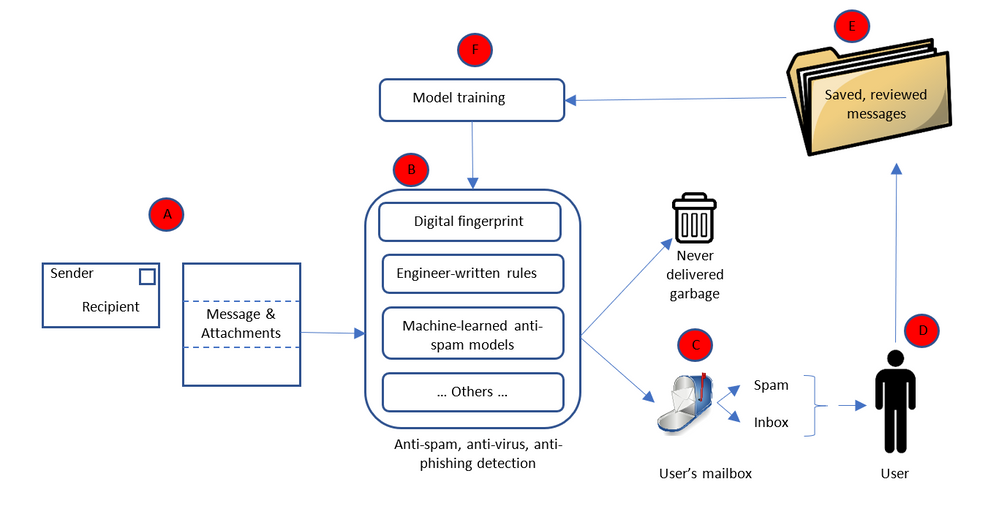
Starting with “A” the message is received by the recipient’s email service. The message’s envelope, as well as the message contents and any attachments, are passed on to the anti-malware portion of the email service (“B”) which determines whether or not the message is malware. Based on what the anti-malware service determines, the message is delivered to the user as appropriate (“C”). Some messages are determined to be malware with near certainty and are never delivered to the user. Instead they are deleted as quickly as possible[4]. Some messages are likely to be spam, however the service is not always certain. So the message is delivered to the user’s mailbox but into their spam/junk-mail folder. The remaining valid messages are delivered to the user’s inbox. The service can never determine with absolute certainty whether or not a message is malicious; it is always a probabilistic assessment. If the service is wrong either way; i.e. the user is exposed to malware or the user indicates that a message originally thought to be spam is not, the message may be added to a database of messages (“E”) used to train the next version of the anti-malware logic (“F”), thus permitting the system to “learn” over time and become more effective.
Clearly this entire process entails considerable processing of the messages. The types of processing are diverse and done in two key phases: message processing (“A” – “D”) and model building (“E” – “F”).
Anti-malware is particularly important for in-transit messages because attacks most typically enter the service through communications being transmitted. It is, however, also performed against already received and processed messages. As new attacks are identified – usually after the attack has been launched and some infected content has evaded the filters and been delivered to users – the anti-malware service is updated to defend against those attacks, and the service is rerun against recently delivered message to retroactively remove instances of said attack.
Processing message:
The types of processing done on messages to determine whether or not they are malicious include simple rules (e.g. messages without senders are likely not valid), reputations systems (messages from a certain set of IP addresses or senders are likely not valid, such as lists managed by the Spamhaus project[5]), digital thumbprints (comparing the thumbprint of the message or attachment to the thumbprints of known bad messages), honey pots (email addresses with no user and thus mailboxes that could never get any valid messages – anything delivered to them is spam or malware), and complex machine-learned models which process the contents of the message or the attachment[6]. As new forms of attack are encountered, new forms of defense must be quickly developed to keep users safe.
This requires processing of the message envelope, body, and attachment. For example:
- Message envelopes indicate not only the message recipient but also the supposed sender, and the server path which the message followed to reach the recipient. This is critical, not only to determine the recipient (needed to ensure the message is delivered to the intended recipients), but also to determine how probable it is that the sender is who they claim to be. It is common for attackers to “spoof” a sender, i.e. pretend they are a certain sender even though they are not. Knowing the path taken by the message can help determine if it has been sent by a spoof sender. For example, if a message originates from a trusted sending service which verifies the identity of the sender, then passes through a series of trusted intermediate services to the destination, the probability that the sender has been spoofed is much lower.
- Message bodies are among the most critical elements of the message which need to be processed to determine if the message is likely spam or a phishing attack. For example, text about “great deals on pharmaceuticals” is often indicative of spam. Without processing the body of the message, it is impossible to determine this. Attackers know that defenders watch out for such phrases, so they often try to hide them as text within an image. To the reader this looks similar, but defenders must run the images through optical character recognition algorithms to convert the images into text that can then be compared against a set of suspicious phrases. For example:
Another example of message body analysis is comparing the text of hyper-links to the URL. If a hyperlink’s text says “Click here to reset your Facebook password” but the URL points to “http://12345.contoso.com“, it is likely a phishing attack because Facebook password reset links should never be any URL other a correct Facebook one. Because most users do not check the URL before clicking on the hyperlink, it is important to protect them from such attacks. Without processing the message body, this is impossible.
- It is equally important to analyze attachments; otherwise attackers use them to deliver malicious payloads or contents to users. Attachments can be executables that open a user’s computer to attacker control. They can also be phishing attacks with the mismatched hyperlink text and URL scenario we described above embedded into the attachment. Any attack in the body of a message can appear in an attachment, and attachments can include additional forms of attack.
Model building:
Model building is the portion of machine learning in which the logic that does the evaluation is updated. It is the “learning” part of the machine learning; where the evaluation algorithm is updated based on new data so that it produces the desired output, not only based on data and results it has previous seen and been trained on, but also based on any new data or results.
The entire computer science sub-discipline of machine learning is the science of learning algorithms, and of this training phase, so a full treatise is beyond the scope of this paper. Generally speaking however, learning algorithms for detecting malware can be developed that respect the privacy of recipients because what is necessary is an understanding of the attack and the pattern of the attack, not the victims of that attack.
Privacy: data protection and confidentiality implications
Protecting the personal data of both sender and recipients, and communications confidentiality, during message processing (“A” – “D” above) can be done without diminishing the efficacy of the anti-malware service because that service acts as a stateless function. The service process the message and creates new metadata indicating whether or not the message should be delivered, without retaining any knowledge of the contents of the message and without exposing the message to anyone except the intended recipients. The recipient’s communication service processes and accesses the content on behalf of the recipient; and it is the recipient’s expectation to be protected against spam and malicious communications.. Failing to process every user’s every message would expose the entire service, and all its users, to known infections, which would be irresponsible.
Protecting personal data and confidentiality during the model building phase (“E” – “F” above) is done by a selection of algorithms and approaches that preserve privacy and confidentiality, those in which personal data is not retained or exposed (for example, selection of privacy preserving machine learning feature vectors), by restricting the use of the communication to building anti-malware capabilities[7], or by building user-specific models which solely benefit that user. The first two techniques have been used historically, but the third is becoming increasingly common as users’ expectations of what qualifies as nuisance communications (i.e. spam) become more individualized[8].
Using communication data for model building in anti-malware capabilities is done without explicit user consent. Malware is an ongoing struggle between attackers and the people providing the communications safety service, with attackers trying to find ways to get messages past the safety service. As new attacks emerge the safety service must respond quickly[9], using as much information as is available (which often necessitates sharing information with the anti-malware elements of other services). Attackers are increasingly using machine learning to create and launch attacks[10], requiring defenders to respond in kind with increasingly advanced machine learning-based defenses. One way to do this is to automate the creation of new versions of the anti-malware model so the service quickly inoculates all users against new attacks. The effectiveness of anti-malware depends on knowing about, and inoculating all users against, these attacks. This data can be used without exposing personal data or compromising confidentiality. All users of a service, and the entire service itself, are at risk if we fail to constantly process content in order to detect new forms of infection for every user. Similar to failing to inoculate a few members of a large population against an infectious disease, failing to process all users against these attacks would be irresponsible and would ultimately put the entire population at risk.
For anti-malware it important to note that the sender is generally malicious, and unlikely to grant consent to build better defenses against their attack. Requiring consent from all parties will make it impossible for services to provide a safe, secure, and nuisance-free communications and collaboration environment for all.
[1] It is difficult to differentiate between communication and collaboration, or between messages and other collaboration artifacts. Consider a document jointly authored by many people, each of whom leaves comments in the document to express ideas and input. Those same comments could be transmitted as email, chats, or through voice rather than comments in a document. Rather than treat them as separate, we recognize collaboration and communication as linked and refer to them interchangeably.
[2] Privacy, protection of personal data and confidentiality are frequently treated as synonymous, but we draw a distinction. For the purposes of this paper we treat data protection as the act of protecting knowledge of who a piece of data is about, and confidentiality as protecting that information. For example, consider a piece of data that indicates Bob is interested in buying a car. Data protection can be achieved by removing any knowledge that the data is about Bob; knowing simply that someone is interested in buying a car protects Bob’s privacy. Protecting confidentiality is preventing Bob’s data from being exposed to anyone but him. In this specific instance, Bob may only be concerned with protecting his personal data. However, if the information related to Microsoft’s interest in buying LinkedIn, Microsoft would be very interested in protecting the confidentiality of that data.
[3] Henceforth in this paper we will refer to this as an email service, but it is understood that similar problems and solutions apply to other communication and collaboration services.
[4] A staggering 77.8% of all messages sent to an email service are spam, with 90.4% of them being identified as such with sufficient certainty to prevent them ever being delivered to users.
[5] https://www.spamhaus.org/
[6] Use of machine learning in anti-spam services is one of the oldest, most pervasive, and most useful applications of that technology, dating back to at least 1998 (http://robotics.stanford.edu/users/sahami/papers-dir/spam.pdf)
[7] Services like Office365 that provide subscription-funded productivity services to users are incentivized to preserve the confidentiality of user data; the user is the customer, not the product.
[8] To my daughter, communications about new Lego toys are not a nuisance, they are interesting and desirable. However to me they are an imposition.
[9] Today, a typical spam campaign lasts under an hour. Yet in that time it gets through often enough to make it worthwhile to the attacker.
[10] https://erpscan.com/press-center/blog/machine-learning-for-cybercriminals
– Jim Kleewein, Technical Fellow, Microsoft
Electronic communication and collaboration services[1] such as Outlook.com, Skype, Gmail, Slack, and OneDrive carry valuable private and confidential communications that need protection. But these same services also provide a means for attackers to steal information or seize control of users’ computers for nefarious purposes, via viruses, worms, spam, phishing attacks, and other forms of malware.
Preventing the theft of user information and the dissemination of malware is a core feature of electronic communication and collaboration services. This requires significant processing of users’ communications and data both in-transit and after delivery. This processing can and should be done without compromising the user’s privacy or the confidentiality of their communications[2].
Message processing data flow:
To protect against malware distributed via electronic communications and collaboration systems such as email servers[3], the content follows a conceptually simple flow.
Starting with “A” the message is received by the recipient’s email service. The message’s envelope, as well as the message contents and any attachments, are passed on to the anti-malware portion of the email service (“B”) which determines whether or not the message is malware. Based on what the anti-malware service determines, the message is delivered to the user as appropriate (“C”). Some messages are determined to be malware with near certainty and are never delivered to the user. Instead they are deleted as quickly as possible[4]. Some messages are likely to be spam, however the service is not always certain. So the message is delivered to the user’s mailbox but into their spam/junk-mail folder. The remaining valid messages are delivered to the user’s inbox. The service can never determine with absolute certainty whether or not a message is malicious; it is always a probabilistic assessment. If the service is wrong either way; i.e. the user is exposed to malware or the user indicates that a message originally thought to be spam is not, the message may be added to a database of messages (“E”) used to train the next version of the anti-malware logic (“F”), thus permitting the system to “learn” over time and become more effective.
Clearly this entire process entails considerable processing of the messages. The types of processing are diverse and done in two key phases: message processing (“A” – “D”) and model building (“E” – “F”).
Anti-malware is particularly important for in-transit messages because attacks most typically enter the service through communications being transmitted. It is, however, also performed against already received and processed messages. As new attacks are identified – usually after the attack has been launched and some infected content has evaded the filters and been delivered to users – the anti-malware service is updated to defend against those attacks, and the service is rerun against recently delivered message to retroactively remove instances of said attack.
Processing message:
The types of processing done on messages to determine whether or not they are malicious include simple rules (e.g. messages without senders are likely not valid), reputations systems (messages from a certain set of IP addresses or senders are likely not valid, such as lists managed by the Spamhaus project[5]), digital thumbprints (comparing the thumbprint of the message or attachment to the thumbprints of known bad messages), honey pots (email addresses with no user and thus mailboxes that could never get any valid messages – anything delivered to them is spam or malware), and complex machine-learned models which process the contents of the message or the attachment[6]. As new forms of attack are encountered, new forms of defense must be quickly developed to keep users safe.
This requires processing of the message envelope, body, and attachment. For example:
- Message envelopes indicate not only the message recipient but also the supposed sender, and the server path which the message followed to reach the recipient. This is critical, not only to determine the recipient (needed to ensure the message is delivered to the intended recipients), but also to determine how probable it is that the sender is who they claim to be. It is common for attackers to “spoof” a sender, i.e. pretend they are a certain sender even though they are not. Knowing the path taken by the message can help determine if it has been sent by a spoof sender. For example, if a message originates from a trusted sending service which verifies the identity of the sender, then passes through a series of trusted intermediate services to the destination, the probability that the sender has been spoofed is much lower.
- Message bodies are among the most critical elements of the message which need to be processed to determine if the message is likely spam or a phishing attack. For example, text about “great deals on pharmaceuticals” is often indicative of spam. Without processing the body of the message, it is impossible to determine this. Attackers know that defenders watch out for such phrases, so they often try to hide them as text within an image. To the reader this looks similar, but defenders must run the images through optical character recognition algorithms to convert the images into text that can then be compared against a set of suspicious phrases. For example:
Another example of message body analysis is comparing the text of hyper-links to the URL. If a hyperlink’s text says “Click here to reset your Facebook password” but the URL points to “http://12345.contoso.com“, it is likely a phishing attack because Facebook password reset links should never be any URL other a correct Facebook one. Because most users do not check the URL before clicking on the hyperlink, it is important to protect them from such attacks. Without processing the message body, this is impossible.
- It is equally important to analyze attachments; otherwise attackers use them to deliver malicious payloads or contents to users. Attachments can be executables that open a user’s computer to attacker control. They can also be phishing attacks with the mismatched hyperlink text and URL scenario we described above embedded into the attachment. Any attack in the body of a message can appear in an attachment, and attachments can include additional forms of attack.
Model building:
Model building is the portion of machine learning in which the logic that does the evaluation is updated. It is the “learning” part of the machine learning; where the evaluation algorithm is updated based on new data so that it produces the desired output, not only based on data and results it has previous seen and been trained on, but also based on any new data or results.
The entire computer science sub-discipline of machine learning is the science of learning algorithms, and of this training phase, so a full treatise is beyond the scope of this paper. Generally speaking however, learning algorithms for detecting malware can be developed that respect the privacy of recipients because what is necessary is an understanding of the attack and the pattern of the attack, not the victims of that attack.
Privacy: data protection and confidentiality implications
Protecting the personal data of both sender and recipients, and communications confidentiality, during message processing (“A” – “D” above) can be done without diminishing the efficacy of the anti-malware service because that service acts as a stateless function. The service process the message and creates new metadata indicating whether or not the message should be delivered, without retaining any knowledge of the contents of the message and without exposing the message to anyone except the intended recipients. The recipient’s communication service processes and accesses the content on behalf of the recipient; and it is the recipient’s expectation to be protected against spam and malicious communications.. Failing to process every user’s every message would expose the entire service, and all its users, to known infections, which would be irresponsible.
Protecting personal data and confidentiality during the model building phase (“E” – “F” above) is done by a selection of algorithms and approaches that preserve privacy and confidentiality, those in which personal data is not retained or exposed (for example, selection of privacy preserving machine learning feature vectors), by restricting the use of the communication to building anti-malware capabilities[7], or by building user-specific models which solely benefit that user. The first two techniques have been used historically, but the third is becoming increasingly common as users’ expectations of what qualifies as nuisance communications (i.e. spam) become more individualized[8].
Using communication data for model building in anti-malware capabilities is done without explicit user consent. Malware is an ongoing struggle between attackers and the people providing the communications safety service, with attackers trying to find ways to get messages past the safety service. As new attacks emerge the safety service must respond quickly[9], using as much information as is available (which often necessitates sharing information with the anti-malware elements of other services). Attackers are increasingly using machine learning to create and launch attacks[10], requiring defenders to respond in kind with increasingly advanced machine learning-based defenses. One way to do this is to automate the creation of new versions of the anti-malware model so the service quickly inoculates all users against new attacks. The effectiveness of anti-malware depends on knowing about, and inoculating all users against, these attacks. This data can be used without exposing personal data or compromising confidentiality. All users of a service, and the entire service itself, are at risk if we fail to constantly process content in order to detect new forms of infection for every user. Similar to failing to inoculate a few members of a large population against an infectious disease, failing to process all users against these attacks would be irresponsible and would ultimately put the entire population at risk.
For anti-malware it important to note that the sender is generally malicious, and unlikely to grant consent to build better defenses against their attack. Requiring consent from all parties will make it impossible for services to provide a safe, secure, and nuisance-free communications and collaboration environment for all.
[1] It is difficult to differentiate between communication and collaboration, or between messages and other collaboration artifacts. Consider a document jointly authored by many people, each of whom leaves comments in the document to express ideas and input. Those same comments could be transmitted as email, chats, or through voice rather than comments in a document. Rather than treat them as separate, we recognize collaboration and communication as linked and refer to them interchangeably.
[2] Privacy, protection of personal data and confidentiality are frequently treated as synonymous, but we draw a distinction. For the purposes of this paper we treat data protection as the act of protecting knowledge of who a piece of data is about, and confidentiality as protecting that information. For example, consider a piece of data that indicates Bob is interested in buying a car. Data protection can be achieved by removing any knowledge that the data is about Bob; knowing simply that someone is interested in buying a car protects Bob’s privacy. Protecting confidentiality is preventing Bob’s data from being exposed to anyone but him. In this specific instance, Bob may only be concerned with protecting his personal data. However, if the information related to Microsoft’s interest in buying LinkedIn, Microsoft would be very interested in protecting the confidentiality of that data.
[3] Henceforth in this paper we will refer to this as an email service, but it is understood that similar problems and solutions apply to other communication and collaboration services.
[4] A staggering 77.8% of all messages sent to an email service are spam, with 90.4% of them being identified as such with sufficient certainty to prevent them ever being delivered to users.
[5] https://www.spamhaus.org/
[6] Use of machine learning in anti-spam services is one of the oldest, most pervasive, and most useful applications of that technology, dating back to at least 1998 (http://robotics.stanford.edu/users/sahami/papers-dir/spam.pdf)
[7] Services like Office365 that provide subscription-funded productivity services to users are incentivized to preserve the confidentiality of user data; the user is the customer, not the product.
[8] To my daughter, communications about new Lego toys are not a nuisance, they are interesting and desirable. However to me they are an imposition.
[9] Today, a typical spam campaign lasts under an hour. Yet in that time it gets through often enough to make it worthwhile to the attacker.
[10] https://erpscan.com/press-center/blog/machine-learning-for-cybercriminals
– Jim Kleewein, Technical Fellow, Microsoft