In SharePoint, there are topology concepts to understand and consider. Servers have roles such as Web, Query, Index, Calculation, Application, and Database. Farms have relationships such as Authoring, Publishing, Development, Test, Staging, and Production as well as service applications covering Search, Profile, Access, Business Data Connectivity, Excel, Machine Translation, Managed Metadata, PerformancePoint, Secure Store, Word Automation, Work Management, Usage/Health, Visio and others. In a SharePoint farm, SharePoint is comprised of Servers, Web Applications, Databases, Site Collections, Sites, Lists, and Items (and in that order from a hierarchical perspective in that order).
The concept of this is difficult to describe graphically, and especially if you are going to design a topology for a customer you will need a good approach. I use Visio for designing topology diagrams, and I managed to get a couple of documents that provides an overview of topology concepts for SharePoint 2013. These are pretty good, if you need to understand the topology and therefore some other concepts such as performance, scale, fault tolerance, etc. These diagrams include topologies, based on the traditional approaches to building SharePoint architectures in these documents.
They are available for download here:
PDF: http://www.geoffevelyn.com/downloads/sps_2013_traditional_topology_model.pdf
VISIO: http://www.geoffevelyn.com/downloads/sps_2013_traditional_topology_model.vsd
I have been asked a lot about the actual process of upgrade from SharePoint 2010 and whether there is any best practice material. Yes there is, and its pretty good! This model explains the process that you use when you upgrade from SharePoint Foundation 2010 or SharePoint Server 2010 to SharePoint Foundation 2013 or SharePoint Server 2013.
They are available for download here:
PDF: http://www.geoffevelyn.com/downloads/sp2013-upgrade-process.pdf
VISIO: http://www.geoffevelyn.com/downloads/sp2013-upgrade-process.vsd
The article is located here: http://www.microsoft.com/en-gb/download/details.aspx?id=30371

One of the most difficult areas of delivering a SharePoint solution is identifying not just who should be targetted for User Adoption, but, going forward, how to sustain that User Adoption through communication. Reasons include rapid changes in the business culture, direction, and changes in technology concerning the methods used to communicate (e.g. business process changes from manual to email notification to automation, etc.). Moreover, if you have developed a customer list for Service Delivery purposes (e.g. support, user adoption, training, governance, etc.) then you will need to keep tabs on customer culture, communication technology and apply communication tactics and strategies.
(more…)

Sustained User Adoption is vital to ensure people using SharePoint remain productive and proactive. Pro-activity is key, since the reliance on SharePoint support will grow based – success breeds success; on solving user queries, meeting and solving business information and collaborative challenges using SharePoint, delivering solutions. A significant number of queries will come from the use of Microsoft Office with SharePoint. Particularly since virtually all interaction with content in SharePoint will come from the use of Microsoft Products such as Word, Excel, PowerPoint, Outlook, and even moving beyond into the lands of Project, Visio, OneNote (the list continues).
If you want sustainable User Adoption, amongst other techniques, focus on the information workers core toolset – Microsoft Office. For information workers to remain SharePoint productive, to make them more empowered, to give them a sense of achievement, you should consider informing and evangelizing to them the Microsoft Office Specialist certification, of which SharePoint is part.
(more…)

Got a great read today I thought I should share with you all. Got to read a thought leadership piece from Forrester focusing on Cloud Change Agents. This report is the result of a study Microsoft commissioned with Forrester to explore the status of cloud as a business transformation driver among a selection of UK businesses.
The Cloud Change Agents report is a new study conducted by Forrester Consulting and commissioned by Microsoft Ltd to show how cloud computing is acting as a ‘big switch’ to drive transformation in businesses. The study shows how a certain set of individuals in UK businesses – change agents – working with IT leaders are leading the way, seizing on the cloud to accelerate projects with minimal risk, low cost, little administration overhead and providing the ability to trial and then quickly scale up.
The research shows that these change agents are coming from everywhere in the business. They spot business opportunities and then team up with IT and use the cloud to make their visions reality. Often they might not even be aware that their new project sits ‘in the cloud’, only that they have discovered a fast, convenient way of working.
Of course, change agents have always existed but the cloud provides a way of delivering IT services that suits them very well, enabling new dimensions and the chance to change radically the way businesses operate, add new services, open additional sales channels, market in new ways and provide greater transparency all round. For people with the vision, strength of conviction, passion and drive to lead change, the cloud is a gift.
Read the foreword from Rob Fraser, Cloud Services CTO, Microsoft Ltd here and to download a copy of the report go here.
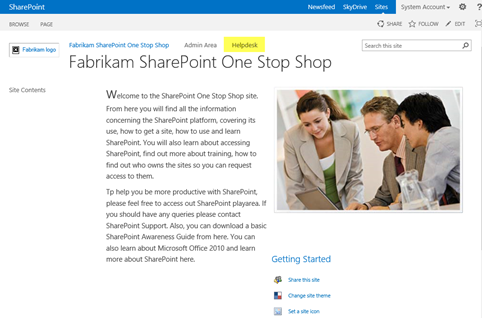
I have created a basic SharePoint 2013 helpdesk template which you can try out, modify and apply as a helper to their SharePoint support desks. The reason for supplying this is to (a) give an understanding of the ability of SharePoint to provide basic helpdesk functionality using built in features and (b) to introduce you to the concept of centralising a helpdesk in a ‘one stop shop site’ concept. Please note, I am not providing this as a suggestion that you drop any helpdesk product you are using – this is not supposed to in anyway detract you from using that!!
(more…)