Today, we are announcing new capabilities in the Microsoft Graph Security API to help our customers simplify integration, speed up response, and improve the effectiveness of their existing security investments. The latest updates include an expanded list of alert providers, new capabilities that enable threat intelligence sharing, streamline the creation of security automation workflows, and enable rich security analytics and reporting. Finally, we’re announcing several new integration partners.
Security Alerts
The Microsoft Graph Security API provides a unified interface and common schema to simplify integration of security alerts from Microsoft products, services, and partners. In addition to the many Microsoft and partner solutions previously available for the Microsoft Graph Security API, you can now access security alerts from Office 365 and Azure Advanced Threat Protection solutions as well as the new Microsoft Azure Sentinel service.
Developers can integrate alerts via a single endpoint, using one authentication key and one SDK. You can query for all alerts pertaining to specific users, devices, files, or command lines when investigating a specific threat or use webhook subscriptions to get notified when any new alert matching your search criteria is created or updated. Learn more about alerts.
Threat Intelligence (preview)
Threat indicators, also referred to as indicators of compromise or IoCs, represent data about known threats, such as malicious files, URLs, domains, and IP addresses. Microsoft amasses a huge volume of indicators each day using trillions of unique insights into cloud, users, and endpoints, which plays a huge role in how we protect Microsoft and our customers. You may also generate indicators through internal threat intelligence gathering or acquire indicators from threat intelligence communities, licensed feeds, and other sources. In addition to the vast threat intelligence built into Microsoft products and services, you can now also leverage your own indicators to enable custom detections in Microsoft solutions. Learn more.
- Connect your threat intelligence platform and communities to automatically share the latest indicators with Microsoft. Use the Microsoft Graph Security API or leverage integrations with leading threat intelligence platforms, including Palo Alto Networks MineMeld and the open source MISP platform. Use with Azure Sentinel today to correlate threat intelligence with log data to alert on malicious activity. Refer to the tiIndicators schema.
- Take immediate action in response to new threat, such as block file, URL, domain, or IP address from within your security tools and workflows. When a security analyst discovers a new threat, protection can be instantly enabled in your Microsoft security solutions. Try it first with Windows Defender ATP (coming soon) to block malicious activity on your Windows endpoints using the properties seen in alerts or identified during investigations. Refer to the SecurityActions schema.
Security Automation
In a world of fast-moving, disruptive attacks and under-resourced security teams, automation of security workflows is essential. However, development of workflows to expedite alert routing, triage, investigation, and remediation can be challenging to create and maintain. We recently announced a set of Microsoft Graph Security API connectors to simplify development of automated security workflows without writing any code.
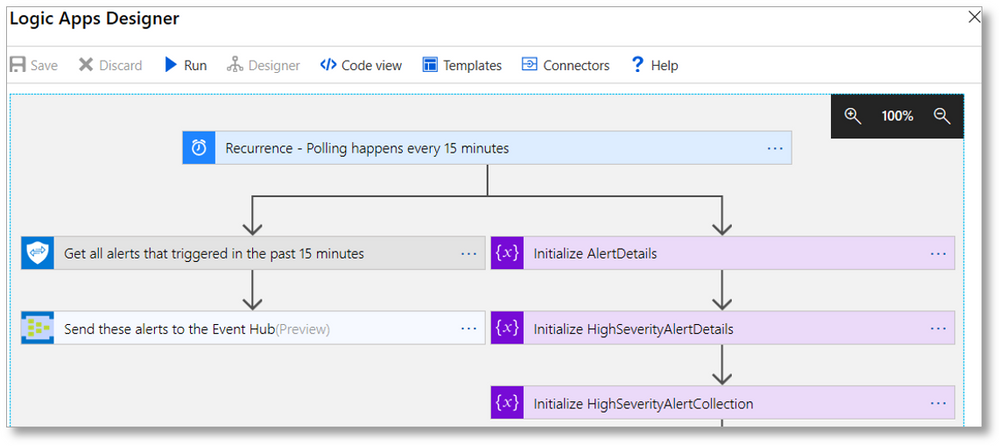
- Leverage Azure Logic Apps, Microsoft Flow, and PowerApps connectors to quickly build automation workflows using insights from the Microsoft Graph Security API. Mash up the Microsoft Graph Security API connector with over 200 other connectors to build workflows that act on security alerts, such as automatically routing high severity alerts to the on-call analyst – creating a ticket assigned to that user, sending an email or SMS notification, and collecting related alerts to speed their investigation See other example workflows.
Security Analytics + Reporting
The Microsoft Graph Security API now makes it easier than ever to analyze and visualize data across different security products running in your organization to get deeper security insights. Create reports and dashboards for visibility into active threats and trends. Discover opportunities to learn from the data and train your security models. The Microsoft Graph Security API schema provides multiple properties to pivot on to build rich reports and exploratory datasets using your security data.
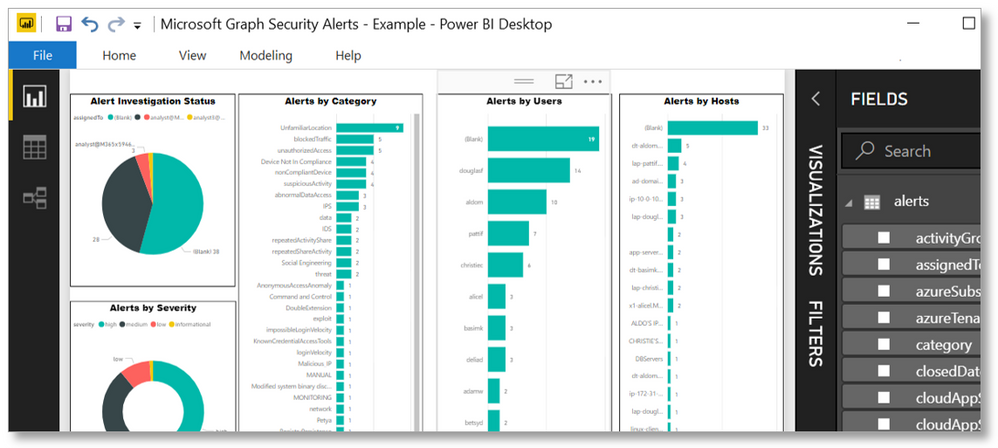
- Use the PowerBI connector to create enterprise-wide security dashboards and reports. Get a complete picture of security alerts and secure score across your organization. Mash up security data with data from the other Power BI connectors, like Excel workbooks or other databases, for richer context. Use Power BI and Microsoft Flow to trigger an automated security workflow based on metrics, such as a percent decrease in your secure score. A sample dashboard and template help you get started. Learn more.
- Get deep insights to train security solutions by leveraging the power of Jupyter Notebooks for Microsoft Graph Security API. Use these Notebooks to build your visualizations and training data models with alert properties for users, files, hosts, processes, etc. across multiple security products. Learn more.
Integrated Partner Solutions
The Microsoft Graph Security API offers a wide range of possibilities for partners to build and enhance security solutions. We’ve been building an ecosystem of technology partners and are excited to announce the following new integrations:
- Barracuda Cloud Security Guardian accesses alerts and a secure score from the Microsoft Security Graph API and displays this on a single plane of glass.
- Bay Dynamics Risk Fabric integrates with the Microsoft Graph Security API to gain greater visibility into threats, enabling them to better prioritize remediation activities.
- Citrix Analytics leverages the Microsoft Graph Security API to correlate alerts from the Graph with Citrix products and take security actions. See video.
- DF Labs integrates with the Microsoft Graph Security API to enable its IncMan SOAR solution to orchestrate and automate response to threats from Graph Providers.
- FireEye Helix uses the Microsoft Graph Security API to integrate security insights from Microsoft and partners into its security operations platform.
- JASK uses the Microsoft Graph Security API to ingest data and information related to Microsoft users, applications, and events into its ASOC SIEM platform.
- Swimlane’s SOAR platform integrates with Microsoft Graph Security API to orchestrate and automate incident response across multiple solutions for faster threat response.
Find out more about partner integration opportunities here.
In addition to technology partners, we’re also working closely with a number of managed security services providers who are building solutions leveraging the Security API. Most recently, SWC Technology Partners announced new security solutions that help improve organizations’ security posture. In particular, SWC is using the Microsoft Graph Security API in its Managed Defense Service that helps identify suspicious behavior and allows organizations to quickly surface and remediate threats.
We know that our customers struggle with integrating their diverse security tools, workflows, and systems. The cost, time, and resources necessary to integrate systems, enable correlation of alerts, connect to existing workflows, and provide access to contextual data is extremely high. We’re excited about the potential the Microsoft Graph Security API offers to directly address these challenges.
Get started today
Join us at the Microsoft booth, N6059 in the north expo hall, at RSA Conference 2019 in San Francisco. You’ll get the chance to speak to experts and see how our partners are using the API.
To learn more and get started with using the Microsoft Graph Security API, check out the following resources:
Today, we are announcing new capabilities in the Microsoft Graph Security API to help our customers simplify integration, speed up response, and improve the effectiveness of their existing security investments. The latest updates include an expanded list of alert providers, new capabilities that enable threat intelligence sharing, streamline the creation of security automation workflows, and enable rich security analytics and reporting. Finally, we’re announcing several new integration partners.
Security Alerts
The Microsoft Graph Security API provides a unified interface and common schema to simplify integration of security alerts from Microsoft products, services, and partners. In addition to the many Microsoft and partner solutions previously available for the Microsoft Graph Security API, you can now access security alerts from Office 365 and Azure Advanced Threat Protection solutions as well as the new Microsoft Azure Sentinel service.
Developers can integrate alerts via a single endpoint, using one authentication key and one SDK. You can query for all alerts pertaining to specific users, devices, files, or command lines when investigating a specific threat or use webhook subscriptions to get notified when any new alert matching your search criteria is created or updated. Learn more about alerts.
Threat Intelligence (preview)
Threat indicators, also referred to as indicators of compromise or IoCs, represent data about known threats, such as malicious files, URLs, domains, and IP addresses. Microsoft amasses a huge volume of indicators each day using trillions of unique insights into cloud, users, and endpoints, which plays a huge role in how we protect Microsoft and our customers. You may also generate indicators through internal threat intelligence gathering or acquire indicators from threat intelligence communities, licensed feeds, and other sources. In addition to the vast threat intelligence built into Microsoft products and services, you can now also leverage your own indicators to enable custom detections in Microsoft solutions. Learn more.
- Connect your threat intelligence platform and communities to automatically share the latest indicators with Microsoft. Use the Microsoft Graph Security API or leverage integrations with leading threat intelligence platforms, including Palo Alto Networks MineMeld and the open source MISP platform. Use with Azure Sentinel today to correlate threat intelligence with log data to alert on malicious activity. Refer to the tiIndicators schema.
- Take immediate action in response to new threat, such as block file, URL, domain, or IP address from within your security tools and workflows. When a security analyst discovers a new threat, protection can be instantly enabled in your Microsoft security solutions. Try it first with Windows Defender ATP (coming soon) to block malicious activity on your Windows endpoints using the properties seen in alerts or identified during investigations. Refer to the SecurityActions schema.
Security Automation
In a world of fast-moving, disruptive attacks and under-resourced security teams, automation of security workflows is essential. However, development of workflows to expedite alert routing, triage, investigation, and remediation can be challenging to create and maintain. We recently announced a set of Microsoft Graph Security API connectors to simplify development of automated security workflows without writing any code.
- Leverage Azure Logic Apps, Microsoft Flow, and PowerApps connectors to quickly build automation workflows using insights from the Microsoft Graph Security API. Mash up the Microsoft Graph Security API connector with over 200 other connectors to build workflows that act on security alerts, such as automatically routing high severity alerts to the on-call analyst – creating a ticket assigned to that user, sending an email or SMS notification, and collecting related alerts to speed their investigation See other example workflows.
Security Analytics + Reporting
The Microsoft Graph Security API now makes it easier than ever to analyze and visualize data across different security products running in your organization to get deeper security insights. Create reports and dashboards for visibility into active threats and trends. Discover opportunities to learn from the data and train your security models. The Microsoft Graph Security API schema provides multiple properties to pivot on to build rich reports and exploratory datasets using your security data.
- Use the PowerBI connector to create enterprise-wide security dashboards and reports. Get a complete picture of security alerts and secure score across your organization. Mash up security data with data from the other Power BI connectors, like Excel workbooks or other databases, for richer context. Use Power BI and Microsoft Flow to trigger an automated security workflow based on metrics, such as a percent decrease in your secure score. A sample dashboard and template help you get started. Learn more.
- Get deep insights to train security solutions by leveraging the power of Jupyter Notebooks for Microsoft Graph Security API. Use these Notebooks to build your visualizations and training data models with alert properties for users, files, hosts, processes, etc. across multiple security products. Learn more.
Integrated Partner Solutions
The Microsoft Graph Security API offers a wide range of possibilities for partners to build and enhance security solutions. We’ve been building an ecosystem of technology partners and are excited to announce the following new integrations:
- Barracuda Cloud Security Guardian accesses alerts and a secure score from the Microsoft Security Graph API and displays this on a single plane of glass.
- Bay Dynamics Risk Fabric integrates with the Microsoft Graph Security API to gain greater visibility into threats, enabling them to better prioritize remediation activities.
- Citrix Analytics leverages the Microsoft Graph Security API to correlate alerts from the Graph with Citrix products and take security actions. See video.
- DF Labs integrates with the Microsoft Graph Security API to enable its IncMan SOAR solution to orchestrate and automate response to threats from Graph Providers.
- FireEye Helix uses the Microsoft Graph Security API to integrate security insights from Microsoft and partners into its security operations platform.
- JASK uses the Microsoft Graph Security API to ingest data and information related to Microsoft users, applications, and events into its ASOC SIEM platform.
- Swimlane’s SOAR platform integrates with Microsoft Graph Security API to orchestrate and automate incident response across multiple solutions for faster threat response.
Find out more about partner integration opportunities here.
In addition to technology partners, we’re also working closely with a number of managed security services providers who are building solutions leveraging the Security API. Most recently, SWC Technology Partners announced new security solutions that help improve organizations’ security posture. In particular, SWC is using the Microsoft Graph Security API in its Managed Defense Service that helps identify suspicious behavior and allows organizations to quickly surface and remediate threats.
We know that our customers struggle with integrating their diverse security tools, workflows, and systems. The cost, time, and resources necessary to integrate systems, enable correlation of alerts, connect to existing workflows, and provide access to contextual data is extremely high. We’re excited about the potential the Microsoft Graph Security API offers to directly address these challenges.
Get started today
Join us at the Microsoft booth, N6059 in the north expo hall, at RSA Conference 2019 in San Francisco. You’ll get the chance to speak to experts and see how our partners are using the API.
To learn more and get started with using the Microsoft Graph Security API, check out the following resources:
Today, we are announcing new capabilities in the Microsoft Graph Security API to help our customers simplify integration, speed up response, and improve the effectiveness of their existing security investments. The latest updates include an expanded list of alert providers, new capabilities that enable threat intelligence sharing, streamline the creation of security automation workflows, and enable rich security analytics and reporting. Finally, we’re announcing several new integration partners.
Security Alerts
The Microsoft Graph Security API provides a unified interface and common schema to simplify integration of security alerts from Microsoft products, services, and partners. In addition to the many Microsoft and partner solutions previously available for the Microsoft Graph Security API, you can now access security alerts from Office 365 and Azure Advanced Threat Protection solutions as well as the new Microsoft Azure Sentinel service.
Developers can integrate alerts via a single endpoint, using one authentication key and one SDK. You can query for all alerts pertaining to specific users, devices, files, or command lines when investigating a specific threat or use webhook subscriptions to get notified when any new alert matching your search criteria is created or updated. Learn more about alerts.
Threat Intelligence (preview)
Threat indicators, also referred to as indicators of compromise or IoCs, represent data about known threats, such as malicious files, URLs, domains, and IP addresses. Microsoft amasses a huge volume of indicators each day using trillions of unique insights into cloud, users, and endpoints, which plays a huge role in how we protect Microsoft and our customers. You may also generate indicators through internal threat intelligence gathering or acquire indicators from threat intelligence communities, licensed feeds, and other sources. In addition to the vast threat intelligence built into Microsoft products and services, you can now also leverage your own indicators to enable custom detections in Microsoft solutions. Learn more.
- Connect your threat intelligence platform and communities to automatically share the latest indicators with Microsoft. Use the Microsoft Graph Security API or leverage integrations with leading threat intelligence platforms, including Palo Alto Networks MineMeld and the open source MISP platform. Use with Azure Sentinel today to correlate threat intelligence with log data to alert on malicious activity. Refer to the tiIndicators schema.
- Take immediate action in response to new threat, such as block file, URL, domain, or IP address from within your security tools and workflows. When a security analyst discovers a new threat, protection can be instantly enabled in your Microsoft security solutions. Try it first with Windows Defender ATP (coming soon) to block malicious activity on your Windows endpoints using the properties seen in alerts or identified during investigations. Refer to the SecurityActions schema.
Security Automation
In a world of fast-moving, disruptive attacks and under-resourced security teams, automation of security workflows is essential. However, development of workflows to expedite alert routing, triage, investigation, and remediation can be challenging to create and maintain. We recently announced a set of Microsoft Graph Security API connectors to simplify development of automated security workflows without writing any code.
- Leverage Azure Logic Apps, Microsoft Flow, and PowerApps connectors to quickly build automation workflows using insights from the Microsoft Graph Security API. Mash up the Microsoft Graph Security API connector with over 200 other connectors to build workflows that act on security alerts, such as automatically routing high severity alerts to the on-call analyst – creating a ticket assigned to that user, sending an email or SMS notification, and collecting related alerts to speed their investigation See other example workflows.
Security Analytics + Reporting
The Microsoft Graph Security API now makes it easier than ever to analyze and visualize data across different security products running in your organization to get deeper security insights. Create reports and dashboards for visibility into active threats and trends. Discover opportunities to learn from the data and train your security models. The Microsoft Graph Security API schema provides multiple properties to pivot on to build rich reports and exploratory datasets using your security data.
- Use the PowerBI connector to create enterprise-wide security dashboards and reports. Get a complete picture of security alerts and secure score across your organization. Mash up security data with data from the other Power BI connectors, like Excel workbooks or other databases, for richer context. Use Power BI and Microsoft Flow to trigger an automated security workflow based on metrics, such as a percent decrease in your secure score. A sample dashboard and template help you get started. Learn more.
- Get deep insights to train security solutions by leveraging the power of Jupyter Notebooks for Microsoft Graph Security API. Use these Notebooks to build your visualizations and training data models with alert properties for users, files, hosts, processes, etc. across multiple security products. Learn more.
Integrated Partner Solutions
The Microsoft Graph Security API offers a wide range of possibilities for partners to build and enhance security solutions. We’ve been building an ecosystem of technology partners and are excited to announce the following new integrations:
- Barracuda Cloud Security Guardian accesses alerts and a secure score from the Microsoft Security Graph API and displays this on a single plane of glass.
- Bay Dynamics Risk Fabric integrates with the Microsoft Graph Security API to gain greater visibility into threats, enabling them to better prioritize remediation activities.
- Citrix Analytics leverages the Microsoft Graph Security API to correlate alerts from the Graph with Citrix products and take security actions. See video.
- DF Labs integrates with the Microsoft Graph Security API to enable its IncMan SOAR solution to orchestrate and automate response to threats from Graph Providers.
- FireEye Helix uses the Microsoft Graph Security API to integrate security insights from Microsoft and partners into its security operations platform.
- JASK uses the Microsoft Graph Security API to ingest data and information related to Microsoft users, applications, and events into its ASOC SIEM platform.
- Swimlane’s SOAR platform integrates with Microsoft Graph Security API to orchestrate and automate incident response across multiple solutions for faster threat response.
Find out more about partner integration opportunities here.
In addition to technology partners, we’re also working closely with a number of managed security services providers who are building solutions leveraging the Security API. Most recently, SWC Technology Partners announced new security solutions that help improve organizations’ security posture. In particular, SWC is using the Microsoft Graph Security API in its Managed Defense Service that helps identify suspicious behavior and allows organizations to quickly surface and remediate threats.
We know that our customers struggle with integrating their diverse security tools, workflows, and systems. The cost, time, and resources necessary to integrate systems, enable correlation of alerts, connect to existing workflows, and provide access to contextual data is extremely high. We’re excited about the potential the Microsoft Graph Security API offers to directly address these challenges.
Get started today
Join us at the Microsoft booth, N6059 in the north expo hall, at RSA Conference 2019 in San Francisco. You’ll get the chance to speak to experts and see how our partners are using the API.
To learn more and get started with using the Microsoft Graph Security API, check out the following resources:
Across Microsoft Information Protection solutions, our goal is to provide a comprehensive set of capabilities to help you protect your sensitive data throughout its entire lifecycle – across devices, apps, cloud services and on-premises. With the exponential growth of data and increasing data mobility, it’s critical to implement an information protection strategy that not only enables you to meet your internal security objectives, but also address new and emerging compliance and privacy requirements. We’ve recently released several new capabilities to help you discover, classify & label, protect and monitor your sensitive information – here’s a quick roundup of the latest news.
You can also check out this video to see some of the highlights in action:
A unified approach to data classification and label management
In order to effectively apply policy-based protection and controls to your sensitive data, you need to be able to inspect and reason over documents and emails. We provide a unified approach to data classification across our information protection and data governance solutions. There are over 90 out-of-the-box sensitive information types that you can use to detect common types of data, such as financial data, PII or health-care related information. You can also create and customize your sensitive information types (such as detecting employee ID numbers that are unique to your organization). Our classification engine is leveraged across services – including Azure Information Protection, Microsoft Cloud App Security, Advanced Data Governance and Office 365 Data Loss Prevention – enabling consistent classification outcomes for the purpose of applying labels, protecting information and enforcing data policies.
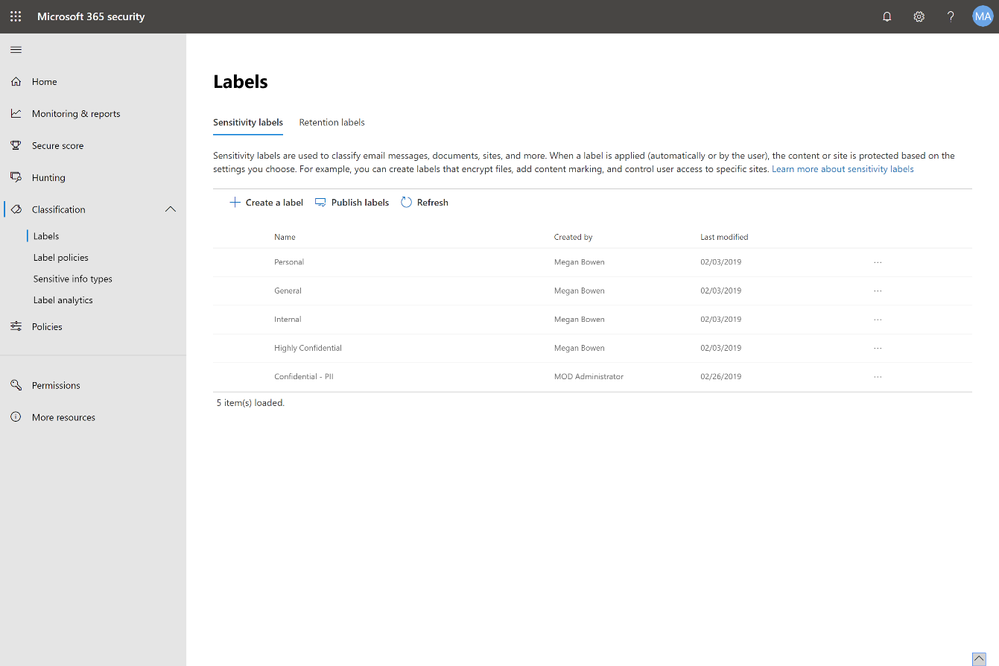
In addition to a consistent approach to data classification, we also provide a unified experience for configuring and managing labels – both sensitivity labels for the purpose of apply protection policies and retention labels for the purpose of applying data governance policies. In late 2018 we released a unified label management experience in the Office 365 Security & Compliance Center. Customers have been using this to create and configure their sensitivity labels and retention labels, set label policies and migrate existing labels from the Azure portal (for Azure Information Protection customers). The recently released Microsoft 365 security center and compliance center gives admins an enhanced experience and a dedicated workspace to manage Microsoft 365 security and compliance solutions, including sensitivity labels and retention labels.
The new Microsoft 365 security center and compliance center (rolling out now) provides a centralized workspace to manage your Microsoft 365 security and compliance solutions, including management of your sensitivity labels and retention labels.
We’ve also recently announced two new retention capabilities, including the general availability of file plan manager, which helps you migrate complex retention hierarchies into Office 365, and a new assessment of Office 365’s ability to meet SEC 17a-4 requirements around immutability.
New sensitivity labeling capabilities built into Office apps – across platforms
We want to make it easy for end-users to apply sensitivity labels to their documents and emails – without interrupting their workflow or productivity. We recently announced the availability of end-user driven labeling capabilities built natively into Office apps on Mac, iOS and Android. This enables users to assign the appropriate sensitivity label while creating or editing documents and emails – such as “Highly Confidential” when the file contains company secrets. Based on the policies defined by your company, sensitivity labels can result in several actions, such as encryption, rights restrictions or adding visual markings stamped to the document. The experience is consistent and familiar across Office applications.
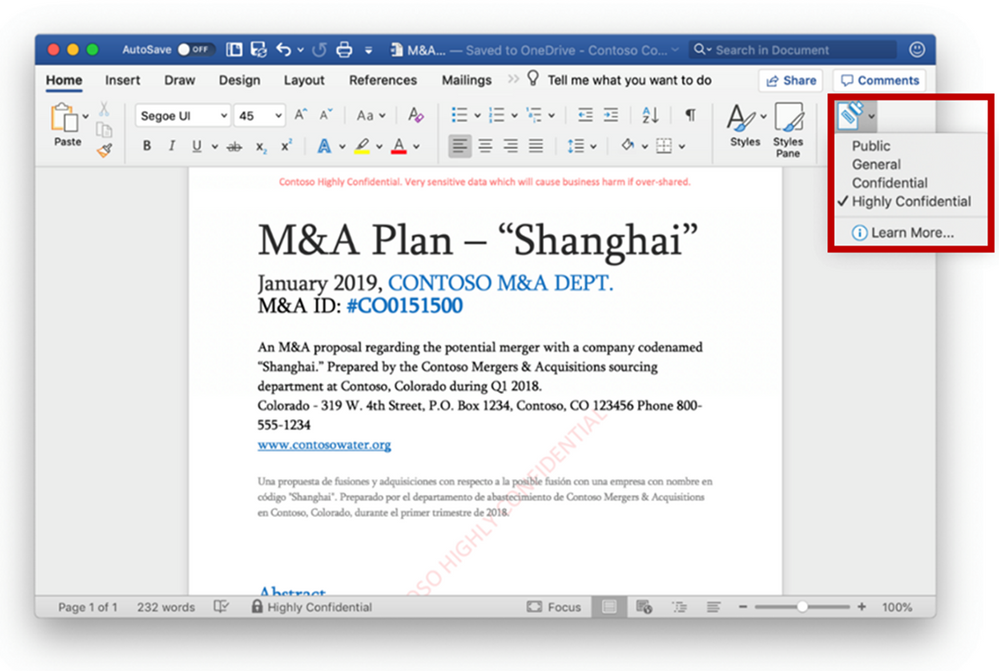 Apply sensitivity labels in Office apps on Mac – encryption, rights restrictions and visual markings can be applied, based on your label policy
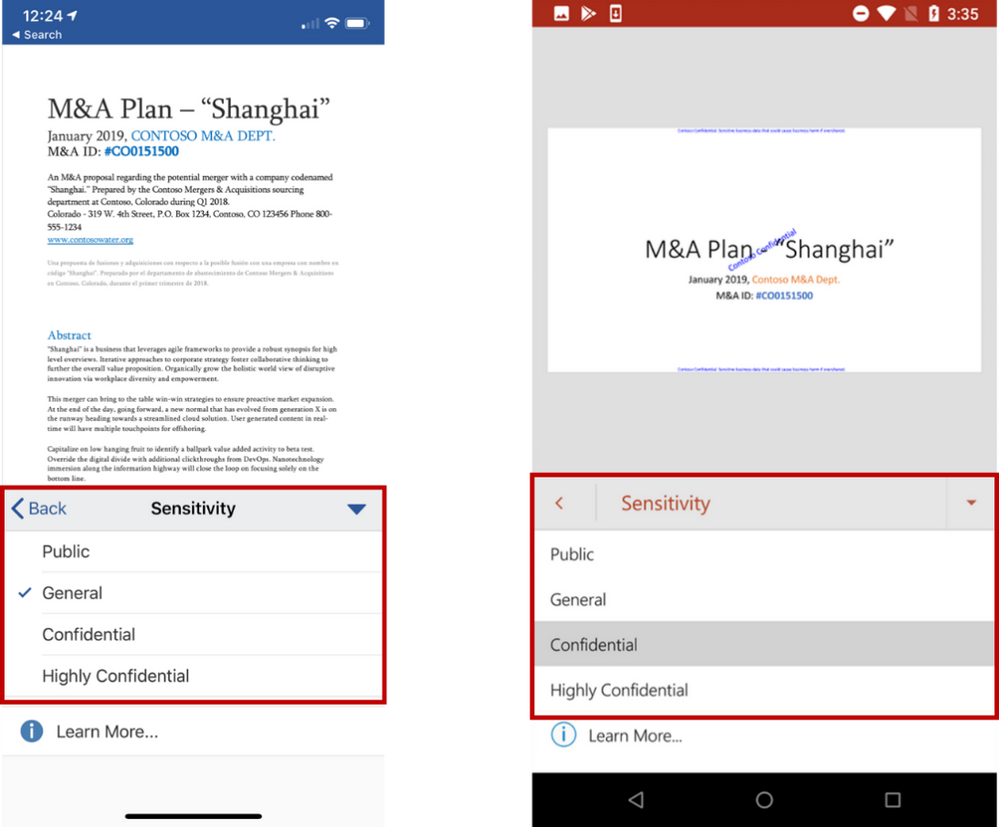 Easily apply the same sensitivity labels in Office mobile apps on iOS and Android
Learn more about the native labeling experience in our blog.
We’re also announcing an updated public preview of the Azure Information Protection client that supports unified labeling. The Azure Information Protection unified labeling client gets it sensitivity labels and policy settings from the Security & Compliance Center or the Microsoft 365 security center (as mentioned earlier). This is particularly useful for existing Azure Information Protection customers who want to evaluate and test the unified labeling and protection capabilities in Office apps on Windows (Word, PowerPoint, Excel and Outlook). The original public preview of the Azure Information Protection unified labeling client supported several features, such as end-user driven manual labeling, and the new updated public preview version now includes recommended labeling, automatic labeling and other customization options. Learn more about the supported features or read our product documentation.
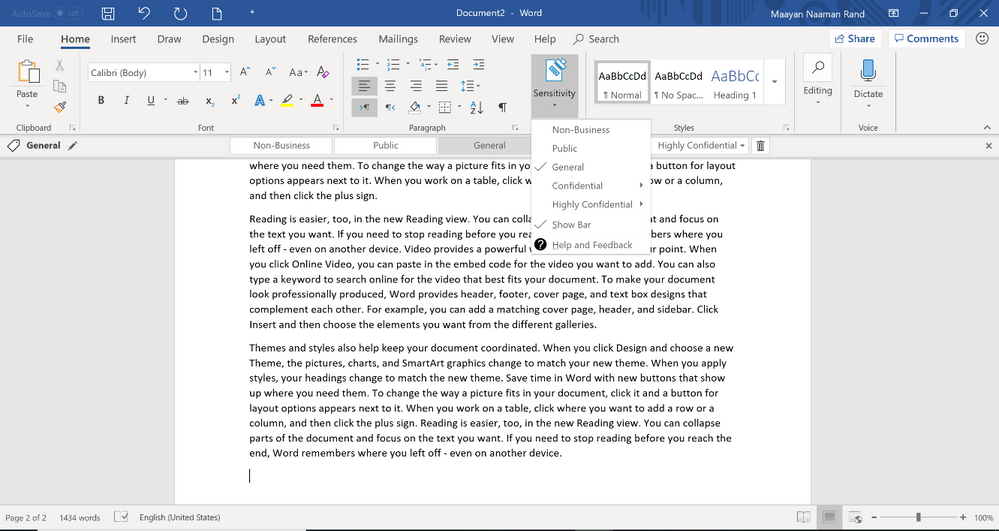 Apply sensitivity labels to Office apps on Windows using the Azure Information Protection unified labeling client (in preview)
Enhanced data discovery and protection across your on-premises repositories
The Azure Information Protection scanner is used by customers all over the world to discover, classify, label and protect sensitive information that resides in their on-premises file servers. Based on customer feedback to provide additional capabilities to make it easier and more efficient to deploy and manage the Azure Information Protection scanner at scale, we recently released a new management and operational UI.
The management UI (currently in public preview) helps you manage scanner configuration and scanned repositories – all in one central place within the Azure portal. You can configure sensitive information types that you want to discover, set file types to be scanned, set default label settings along with other configuration options.
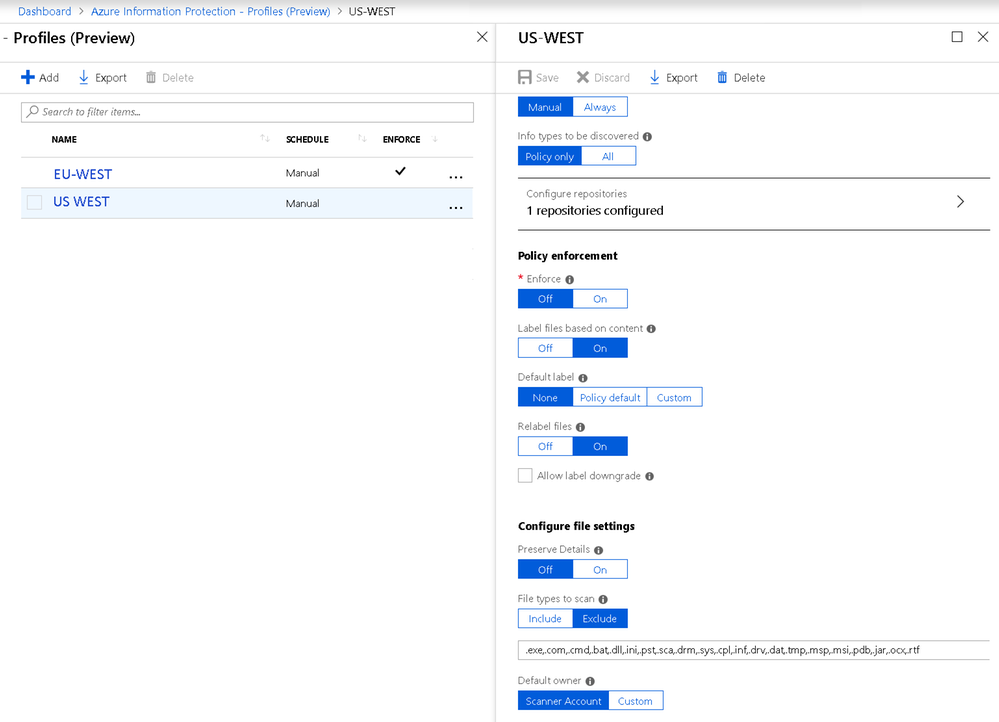 Azure Information Protection scanner profiles management page enables admins to set scanner configuration options
We also recently announced the general availability of a new operational UI which makes it easier to stay on top of Azure Information Protection scanner operations, such as monitoring the status of all scanner nodes, get the latest scanning statistics, initiate on-demand incremental scans or run full rescans. Learn more about the latest Azure Information Protection scanner UI experience in our blog or review the product documentation.
New classification methods to automatically detect sensitive credential information in documents
While we provide over 90 out-of-the-box sensitive information types that you can use to detect common types of data, a frequent customer request has been the ability to automatically detect passwords and other credential types that users have recorded or pasted in unprotected files. For example, sometimes users and admins use Word or Excel to store a list of usernames and passwords they use for applications and services. We’re announcing the public preview of the first group of credential types that we can automatically detect – focusing on Azure secrets and SQL credentials. These new sensitive information types are coming first to Azure Information Protection and will be coming soon to Office 365. Similar to other sensitive information types, you can configure your policy to recommend a sensitivity label to the user or automatically apply a label and protection settings. Read more about the credential types supported in our blog.
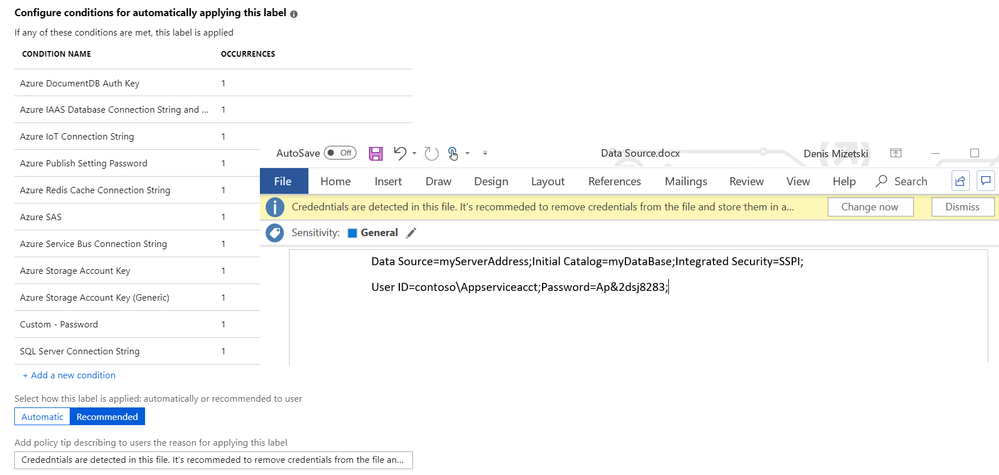 Credential information in a document is automatically detected; sensitivity label is recommended or automatically applied
Deeper visibility into the sensitive data landscape across your organization
The information protection lifecycle wouldn’t be complete without the ability to understand your sensitive data landscape. Within the new Microsoft 365 security center (and compliance center), the new Label analytics page (currently in preview), provides the starting point for you to better understand label usage across your organization. You can quickly see the overall activity of sensitivity labeling during the past 30 days, the distribution of labels used (such as how many “Highly Confidential” labels were applied), along with the location where labels were applied (such as Word, Excel, PowerPoint, File Explorer).
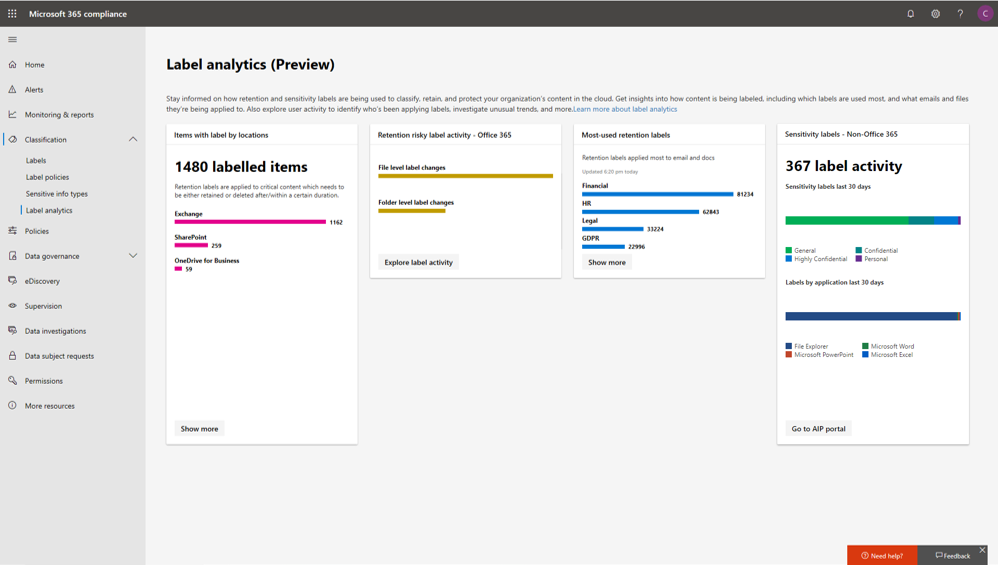 Label analytics (preview) in the Microsoft 365 compliance center gives you an overview of labeled documents and emails – for both retention labels and sensitivity labels
For a deeper view into sensitivity label activity, you can go the Azure Information Protection portal. In late 2018 we announced the public preview of Azure Information Protection analytics, which gives you insights into classified, labeled and protected documents across your organization. There have been several updates to the preview experience over the past couple of months. Information from Windows computers running Windows Defender ATP is now included. Additional activity information is also included, such as which users have accessed a specific labeled document and whether a document label has been upgraded or downgraded by a user. You can learn more in the product documentation. We are targeting general availability in early Q2 CY19, so stay tuned.
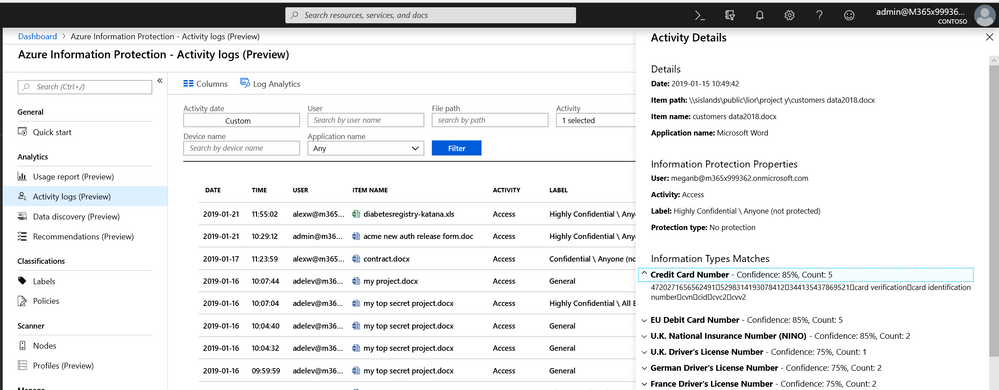
Extend visibility into sensitive information in Windows endpoints
While more and more data lives in cloud services, a significant amount of important data also resides on end-users’ devices. Endpoints represent a key control point for your information protection strategy – especially since devices are often the entry point for sophisticated attacks and data breaches. Windows Defender Advanced Threat Protection (Windows Defender ATP), Microsoft’s endpoint protection platform, can now understand Microsoft Information Protection sensitivity labels – providing visibility into sensitive data on endpoints, protect data based on its content and help you respond to post-breach malicious activity that involves sensitive data.
This integration enables Azure Information Protection analytics to show information on labeled data on Windows devices (as reported by Windows Defender ATP). This help gives admins better visibility into sensitive information residing on a given endpoint and investigates and mitigate security threats on potentially compromised machines.
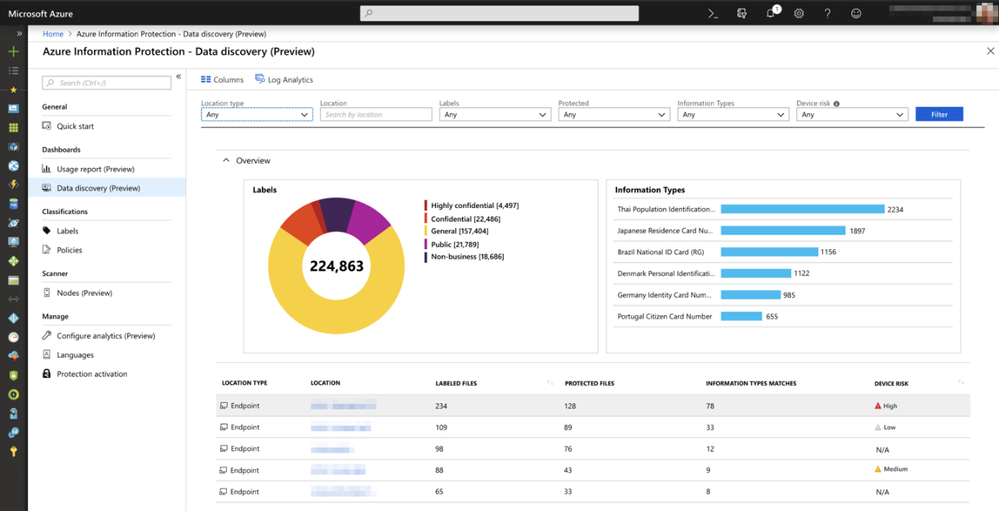 The Azure Information Protection Data discovery dashboard shows labeled files discovered on endpoints by Windows Defender ATP; along with a device risk calculation to help direct further investigation
Learn more about the latest integration between Windows Defender ATP and Microsoft Information Protection in our blog.
Partners are extending Microsoft Information Protection experiences to their own apps and services
At the RSA Conference in 2018 we announced the public preview of the Microsoft Information Protection SDK, which became generally available in September 2018. Since then, we’ve made several updates, and our partners are developing a diverse set of integrations – ranging from endpoint DLP solutions, classifying and labeling, to reporting on data that has been labeled and protected. With the Microsoft Information Protection SDK, we now have a comprehensive cross-platform SDK that covers Windows, Linux, macOS, iOS and Android. More details on partner integrations are available here. Download the Microsoft Information SDK and get started!
Getting started and looking ahead
We encourage you to start evaluating and deploying these new capabilities. Start using the unified labeling experience to configure and deploy your sensitivity labels. Use the native labeling experience in the Office apps on Mac, iOS and Android to empower users to label and protect their documents and emails. Enable Windows users to do the same by using the Azure Information Protection unified labeling client (preview). Configure Windows Information Protection and Windows Defender ATP to help protect sensitive data on Windows endpoints. Gain visibility into sensitive data across your environment using the Label analytics preview in the Microsoft 365 security center and go deeper with Azure Information Protection analytics.
You can also engage with us and the community on Yammer or Twitter and provide additional feedback on UserVoice.
Across Microsoft Information Protection solutions, our goal is to provide a comprehensive set of capabilities to help you protect your sensitive data throughout its entire lifecycle – across devices, apps, cloud services and on-premises. With the exponential growth of data and increasing data mobility, it’s critical to implement an information protection strategy that not only enables you to meet your internal security objectives, but also address new and emerging compliance and privacy requirements. We’ve recently released several new capabilities to help you discover, classify & label, protect and monitor your sensitive information – here’s a quick roundup of the latest news.
You can also check out this video to see some of the highlights in action:
A unified approach to data classification and label management
In order to effectively apply policy-based protection and controls to your sensitive data, you need to be able to inspect and reason over documents and emails. We provide a unified approach to data classification across our information protection and data governance solutions. There are over 90 out-of-the-box sensitive information types that you can use to detect common types of data, such as financial data, PII or health-care related information. You can also create and customize your sensitive information types (such as detecting employee ID numbers that are unique to your organization). Our classification engine is leveraged across services – including Azure Information Protection, Microsoft Cloud App Security, Advanced Data Governance and Office 365 Data Loss Prevention – enabling consistent classification outcomes for the purpose of applying labels, protecting information and enforcing data policies.
In addition to a consistent approach to data classification, we also provide a unified experience for configuring and managing labels – both sensitivity labels for the purpose of apply protection policies and retention labels for the purpose of applying data governance policies. In late 2018 we released a unified label management experience in the Office 365 Security & Compliance Center. Customers have been using this to create and configure their sensitivity labels and retention labels, set label policies and migrate existing labels from the Azure portal (for Azure Information Protection customers). The recently released Microsoft 365 security center and compliance center gives admins an enhanced experience and a dedicated workspace to manage Microsoft 365 security and compliance solutions, including sensitivity labels and retention labels.
The new Microsoft 365 security center and compliance center (rolling out now) provides a centralized workspace to manage your Microsoft 365 security and compliance solutions, including management of your sensitivity labels and retention labels.
We’ve also recently announced two new retention capabilities, including the general availability of file plan manager, which helps you migrate complex retention hierarchies into Office 365, and a new assessment of Office 365’s ability to meet SEC 17a-4 requirements around immutability.
New sensitivity labeling capabilities built into Office apps – across platforms
We want to make it easy for end-users to apply sensitivity labels to their documents and emails – without interrupting their workflow or productivity. We recently announced the availability of end-user driven labeling capabilities built natively into Office apps on Mac, iOS and Android. This enables users to assign the appropriate sensitivity label while creating or editing documents and emails – such as “Highly Confidential” when the file contains company secrets. Based on the policies defined by your company, sensitivity labels can result in several actions, such as encryption, rights restrictions or adding visual markings stamped to the document. The experience is consistent and familiar across Office applications.
Apply sensitivity labels in Office apps on Mac – encryption, rights restrictions and visual markings can be applied, based on your label policy
Easily apply the same sensitivity labels in Office mobile apps on iOS and Android
Learn more about the native labeling experience in our blog.
We’re also announcing an updated public preview of the Azure Information Protection client that supports unified labeling. The Azure Information Protection unified labeling client gets it sensitivity labels and policy settings from the Security & Compliance Center or the Microsoft 365 security center (as mentioned earlier). This is particularly useful for existing Azure Information Protection customers who want to evaluate and test the unified labeling and protection capabilities in Office apps on Windows (Word, PowerPoint, Excel and Outlook). The original public preview of the Azure Information Protection unified labeling client supported several features, such as end-user driven manual labeling, and the new updated public preview version now includes recommended labeling, automatic labeling and other customization options. Learn more about the supported features or read our product documentation.
Apply sensitivity labels to Office apps on Windows using the Azure Information Protection unified labeling client (in preview)
Enhanced data discovery and protection across your on-premises repositories
The Azure Information Protection scanner is used by customers all over the world to discover, classify, label and protect sensitive information that resides in their on-premises file servers. Based on customer feedback to provide additional capabilities to make it easier and more efficient to deploy and manage the Azure Information Protection scanner at scale, we recently released a new management and operational UI.
The management UI (currently in public preview) helps you manage scanner configuration and scanned repositories – all in one central place within the Azure portal. You can configure sensitive information types that you want to discover, set file types to be scanned, set default label settings along with other configuration options.
Azure Information Protection scanner profiles management page enables admins to set scanner configuration options
We also recently announced the general availability of a new operational UI which makes it easier to stay on top of Azure Information Protection scanner operations, such as monitoring the status of all scanner nodes, get the latest scanning statistics, initiate on-demand incremental scans or run full rescans. Learn more about the latest Azure Information Protection scanner UI experience in our blog or review the product documentation.
New classification methods to automatically detect sensitive credential information in documents
While we provide over 90 out-of-the-box sensitive information types that you can use to detect common types of data, a frequent customer request has been the ability to automatically detect passwords and other credential types that users have recorded or pasted in unprotected files. For example, sometimes users and admins use Word or Excel to store a list of usernames and passwords they use for applications and services. We’re announcing the public preview of the first group of credential types that we can automatically detect – focusing on Azure secrets and SQL credentials. These new sensitive information types are coming first to Azure Information Protection and will be coming soon to Office 365. Similar to other sensitive information types, you can configure your policy to recommend a sensitivity label to the user or automatically apply a label and protection settings. Read more about the credential types supported in our blog.
Credential information in a document is automatically detected; sensitivity label is recommended or automatically applied
Deeper visibility into the sensitive data landscape across your organization
The information protection lifecycle wouldn’t be complete without the ability to understand your sensitive data landscape. Within the new Microsoft 365 security center (and compliance center), the new Label analytics page (currently in preview), provides the starting point for you to better understand label usage across your organization. You can quickly see the overall activity of sensitivity labeling during the past 30 days, the distribution of labels used (such as how many “Highly Confidential” labels were applied), along with the location where labels were applied (such as Word, Excel, PowerPoint, File Explorer).
Label analytics (preview) in the Microsoft 365 compliance center gives you an overview of labeled documents and emails – for both retention labels and sensitivity labels
For a deeper view into sensitivity label activity, you can go the Azure Information Protection portal. In late 2018 we announced the public preview of Azure Information Protection analytics, which gives you insights into classified, labeled and protected documents across your organization. There have been several updates to the preview experience over the past couple of months. Information from Windows computers running Windows Defender ATP is now included. Additional activity information is also included, such as which users have accessed a specific labeled document and whether a document label has been upgraded or downgraded by a user. You can learn more in the product documentation. We are targeting general availability in early Q2 CY19, so stay tuned.
Extend visibility into sensitive information in Windows endpoints
While more and more data lives in cloud services, a significant amount of important data also resides on end-users’ devices. Endpoints represent a key control point for your information protection strategy – especially since devices are often the entry point for sophisticated attacks and data breaches. Windows Defender Advanced Threat Protection (Windows Defender ATP), Microsoft’s endpoint protection platform, can now understand Microsoft Information Protection sensitivity labels – providing visibility into sensitive data on endpoints, protect data based on its content and help you respond to post-breach malicious activity that involves sensitive data.
This integration enables Azure Information Protection analytics to show information on labeled data on Windows devices (as reported by Windows Defender ATP). This help gives admins better visibility into sensitive information residing on a given endpoint and investigates and mitigate security threats on potentially compromised machines.
The Azure Information Protection Data discovery dashboard shows labeled files discovered on endpoints by Windows Defender ATP; along with a device risk calculation to help direct further investigation
Learn more about the latest integration between Windows Defender ATP and Microsoft Information Protection in our blog.
Partners are extending Microsoft Information Protection experiences to their own apps and services
At the RSA Conference in 2018 we announced the public preview of the Microsoft Information Protection SDK, which became generally available in September 2018. Since then, we’ve made several updates, and our partners are developing a diverse set of integrations – ranging from endpoint DLP solutions, classifying and labeling, to reporting on data that has been labeled and protected. With the Microsoft Information Protection SDK, we now have a comprehensive cross-platform SDK that covers Windows, Linux, macOS, iOS and Android. More details on partner integrations are available here. Download the Microsoft Information SDK and get started!
Getting started and looking ahead
We encourage you to start evaluating and deploying these new capabilities. Start using the unified labeling experience to configure and deploy your sensitivity labels. Use the native labeling experience in the Office apps on Mac, iOS and Android to empower users to label and protect their documents and emails. Enable Windows users to do the same by using the Azure Information Protection unified labeling client (preview). Configure Windows Information Protection and Windows Defender ATP to help protect sensitive data on Windows endpoints. Gain visibility into sensitive data across your environment using the Label analytics preview in the Microsoft 365 security center and go deeper with Azure Information Protection analytics.
You can also engage with us and the community on Yammer or Twitter and provide additional feedback on UserVoice.
Across Microsoft Information Protection solutions, our goal is to provide a comprehensive set of capabilities to help you protect your sensitive data throughout its entire lifecycle – across devices, apps, cloud services and on-premises. With the exponential growth of data and increasing data mobility, it’s critical to implement an information protection strategy that not only enables you to meet your internal security objectives, but also address new and emerging compliance and privacy requirements. We’ve recently released several new capabilities to help you discover, classify & label, protect and monitor your sensitive information – here’s a quick roundup of the latest news.
You can also check out this video to see some of the highlights in action:
A unified approach to data classification and label management
In order to effectively apply policy-based protection and controls to your sensitive data, you need to be able to inspect and reason over documents and emails. We provide a unified approach to data classification across our information protection and data governance solutions. There are over 90 out-of-the-box sensitive information types that you can use to detect common types of data, such as financial data, PII or health-care related information. You can also create and customize your sensitive information types (such as detecting employee ID numbers that are unique to your organization). Our classification engine is leveraged across services – including Azure Information Protection, Microsoft Cloud App Security, Advanced Data Governance and Office 365 Data Loss Prevention – enabling consistent classification outcomes for the purpose of applying labels, protecting information and enforcing data policies.
In addition to a consistent approach to data classification, we also provide a unified experience for configuring and managing labels – both sensitivity labels for the purpose of apply protection policies and retention labels for the purpose of applying data governance policies. In late 2018 we released a unified label management experience in the Office 365 Security & Compliance Center. Customers have been using this to create and configure their sensitivity labels and retention labels, set label policies and migrate existing labels from the Azure portal (for Azure Information Protection customers). The recently released Microsoft 365 security center and compliance center gives admins an enhanced experience and a dedicated workspace to manage Microsoft 365 security and compliance solutions, including sensitivity labels and retention labels.
The new Microsoft 365 security center and compliance center (rolling out now) provides a centralized workspace to manage your Microsoft 365 security and compliance solutions, including management of your sensitivity labels and retention labels.
We’ve also recently announced two new retention capabilities, including the general availability of file plan manager, which helps you migrate complex retention hierarchies into Office 365, and a new assessment of Office 365’s ability to meet SEC 17a-4 requirements around immutability.
New sensitivity labeling capabilities built into Office apps – across platforms
We want to make it easy for end-users to apply sensitivity labels to their documents and emails – without interrupting their workflow or productivity. We recently announced the availability of end-user driven labeling capabilities built natively into Office apps on Mac, iOS and Android. This enables users to assign the appropriate sensitivity label while creating or editing documents and emails – such as “Highly Confidential” when the file contains company secrets. Based on the policies defined by your company, sensitivity labels can result in several actions, such as encryption, rights restrictions or adding visual markings stamped to the document. The experience is consistent and familiar across Office applications.
Apply sensitivity labels in Office apps on Mac – encryption, rights restrictions and visual markings can be applied, based on your label policy
Easily apply the same sensitivity labels in Office mobile apps on iOS and Android
Learn more about the native labeling experience in our blog.
We’re also announcing an updated public preview of the Azure Information Protection client that supports unified labeling. The Azure Information Protection unified labeling client gets it sensitivity labels and policy settings from the Security & Compliance Center or the Microsoft 365 security center (as mentioned earlier). This is particularly useful for existing Azure Information Protection customers who want to evaluate and test the unified labeling and protection capabilities in Office apps on Windows (Word, PowerPoint, Excel and Outlook). The original public preview of the Azure Information Protection unified labeling client supported several features, such as end-user driven manual labeling, and the new updated public preview version now includes recommended labeling, automatic labeling and other customization options. Learn more about the supported features or read our product documentation.
Apply sensitivity labels to Office apps on Windows using the Azure Information Protection unified labeling client (in preview)
Enhanced data discovery and protection across your on-premises repositories
The Azure Information Protection scanner is used by customers all over the world to discover, classify, label and protect sensitive information that resides in their on-premises file servers. Based on customer feedback to provide additional capabilities to make it easier and more efficient to deploy and manage the Azure Information Protection scanner at scale, we recently released a new management and operational UI.
The management UI (currently in public preview) helps you manage scanner configuration and scanned repositories – all in one central place within the Azure portal. You can configure sensitive information types that you want to discover, set file types to be scanned, set default label settings along with other configuration options.
Azure Information Protection scanner profiles management page enables admins to set scanner configuration options
We also recently announced the general availability of a new operational UI which makes it easier to stay on top of Azure Information Protection scanner operations, such as monitoring the status of all scanner nodes, get the latest scanning statistics, initiate on-demand incremental scans or run full rescans. Learn more about the latest Azure Information Protection scanner UI experience in our blog or review the product documentation.
New classification methods to automatically detect sensitive credential information in documents
While we provide over 90 out-of-the-box sensitive information types that you can use to detect common types of data, a frequent customer request has been the ability to automatically detect passwords and other credential types that users have recorded or pasted in unprotected files. For example, sometimes users and admins use Word or Excel to store a list of usernames and passwords they use for applications and services. We’re announcing the public preview of the first group of credential types that we can automatically detect – focusing on Azure secrets and SQL credentials. These new sensitive information types are coming first to Azure Information Protection and will be coming soon to Office 365. Similar to other sensitive information types, you can configure your policy to recommend a sensitivity label to the user or automatically apply a label and protection settings. Read more about the credential types supported in our blog.
Credential information in a document is automatically detected; sensitivity label is recommended or automatically applied
Deeper visibility into the sensitive data landscape across your organization
The information protection lifecycle wouldn’t be complete without the ability to understand your sensitive data landscape. Within the new Microsoft 365 security center (and compliance center), the new Label analytics page (currently in preview), provides the starting point for you to better understand label usage across your organization. You can quickly see the overall activity of sensitivity labeling during the past 30 days, the distribution of labels used (such as how many “Highly Confidential” labels were applied), along with the location where labels were applied (such as Word, Excel, PowerPoint, File Explorer).
Label analytics (preview) in the Microsoft 365 compliance center gives you an overview of labeled documents and emails – for both retention labels and sensitivity labels
For a deeper view into sensitivity label activity, you can go the Azure Information Protection portal. In late 2018 we announced the public preview of Azure Information Protection analytics, which gives you insights into classified, labeled and protected documents across your organization. There have been several updates to the preview experience over the past couple of months. Information from Windows computers running Windows Defender ATP is now included. Additional activity information is also included, such as which users have accessed a specific labeled document and whether a document label has been upgraded or downgraded by a user. You can learn more in the product documentation. We are targeting general availability in early Q2 CY19, so stay tuned.
Extend visibility into sensitive information in Windows endpoints
While more and more data lives in cloud services, a significant amount of important data also resides on end-users’ devices. Endpoints represent a key control point for your information protection strategy – especially since devices are often the entry point for sophisticated attacks and data breaches. Windows Defender Advanced Threat Protection (Windows Defender ATP), Microsoft’s endpoint protection platform, can now understand Microsoft Information Protection sensitivity labels – providing visibility into sensitive data on endpoints, protect data based on its content and help you respond to post-breach malicious activity that involves sensitive data.
This integration enables Azure Information Protection analytics to show information on labeled data on Windows devices (as reported by Windows Defender ATP). This help gives admins better visibility into sensitive information residing on a given endpoint and investigates and mitigate security threats on potentially compromised machines.
The Azure Information Protection Data discovery dashboard shows labeled files discovered on endpoints by Windows Defender ATP; along with a device risk calculation to help direct further investigation
Learn more about the latest integration between Windows Defender ATP and Microsoft Information Protection in our blog.
Partners are extending Microsoft Information Protection experiences to their own apps and services
At the RSA Conference in 2018 we announced the public preview of the Microsoft Information Protection SDK, which became generally available in September 2018. Since then, we’ve made several updates, and our partners are developing a diverse set of integrations – ranging from endpoint DLP solutions, classifying and labeling, to reporting on data that has been labeled and protected. With the Microsoft Information Protection SDK, we now have a comprehensive cross-platform SDK that covers Windows, Linux, macOS, iOS and Android. More details on partner integrations are available here. Download the Microsoft Information SDK and get started!
Getting started and looking ahead
We encourage you to start evaluating and deploying these new capabilities. Start using the unified labeling experience to configure and deploy your sensitivity labels. Use the native labeling experience in the Office apps on Mac, iOS and Android to empower users to label and protect their documents and emails. Enable Windows users to do the same by using the Azure Information Protection unified labeling client (preview). Configure Windows Information Protection and Windows Defender ATP to help protect sensitive data on Windows endpoints. Gain visibility into sensitive data across your environment using the Label analytics preview in the Microsoft 365 security center and go deeper with Azure Information Protection analytics.
You can also engage with us and the community on Yammer or Twitter and provide additional feedback on UserVoice.
Across Microsoft Information Protection solutions, our goal is to provide a comprehensive set of capabilities to help you protect your sensitive data throughout its entire lifecycle – across devices, apps, cloud services and on-premises. With the exponential growth of data and increasing data mobility, it’s critical to implement an information protection strategy that not only enables you to meet your internal security objectives, but also address new and emerging compliance and privacy requirements. We’ve recently released several new capabilities to help you discover, classify & label, protect and monitor your sensitive information – here’s a quick roundup of the latest news.
You can also check out this video to see some of the highlights in action:
A unified approach to data classification and label management
In order to effectively apply policy-based protection and controls to your sensitive data, you need to be able to inspect and reason over documents and emails. We provide a unified approach to data classification across our information protection and data governance solutions. There are over 90 out-of-the-box sensitive information types that you can use to detect common types of data, such as financial data, PII or health-care related information. You can also create and customize your sensitive information types (such as detecting employee ID numbers that are unique to your organization). Our classification engine is leveraged across services – including Azure Information Protection, Microsoft Cloud App Security, Advanced Data Governance and Office 365 Data Loss Prevention – enabling consistent classification outcomes for the purpose of applying labels, protecting information and enforcing data policies.
In addition to a consistent approach to data classification, we also provide a unified experience for configuring and managing labels – both sensitivity labels for the purpose of apply protection policies and retention labels for the purpose of applying data governance policies. In late 2018 we released a unified label management experience in the Office 365 Security & Compliance Center. Customers have been using this to create and configure their sensitivity labels and retention labels, set label policies and migrate existing labels from the Azure portal (for Azure Information Protection customers). The recently released Microsoft 365 security center and compliance center gives admins an enhanced experience and a dedicated workspace to manage Microsoft 365 security and compliance solutions, including sensitivity labels and retention labels.
The new Microsoft 365 security center and compliance center (rolling out now) provides a centralized workspace to manage your Microsoft 365 security and compliance solutions, including management of your sensitivity labels and retention labels.
We’ve also recently announced two new retention capabilities, including the general availability of file plan manager, which helps you migrate complex retention hierarchies into Office 365, and a new assessment of Office 365’s ability to meet SEC 17a-4 requirements around immutability.
New sensitivity labeling capabilities built into Office apps – across platforms
We want to make it easy for end-users to apply sensitivity labels to their documents and emails – without interrupting their workflow or productivity. We recently announced the availability of end-user driven labeling capabilities built natively into Office apps on Mac, iOS and Android. This enables users to assign the appropriate sensitivity label while creating or editing documents and emails – such as “Highly Confidential” when the file contains company secrets. Based on the policies defined by your company, sensitivity labels can result in several actions, such as encryption, rights restrictions or adding visual markings stamped to the document. The experience is consistent and familiar across Office applications.
Apply sensitivity labels in Office apps on Mac – encryption, rights restrictions and visual markings can be applied, based on your label policy
Easily apply the same sensitivity labels in Office mobile apps on iOS and Android
Learn more about the native labeling experience in our blog.
We’re also announcing an updated public preview of the Azure Information Protection client that supports unified labeling. The Azure Information Protection unified labeling client gets it sensitivity labels and policy settings from the Security & Compliance Center or the Microsoft 365 security center (as mentioned earlier). This is particularly useful for existing Azure Information Protection customers who want to evaluate and test the unified labeling and protection capabilities in Office apps on Windows (Word, PowerPoint, Excel and Outlook). The original public preview of the Azure Information Protection unified labeling client supported several features, such as end-user driven manual labeling, and the new updated public preview version now includes recommended labeling, automatic labeling and other customization options. Learn more about the supported features or read our product documentation.
Apply sensitivity labels to Office apps on Windows using the Azure Information Protection unified labeling client (in preview)
Enhanced data discovery and protection across your on-premises repositories
The Azure Information Protection scanner is used by customers all over the world to discover, classify, label and protect sensitive information that resides in their on-premises file servers. Based on customer feedback to provide additional capabilities to make it easier and more efficient to deploy and manage the Azure Information Protection scanner at scale, we recently released a new management and operational UI.
The management UI (currently in public preview) helps you manage scanner configuration and scanned repositories – all in one central place within the Azure portal. You can configure sensitive information types that you want to discover, set file types to be scanned, set default label settings along with other configuration options.
Azure Information Protection scanner profiles management page enables admins to set scanner configuration options
We also recently announced the general availability of a new operational UI which makes it easier to stay on top of Azure Information Protection scanner operations, such as monitoring the status of all scanner nodes, get the latest scanning statistics, initiate on-demand incremental scans or run full rescans. Learn more about the latest Azure Information Protection scanner UI experience in our blog or review the product documentation.
New classification methods to automatically detect sensitive credential information in documents
While we provide over 90 out-of-the-box sensitive information types that you can use to detect common types of data, a frequent customer request has been the ability to automatically detect passwords and other credential types that users have recorded or pasted in unprotected files. For example, sometimes users and admins use Word or Excel to store a list of usernames and passwords they use for applications and services. We’re announcing the public preview of the first group of credential types that we can automatically detect – focusing on Azure secrets and SQL credentials. These new sensitive information types are coming first to Azure Information Protection and will be coming soon to Office 365. Similar to other sensitive information types, you can configure your policy to recommend a sensitivity label to the user or automatically apply a label and protection settings. Read more about the credential types supported in our blog.
Credential information in a document is automatically detected; sensitivity label is recommended or automatically applied
Deeper visibility into the sensitive data landscape across your organization
The information protection lifecycle wouldn’t be complete without the ability to understand your sensitive data landscape. Within the new Microsoft 365 security center (and compliance center), the new Label analytics page (currently in preview), provides the starting point for you to better understand label usage across your organization. You can quickly see the overall activity of sensitivity labeling during the past 30 days, the distribution of labels used (such as how many “Highly Confidential” labels were applied), along with the location where labels were applied (such as Word, Excel, PowerPoint, File Explorer).
Label analytics (preview) in the Microsoft 365 compliance center gives you an overview of labeled documents and emails – for both retention labels and sensitivity labels
For a deeper view into sensitivity label activity, you can go the Azure Information Protection portal. In late 2018 we announced the public preview of Azure Information Protection analytics, which gives you insights into classified, labeled and protected documents across your organization. There have been several updates to the preview experience over the past couple of months. Information from Windows computers running Windows Defender ATP is now included. Additional activity information is also included, such as which users have accessed a specific labeled document and whether a document label has been upgraded or downgraded by a user. You can learn more in the product documentation. We are targeting general availability in early Q2 CY19, so stay tuned.
Extend visibility into sensitive information in Windows endpoints
While more and more data lives in cloud services, a significant amount of important data also resides on end-users’ devices. Endpoints represent a key control point for your information protection strategy – especially since devices are often the entry point for sophisticated attacks and data breaches. Windows Defender Advanced Threat Protection (Windows Defender ATP), Microsoft’s endpoint protection platform, can now understand Microsoft Information Protection sensitivity labels – providing visibility into sensitive data on endpoints, protect data based on its content and help you respond to post-breach malicious activity that involves sensitive data.
This integration enables Azure Information Protection analytics to show information on labeled data on Windows devices (as reported by Windows Defender ATP). This help gives admins better visibility into sensitive information residing on a given endpoint and investigates and mitigate security threats on potentially compromised machines.
The Azure Information Protection Data discovery dashboard shows labeled files discovered on endpoints by Windows Defender ATP; along with a device risk calculation to help direct further investigation
Learn more about the latest integration between Windows Defender ATP and Microsoft Information Protection in our blog.
Partners are extending Microsoft Information Protection experiences to their own apps and services
At the RSA Conference in 2018 we announced the public preview of the Microsoft Information Protection SDK, which became generally available in September 2018. Since then, we’ve made several updates, and our partners are developing a diverse set of integrations – ranging from endpoint DLP solutions, classifying and labeling, to reporting on data that has been labeled and protected. With the Microsoft Information Protection SDK, we now have a comprehensive cross-platform SDK that covers Windows, Linux, macOS, iOS and Android. More details on partner integrations are available here. Download the Microsoft Information SDK and get started!
Getting started and looking ahead
We encourage you to start evaluating and deploying these new capabilities. Start using the unified labeling experience to configure and deploy your sensitivity labels. Use the native labeling experience in the Office apps on Mac, iOS and Android to empower users to label and protect their documents and emails. Enable Windows users to do the same by using the Azure Information Protection unified labeling client (preview). Configure Windows Information Protection and Windows Defender ATP to help protect sensitive data on Windows endpoints. Gain visibility into sensitive data across your environment using the Label analytics preview in the Microsoft 365 security center and go deeper with Azure Information Protection analytics.
You can also engage with us and the community on Yammer or Twitter and provide additional feedback on UserVoice.
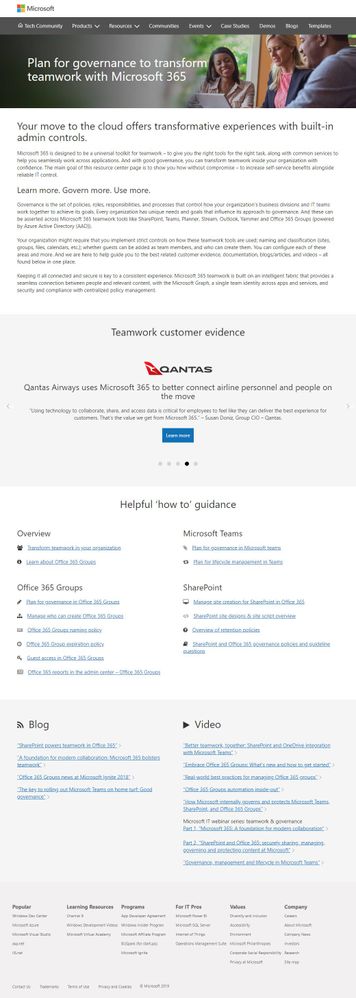
Your move to the cloud offers transformative experiences with built-in admin controls.
Microsoft 365 is designed to be a universal toolkit for teamwork – to give you the right tools for the right task, along with common services to help you seamlessly work across applications. And with good governance, you can transform teamwork inside your organization with confidence – without compromise.
To learn more and act, we invite you to visit and share the NEW “Plan for governance to transform teamwork with Microsoft 365” resource center page [https://aka.ms/teamwork/governance].
This new resource center page contains:
- An overview for business and IT
- Customer highlights – GE plus four other relevant case studies
- Helpful ‘how to’ guidance (14 helpful resources across overview, Office 365 Groups, Microsoft Teams and SharePoint)
- plus, recent and relevant blogs and videos
Keeping it all connected and secure is key to a consistent experience. Microsoft 365 teamwork is built on an intelligent fabric that provides a seamless connection between people and relevant content. And we at Microsoft aim to provide tools and technology to configure and attain programmatic governance across all teamwork apps and information.
This aggregated set of materials are a starting point to help you learn about teamwork-level governance when using Office 365 and how you can begin to take advantage of it.
Full-page screenshot of what the new “Plan for governance to transform teamwork with Microsoft 365” page looks like; https://aka.ms/teamwork/governance.
We are open to content suggestions to make this new resource center page even more helpful and clear. Let us know below in comments below or via Twitter: @SharePoint.
Cheers,
Mark (@mkashman) Kashman
Your move to the cloud offers transformative experiences with built-in admin controls.
Microsoft 365 is designed to be a universal toolkit for teamwork – to give you the right tools for the right task, along with common services to help you seamlessly work across applications. And with good governance, you can transform teamwork inside your organization with confidence – without compromise.
To learn more and act, we invite you to visit and share the NEW “Plan for governance to transform teamwork with Microsoft 365” resource center page [https://aka.ms/teamwork/governance].
This new resource center page contains:
- An overview for business and IT
- Customer highlights – GE plus four other relevant case studies
- Helpful ‘how to’ guidance (14 helpful resources across overview, Office 365 Groups, Microsoft Teams and SharePoint)
- plus, recent and relevant blogs and videos
Keeping it all connected and secure is key to a consistent experience. Microsoft 365 teamwork is built on an intelligent fabric that provides a seamless connection between people and relevant content. And we at Microsoft aim to provide tools and technology to configure and attain programmatic governance across all teamwork apps and information.
This aggregated set of materials are a starting point to help you learn about teamwork-level governance when using Office 365 and how you can begin to take advantage of it.
Full-page screenshot of what the new “Plan for governance to transform teamwork with Microsoft 365” page looks like; https://aka.ms/teamwork/governance.
We are open to content suggestions to make this new resource center page even more helpful and clear. Let us know below in comments below or via Twitter: @SharePoint.
Cheers,
Mark (@mkashman) Kashman
There’s a SharePoint page for that. From content-rich home pages that serves entire organizations, to recurring quarterly business review read outs, to internal campaigns, to “welcome to the company” starter pages. As the rich capabilities of modern SharePoint pages evolve, all communicators can better design and promote their information throughout their team and across the organization.
We are excited to announce the following page enhancements (screenshots + links to learn more below):
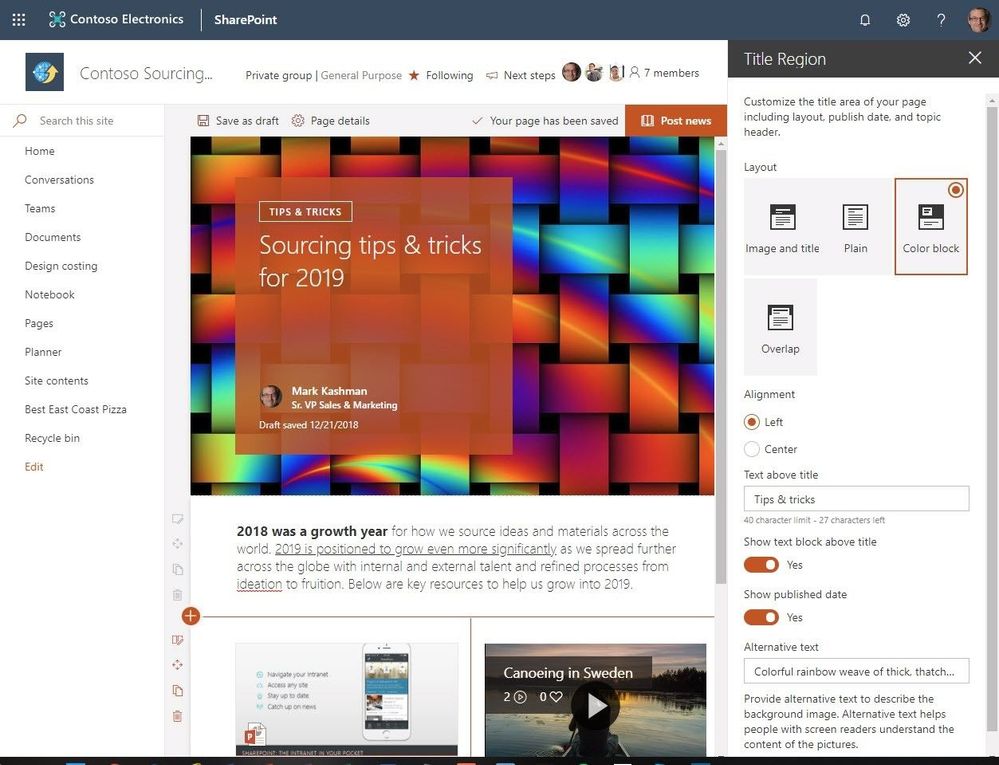
- Customize title region | control what the title region of each page looks like (layout, alignment, title, date).
- Section backgrounds | display as distinct sections with visual variety throughout the page.
- Custom page thumbnails | Choose a preferred thumbnail from Page details.
- Custom page descriptions | Create a custom description from Page details.
- FYI: removal of the Feedback button in preparation of new feedback experience | in preparation for a new feedback experience coming soon, we are removing the current Feedback button from the site footer of all SharePoint home and modern site pages.
- FYI: removal of the pictures of the first three members of the group | Users who want to see members of the group can continue to click the Members link in the header to see the full membership list.
“We are reducing emails and creating a self-service culture where finding answers is as easy as searching for it on our intranet,” says David Pizzey: Manager, Centre of Excellence, Network and End User Services. “Office 365 surfaces personalized content across the suite, making it a great tool to search for information, and it even helps you make connections with areas of interest you might not even know existed.” [read the full Qantas Airways case study]
Let’s dive into the details of each new and updated page option – all powerful additions for communicators throughout your organization.
New and updated enhancements for SharePoint pages in Office 365
SharePoint pages are simple to create and publish, and they look great on any device. When creating a page, you can add and configure web parts, and then publish your page with just a click. And, as previously announced, you can configure the surrounding elements of the page (navigation, header, footer & theme). Now more than ever, creators and site owners present the information in an elegant, easy to consume fashion – with full context intact.
Customize the title region for each page. Modern SharePoint pages and news articles will now have more options to customize the title region of each page, with four layouts, two alignment choices, text badges above the title, the ability to change the displayed author, and show or hide the published date. Own the title and the rest will follow. Make it your own.
Make the title of your page or news article appear more how you like it – with controls for layout, alignment, text blocks and more.
Modern pages support section backgrounds – this makes it easier to see the distinct sections and adds visual variety throughout the page. Create additional visual design and clarity as a user scrolls through your content. Now you can add colors from your site’s theme (neutral, soft & strong) to the background of your page sections or leave them white as they are by default.
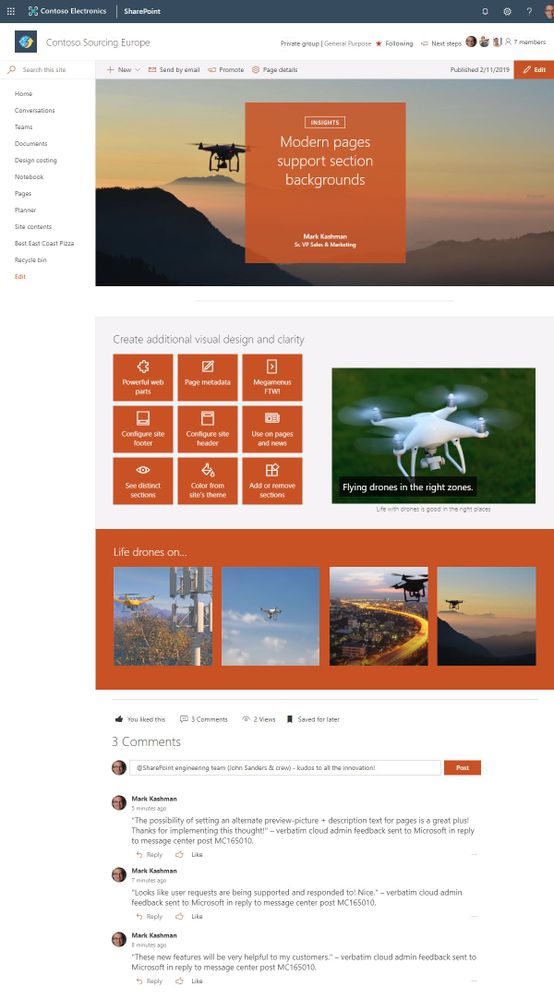 Modern SharePoint pages (and news) section backgrounds make it easier to see the distinct sections and adds visual variety throughout the page.
Page owners can customize their page thumbnails and descriptions from within page details edit pane. Once adjusted, the content will then be represented in this way in search results, highlighted content, previews, and more – just the way you intended.
- Pages – choose new thumbnail – Choose a new thumbnail from Page details: Previously, the thumbnail image for a page (used in search results, highlighted content, and SharePoint News) was auto-selected. Now, you’ll be able to select your own thumbnail image.
- Pages – choose new description – Choose a new description from Page details: Previously, the first text that appeared on the page was auto-selected as the page description. You can now add your own custom description in Page details.
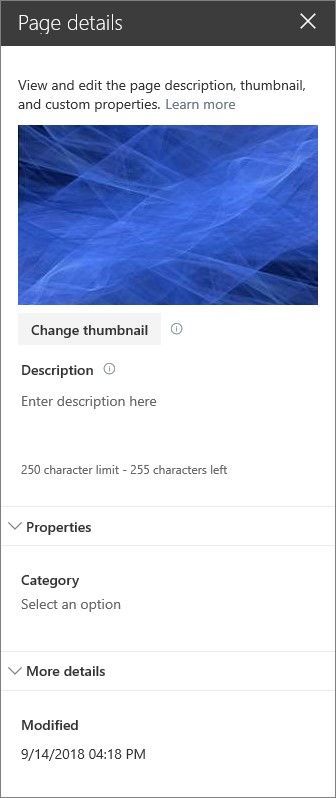 You can view and edit the properties of a SharePoint page in the Page details pane.
The SharePoint feedback button is being retired in preparation of new feedback experience
Starting the week of February 18th, 2019, we’re removing the product Feedback button from the site footer of all SharePoint home and modern site pages. For SharePoint users to easily provide product feedback and suggestions we included a footer link to our SharePoint UserVoice forums. Customer feedback continues to help us prioritize our work. We’ll be adding new ways to send feedback from the navigation bar in the coming months.
Note: If you had previously enabled or disabled the button using the Set-SPOTenant -UserVoiceForFeedbackEnabled property, this setting will no longer be required as the button will no longer be displayed for any tenant sites.
Removing the circular pictures of the first three members of the group
We’re updating the design of the site header for SharePoint sites connected to Office 365 groups. In favor or a more-simple interface, we are removing the circular pictures of the first three members of the group. This was static to the first three members, and duplicative to existing functionality – access to the members of the group. Users who want to see members of the group can continue to click the Members link in the header to see the full membership list.
Try more and more of what SharePoint offers, and let us know what you think
In all, we encourage you to build out and organize your sites, your pages, your intranet – the way you want them to be consumed in context of your content. As you progress year over year, keep creating and sharing structured, easy-to-navigate experiences to your audience.
We want to empower you and every person on your team to achieve more. Let us know what you need next. We are always open to feedback via UserVoice and continued dialog in the SharePoint community in the Microsoft Tech Community —and we always have an eye on tweets to @SharePoint. Let us know.
—Mark Kashman, senior product manager for the SharePoint team
FAQ
Q: When is this all being released in Office 365?
A: All the above items have been released to Targeted Release customers in Office 365. We plan to fully release to all full production Office 365 customers by the end of February 2019.