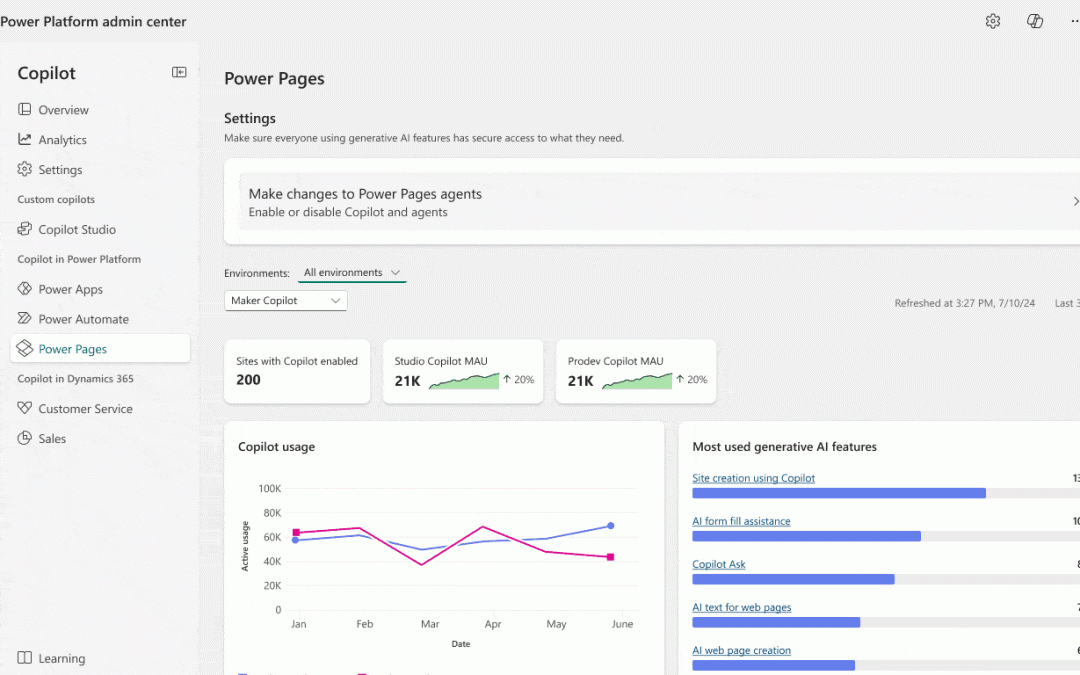
This post was originally published on this site.
Security and IT teams move fast – and so does Security Copilot. This month, we’re delivering powerful new capabilities that help security and IT professionals investigate threats, manage identities, and automate protection with greater speed and precision. From AI-powered triage and policy optimization to smarter data exploration and expanded language support, these updates are designed to help you stay ahead of threats, reduce manual effort, and unlock new levels of efficiency.
Let’s dive into what’s new.
Improve IT efficiency with Copilot in Microsoft Intune – now generally available
IT admins can now use Security Copilot in Intune which includes a dedicated data exploration experience, allowing them to ask questions, extract insights, and take action – all from within the Intune admin center. Whether it’s identifying non-compliant devices, managing updates, or automating remediation, Copilot simplifies complex workflows and brings data and actions together in one place.
Learn more: Copilot in Microsoft Intune announcement
Streamline identity security with Copilot in Microsoft Entra – now generally available
Security Copilot in Microsoft Entra now brings AI-assisted investigation and identity management directly into the Entra admin center. Admins can ask natural language questions to troubleshoot sign-ins, review access, monitor tenant health, and analyze role assignments – without writing queries or switching tools. With expanded coverage and improved performance, Copilot helps teams move faster, close gaps, and stay ahead of threats.
Learn more: Copilot in Microsoft Entra announcement
Close gaps quickly with the Conditional Access Optimization Agent – now generally available
The Conditional Access Optimization Agent in Microsoft Entra brings AI-powered automation to identity workflows. The agent runs autonomously to detect gaps, overlaps, and outdated policy assignments – then recommends precise, one-click remediations to close them fast.
Key benefits include:
- Autonomous protection: Automatically identifies users and apps not covered by policies
- Explainable decisions: Plain-language summaries and visual activity maps
- Custom adaptability: Learns from natural-language feedback and supports business rules
- Full auditability: All actions logged for compliance and transparency
As one security leader put it:
“The Conditional Access Optimization Agent is like having a security analyst on call 24/7. It proactively identifies gaps in our Conditional Access policies and ensures every user is protected from day one… It’s a secure path to innovation that every chief information security officer can trust.”
—Julian Rasmussen, Senior Consultant and Partner, Point Taken, Microsoft MVP
Learn more: Conditional Access Optimization Agent in Microsoft Entra GA announcement
Investigate phishing alerts faster with the new Phishing Triage Agent in Microsoft Defender
The Phishing Triage Agent in Microsoft Defender is now in public preview, bringing autonomous, AI-powered threat detection to your SOC workflows. Powered by large language models, the agent performs deep semantic analysis of emails, URLs, and files to determine whether a submission is a phishing threat or a false alarm – without relying on static rules.
It learns from analyst feedback, adapts to your organization’s patterns, and provides clear, natural language explanations for every verdict. A visual decision map shows exactly how the agent reached its conclusion, making the process fully transparent and reviewable.
Learn more: Announcing public preview Phishing Triage Agent in Microsoft Defender
The Threat Intelligence Briefing Agent is now in Public Preview: Build organization-specific briefings in just minutes
The Threat Intelligence Briefing Agent has entered public preview in the Security Copilot standalone experience, transforming how security teams stay ahead of emerging threats. With this powerful agent, creating highly relevant, organization-specific threat intelligence briefings now takes minutes rather than hours or days, empowering teams to act with speed and confidence. Through real-time dynamic reasoning, the agent surfaces the most relevant threat intelligence based on attributes such as the organization’s industry, geographic location, and unique attack surface to deliver critical context and invaluable situational awareness.
Learn more: aka.ms/ti-briefing-agent
Streamline operations with workspace-level management
Security Copilot now supports workspaces, giving organizations a flexible way to segment environments by team, region, or business unit. With workspaces now in public preview, admins can align access, data boundaries, and SCU capacity with operational and compliance needs. Each workspace supports role-based access control, localized prompt history, and independent capacity planning – making it easier to manage complex, distributed security and IT operations.
As part of this model, workspace-level plugin management is now generally available, allowing admins to configure plugin settings at the workspace or organization level. This eliminates the need for per-user setup and improves efficiency across large environments.
Learn more: New tools for Security Copilot management and capacity planning
Plan smarter with the new Security Copilot Capacity Calculator
The Security Copilot Capacity Calculator is now available in the standalone experience (Azure account required), helping teams estimate how many SCUs they may need.
Security Copilot supports:
- Provisioned SCUs for predictable workloads
- Overage SCUs to scale with variable workloads
Teams can estimate initial capacity using the capacity calculator, monitor usage in the in-product usage dashboard, and adjust their SCU allocation as needed. Learn more about Security Copilot pricing here.
Learn more: New tools for Security Copilot management and capacity planning
Automate Entra workflows with embedded NL2API skill
Security Copilot can now reason over Microsoft Graph APIs to answer complex, multi-stage questions across Entra resources. This embedded experience in Entra, powered by the NL2API skill, is now generally available – bringing advanced automation and intelligence directly into your Entra workflows.
Get faster suggestions with dynamic suggested prompts for Entra skills
Dynamic suggested prompts are now generally available for Entra skills, offering faster and more deterministic follow-up suggestions using direct skill invocation – bypassing the orchestrator for improved performance.
Meet compliance needs with FedRAMP High authorization for Security Copilot
Security Copilot is now included within the Federal Risk and Authorization Management Program (FedRAMP) High Authorization for Azure Commercial. This Provisional Authorization to Operate (P-ATO) within the existing FedRAMP High Azure Commercial environment was approved by the FedRAMP Joint Authorization Board (JAB). This milestone marks a significant step forward in our mission to bring Microsoft Security Copilot’s cutting-edge AI-powered security capabilities to our Government Community Cloud (GCC) customers. Stay tuned for updates on when Security Copilot will be fully available for GCC customers.
Expand global reach with Korean language and Swiss data residency
Security Copilot now supports Korean in both standalone and embedded experiences. For a full list of supported languages, visit Supported languages in Microsoft Security Copilot
Additionally, customers in Switzerland can now benefit from Swiss region data residency, ensuring Security Copilot data is stored within Swiss boundaries to meet local compliance requirements.
Learn more: Availability and recovery of Security Copilot
Improve accuracy and scale with GPT-4.1 and large output support
We’ve upgraded Security Copilot to support GPT-4.1 across all experiences at the evaluation level, offering larger context windows, improved interactions, and up to 50% accuracy improvements in some scenarios.
Also now generally available is large output support, which removes the previous 2MB limit for data used in LLMs – giving teams more flexibility when working with large datasets.
Audit agent changes with Purview UAL integration
Agent administration auditing is now generally available in Microsoft Purview Unified Audit Log, allowing teams to trace agent creation, updates, and deletions with detailed metadata for improved visibility and compliance.
Learn more: Access the Security Copilot audit log
Stay tuned and explore more!
Security Copilot is transforming how security and IT teams operate – bringing AI-powered insights, automation, and decision support into everyday workflows. With new capabilities landing every month, the pace of innovation is accelerating.
We’ll be back in September with more updates. Until then, explore these resources to get hands-on, deepen your understanding, and see what’s possible:
Don’t miss Microsoft Secure digital event on September 30th – we’ll be announcing exciting new capabilities for Security Copilot and sharing what’s next in AI-powered security. Register now to be the first to hear the announcements and see what’s coming.
This post was originally published on this site.
Last year, we launched Microsoft Security Copilot with a bold goal: to help organizations protect at the speed of AI. Since then, Security Copilot has been transforming how IT and security operations teams respond to threats and manage their environments. In fact, research from live operations indicates that Security Copilot users have seen impact like a 30% reduction in mean time to resolution for SOC teams, and a 54% decrease in time to resolve a device policy conflict for IT teams.
As adoption has grown, so has the complexity of customer needs. In many organizations, different teams, business units, and regions require distinct approaches to data access, capacity planning, and tooling. At the same time, customers want the flexibility to start small, test scenarios, and scale usage over time, without committing to long-term contracts.
To meet these needs, Security Copilot is offered as a consumptive solution, allowing organizations to provision Security Compute Units (SCUs) as needed. This flexible model lowers the barrier to entry and encourages experimentation. And now, with workspaces and the Security Copilot capacity calculator to help manage capacity, customers can adopt Security Copilot with even more confidence and control.
Workspaces
Security operations don’t happen in a vacuum – different teams, business units, and regions have unique operational needs. This is why we’re excited to launch workspaces in public preview – a major enhancement to how teams can manage access, resources, and collaboration within Security Copilot. Workspaces provide a flexible way to segment environments, making it easier to align access and capacity with organizational needs, legal structures, or compliance requirements.
![]()
Let’s take the example of a multinational organization with separate security and IT teams in North America, Europe, and Asia. With workspaces, this company can realize benefits in:
- Data boundaries: Each regional team operates within its own dedicated workspace, keeping data like prompt history local and accessible only to that team. This isolation ensures information stays relevant to the team and supports compliance with regional data residency requirements and internal policies.
- Role-based access control: Only authorized users specified by the admin have access to each workspace, and workspace management is restricted to users with administrator roles.
- Capacity planning: SCUs can be provisioned per workspace, giving admins the ability to right-size capacity based on each team’s workload. APAC can scale up during a surge while the US conserves usage during a quiet period.
Note: multi-workspace support is now available in Security Copilot, enabling users to manage prompt sessions across multiple workspaces. However, available agents that run autonomously are currently limited to a single workspace, and embedded experiences continue to route traffic exclusively through the tenant-level default workspace. Please refer to the documentation for full details.
Security Copilot capacity calculator
One of the most common questions we hear from customers is: “How many SCUs do I need to get started with Security Copilot?” Given the dynamic nature of AI-powered security workflows, forecasting compute needs can be a challenge, especially for teams just starting their journey. To make planning easier, we’re excited to announce the launch of the Security Copilot capacity calculator, now available in the Security Copilot standalone experience (Azure account required).
This tool offers a practical starting point to help estimate how many SCUs your organization may require. With a few clicks, customers can get an idea of estimated SCU usage based on inputs like number of users in an embedded Security Copilot experience. While actual consumption may vary as it depends on real-time prompt activity, the calculator serves as a helpful guide for initial provisioning and budget planning.
Once you’ve estimated your baseline needs, you can get started in Security Copilot or in the Azure portal. Security Copilot offers two flexible models to support both predictable workloads and unplanned spikes in usage:
- Provisioned SCUs: Ideal for predictable, ongoing operations. A minimum of one provisioned SCU is required.
- Overage SCUs: Designed for variable demand. Overage SCUs allow usage to scale seamlessly, and customers only pay for what they use, up to their chosen optional overage limit.
With the capacity calculator, organizations can confidently begin their Security Copilot journey and better manage usage to align with their business needs. After getting started, teams can monitor consumption through the in-product usage dashboard and adjust capacity as demand fluctuates. Learn more about Security Copilot pricing here.
Get Started with Security Copilot today
Together, workspaces and the capacity calculator provide organizations with deeper insight, flexibility, and control over their Security Copilot usage. These features address the real-world challenges of managing diverse teams, complex environments, and evolving workloads. Whether you’re just starting your Security Copilot journey or looking to optimize your existing usage, these tools help you right-size capacity, maintain compliance, and deliver actionable AI assistance for your security and IT teams.
Discover Security Copilot use cases, best practices, and customer success stories in the Security Copilot adoption hub. Learn more about our most recent Security Copilot innovations for IT teams here. If you have questions or need support, don’t hesitate to contact us or reach out to your account manager.
This post was originally published on this site.
When a security analyst turns to an AI system for help—whether to hunt threats, investigate alerts, or triage incidents—the first step is usually a natural language prompt. But if that prompt is too vague, too general, or not aligned with the system’s capabilities, the response won’t be helpful. In high-stakes environments like cybersecurity, that’s not just a missed opportunity, it’s a risk.
That’s exactly the problem we tackled in our recent paper, Dynamic Context-Aware Prompt Recommendations for Domain-Specific Applications, now published and deployed as a new skill in Security Copilot.
Why Prompting Is a Bigger Problem in Security Than It Seems
LLMs have made impressive progress in general-purpose settings—helping users write emails, summarize documents, or answer trivia. These systems often include smart prompt recommendations based on the flow of conversation. But when you shift into domain-specific systems like Microsoft Security Copilot, the game changes.
Security analysts don’t ask open-ended questions. They ask task-specific ones:
- “List devices that ran a malicious file in the last 24 hours.”
- “Correlate failed login attempts across services.”
- “Visualize outbound traffic from compromised machines.”
These questions map directly to skills—domain-specific functions that query data, connect APIs, or launch workflows. And that means prompt recommendations need to be tightly aligned with the available skills, underlying datasets, and current investigation context. General-purpose prompt systems don’t know how to do that.
What Makes Domain-Specific Prompting Hard
Designing prompt recommendations for systems like Security Copilot comes with unique constraints:
- Constrained Skill Set: The AI can only take actions it’s configured to support. Prompts must align with those skills—no hallucinations allowed.
- Evolving Context: A single investigation might involve multiple rounds of prompts, results, follow-ups, and pivots. Prompt suggestions must adapt dynamically.
- Deep Domain Knowledge: It’s not enough to suggest “Check network logs.” A useful prompt needs to reflect how real analysts work—across Defender, Sentinel, and more.
- Scalability: As new skills are added, prompt systems must scale without requiring constant manual curation or rewriting.
Our Approach: Dynamic, Context-Aware, and Skill-Constrained
![]()
We introduce a dynamic prompt recommendation system for Security Copilot. The key innovations include:
- Contextual understanding of the session: We track the user’s investigation path and surface prompts that are relevant to what they’re doing now, not just generic starters.
- Skill-awareness: The system knows what internal capabilities exist (e.g., “list devices,” “query login events”) and only recommends prompts that can be executed via those skills.
- Domain knowledge injection: By encoding metadata about products, datasets, and typical workflows (e.g., MITRE attack stages), the system produces prompts that make sense in security analyst workflows.
- Scalable prompt generation: Rather than relying on hardcoded lists, our system dynamically generates and ranks prompt suggestions.
What It Looks Like in Action
The dynamic prompt suggestion system is now live in Microsoft Entra, available in both Embedded and Immersive experiences. When a user enters a natural language prompt, the system automatically suggests several context-aware follow-up prompts, based on the user’s prior interactions and the system’s understanding of the current task.
These suggestions are generated in real time—users can simply click on a suggestion, and it’s executed immediately, allowing for quick and seamless follow-up queries without needing to rephrase or retype.
Let’s walk through two examples:
Embedded Experience
We begin with the prompt: “How does Microsoft determine Risky Users?”
![]()
The system returns the response and generates 3 follow-up suggestions, such as: “List dismissed risky detections.”
We click on that suggestion, which executes the query and shows the results.
![]()
New suggestions continue to appear after each prompt execution, making it easy to explore related insights.
Immersive Experience
We start with a prompt: “Who am I?”
![]()
Among the 5 suggested prompts, we select: “List the groups user nase74@woodgrove.ms is a member of.”
The user clicks, the query runs, and more follow-up suggestions appear, enabling a natural, guided flow throughout the session.
![]()
![]()
Why This Matters for the Future of Security AI
Prompting isn’t just an interface detail—it’s the entry point to intelligence. And in cybersecurity, where time, accuracy, and reliability matter, we need AI systems that are not just capable, but cooperative. Our research contributes to a future where security analysts don’t have to be prompt engineers to get the most out of AI.
By making prompt recommendations dynamic, contextual, and grounded in real domain knowledge, we help close the gap between LLM potential and security reality.
Interested in learning more?
Check out the full paper: Dynamic Context-Aware Prompt Recommendations for Domain-Specific Applications
If you’re using or building upon this work in your own research, we’d appreciate you citing our paper:
@article {tang2025dynamic,
title={Dynamic Context-Aware Prompt Recommendation for Domain-Specific AI Applications},
author={Tang, Xinye and Zhai, Haijun and Belwal, Chaitanya and Thayanithi, Vineeth and Baumann, Philip and Roy, Yogesh K},
journal={arXiv preprint arXiv:2506.20815},
year={2025}
}
This post was originally published on this site.
This blog details automating phishing email triage using Azure Logic Apps, Azure Function Apps, and Microsoft Security Copilot. Deployable in under 10 minutes, this solution primarily analyzes email intent without relying on traditional indicators of compromise, accurately classifying benign/junk, suspicious, and phishing emails. Benefits include reducing manual workload, improved threat detection, and (optional) integration seamlessly with Microsoft Sentinel – enabling analysts to see Security Copilot analysis within the incident itself.
Designed for flexibility and control, this Logic App is a customizable solution that can be self-deployed from GitHub. It helps automate phishing response at scale without requiring deep coding expertise, making it ideal for teams that prefer a more configurable approach and want to tailor workflows to their environment. The solution streamlines response and significantly reduces manual effort.
Access the full solution on the Security Copilot Github:
GitHub – UserReportedPhishing Solution.
For teams looking for a more sophisticated, fully integrated experience, the Security Copilot Phishing Triage Agent represents the next generation of phishing response. Natively embedded in Microsoft Defender, the agent autonomously triages phishing incidents with minimal setup. It uses advanced LLM-based reasoning to resolve false alarms, enabling analysts to stay focused on real threats. The agent offers step-by-step decision transparency and continuously learns from user feedback. Read the official announcement here.
Introduction: Phishing Challenges Continue to Evolve
Phishing continues to evolve in both scale and sophistication, but a growing challenge for defenders isn’t just stopping phishing, it’s scaling response. Thanks to tools like Outlook’s “Report Phishing” button and increased user awareness, organizations are now flooded with user-reported emails, many of which are ambiguous or benign. This has created a paradox: better detection by users has overwhelmed SOC teams, turning email triage into a manual, rotational task dreaded for its repetitiveness and time cost, often taking over 25 minutes per email to review.
Our solution addresses that problem, by automating the triage of user-reported phishing through AI-driven intent analysis. It’s not built to replace your secure email gateways or Microsoft Defender for Office 365; those tools have already done their job. This system assumes the email:
- Slipped past existing filters,
- Was suspicious enough for a user to escalate,
- Lacks typical IOCs like malicious domains or attachments.
As a former attacker, I spent years crafting high-quality phishing emails to penetrate the defenses of major banks. Effective phishing doesn’t rely on obvious IOCs like malicious domains, URLs, or attachments… the infrastructure often appears clean. The danger lies in the intent. This is where Security Copilot’s LLM-based reasoning is critical, analyzing structure, context, tone, and seasonal pretexts to determine whether an email is phishing, suspicious, spam, or legitimate.
What makes this novel is that it’s the first solution built specifically for the “last mile” of phishing defense, where human suspicion meets automation, and intent is the only signal left to analyze. It transforms noisy inboxes into structured intelligence and empowers analysts to focus only on what truly matters.
Solution Overview: How the Logic App Solution Works (and Why It’s Different)
Core Components:
- Azure Logic Apps: Orchestrates the entire workflow, from ingestion to analysis, and 100% customizable.
- Azure Function Apps: Parses and normalizes email data for efficient AI consumption.
- Microsoft Security Copilot: Performs sophisticated AI-based phishing analysis by understanding email intent and tactics, rather than relying exclusively on predefined malicious indicators.
Key Benefits:
- Rapid Analysis: Processes phishing alerts and, in minutes, delivers comprehensive reports that empower analysts to make faster, more informed triage decisions – compared to manual reviews that can take up to 30 minutes. And, unlike analysts, Security Copilot requires zero sleep!
- AI-driven Insights: LLM-based analysis is leveraged to generate clear explanations of classifications by assessing behavioral and contextual signals like urgency, seasonal threats, Business Email Compromise (BEC), subtle language clues, and otherwise sophisticated techniques. Most importantly, it identifies benign emails, which are often the bulk of reported emails.
- Detailed, Actionable Reports: Generates clear, human-readable HTML reports summarizing threats and recommendations for analyst review.
- Robust Attachment Parsing: Automatically examines attachments like PDFs and Excel documents for malicious content or contextual inconsistencies.
- Integrated with Microsoft Sentinel: Optional integration with Sentinel ensures central incident tracking and comprehensive threat management. Analysis is attached directly to the incident, saving analysts more time.
- Customization: Add, move, or replace any element of the Logic App or prompt to fit your specific workflows.
Deployment Guide: Quick, Secure, and Reliable Setup
The solution provides Azure Resource Manager (ARM) templates for rapid deployment:
Prerequisites:
- Azure Subscription with Contributor access to a resource group.
- Microsoft Security Copilot enabled.
- Dedicated Office 365 shared mailbox (e.g., phishing@yourdomain.com) with Mailbox.Read.Shared permissions.
- (Optional) Microsoft Sentinel workspace.
Refer to the up to date deployment instructions on the Security Copilot GitHub page.
Technical Architecture & Workflow:
The automated workflow operates as follows:
Email Ingestion:
- Monitors the shared mailbox via Office 365 connector.
- Triggers on new email arrivals every 3 minutes.
- Assumes that the reported email has arrived as an attachment to a “carrier” email.
![]()
Determine if the Email Came from Defender/Sentinel:
If the email came from Defender, it would have a prepended subject of “Phishing”, if not, it takes the “False” branch. Change as necessary.
![]()
Initial Email Processing:
- Exports raw email content from the shared mailbox.
- Determines if .msg or .eml attachments are in binary format and converts if necessary.
![]()
Email Parsing via Azure Function App:
- Extracts data from email content and attachments (URLs, sender info, email body, etc.) and returns a JSON structure.
- Prepares clean JSON data for AI analysis.
- This step is required to “prep” the data for LLM analysis due to token limits.
- Click on the “Parse Email” block to see the output of the Function App for any troubleshooting. You’ll also notice a number of JSON keys that are not used but provided for flexibility.
![]()
Security Copilot Advanced AI Reasoning:
- Analyzes email content using a comprehensive prompt that evaluates behavioral and seasonal patterns, BEC indicators, attachment context, and social engineering signals.
- Scores cumulative risk based on structured heuristics without relying solely on known malicious indicators.
- Returns validated JSON output (some customers are parsing this JSON and performing other action).
- This is where you would customize the prompt, should you need to add some of your own organizational situations if the Logic App needs to be tuned:
![]()
JSON Normalization & Error Handling:
- A “normalization” Azure Function ensures output matches the expected JSON schema.
- Sometimes LLMs will stray from a strict output structure, this aims to solve that problem.
- If you add or remove anything from the Parse Email code that alters the structure of the JSON, this and the next block will need to be updated to match your new structure.
![]()
Detailed HTML Reporting:
- Generates a detailed HTML report summarizing AI findings, indicators, and recommended actions.
- Reports are emailed directly to SOC team distribution lists or ticketing systems.
![]()
Optional Sentinel Integration:
Adds the reasoning & output from Security Copilot directly to the incident comments. This is the ideal location for output since the analyst is already in the security.microsoft.com portal. It waits up to 15 minutes for logs to appear, in situations where the user reports before an incident is created.
![]()
The solution works pretty well out of the box but may require some tuning, give it a test. Here are some examples of the type of Security Copilot reasoning.
Benign email detection:
![]()
![]()
Example of phishing email detection:
![]()
![]()
More sophisticated phishing with subtle clues:
![]()
![]()
![]()
Enhanced Technical Details & Clarifications
Attachment Processing:
- When multiple email attachments are detected, the Logic App processes each binary-format email sequentially.
- If PDF or Excel attachments are detected, they are parsed for content and are evaluated appropriately for content and intent.
Security Copilot Reliability:
- The Security Copilot Logic App API call uses an extensive retry policy (10 retries at 10-minute intervals) to ensure reliable AI analysis despite intermittent service latency.
- If you run out of SCUs in an hour, it will pause until they are refreshed and continue.
Sentinel Integration Reliability:
- Acknowledges inherent Sentinel logging delays (up to 15 minutes).
- Implements retry logic and explicit manual alerting for unmatched incidents, if the analysis runs before the incident is created.
Security Best Practices:
- Compare the Function & Logic App to your company security policies to ensure compliance.
- Credentials, API keys, and sensitive details utilize Azure Managed Identities or secure API connections. No secrets are stored in plaintext.
- Azure Function Apps perform only safe parsing operations; attachments and content are never executed or opened insecurely.
Be sure to check out how the Microsoft Defender for Office team is improving detection capabilities as well Microsoft Defender for Office 365’s Language AI for Phish: Enhancing Email Security | Microsoft Community Hub.
This post was originally published on this site.
In this blog, I will walk through how you can build functions based on a Microsoft Sentinel Log Analytics workspace for use in custom KQL-based plugins for Security Copilot. The same approach can be used for Azure Data Explorer and Defender XDR, so long as you follow the specific guidance for either platform. A link to those steps is provided in the Additional Resources section at the end of this blog.
But first, it’s helpful to clarify what parameterized functions are and why they are important in the context of Security Copilot KQL-based plugins. Parameterized functions accept input details (variables) such as lookback periods or entities, allowing you to dynamically alter parts of a query without rewriting the entire logic
Parameterized functions are important in the context of Security Copilot plugins because of:
- Dynamic prompt completion:
Security Copilot plugins often accept user input (e.g., usernames, time ranges, IPs). Parameterized functions allow these inputs to be consistently injected into KQL queries without rebuilding query logic.
- Plugin reusability:
By using parameters, a single function can serve multiple investigation scenarios (e.g., checking sign-ins, data access, or alerts for any user or timeframe) instead of hardcoding different versions.
- Maintainability and modularity:
Parameterized functions centralize query logic, making it easier to update or enhance without modifying every instance across the plugin spec. To modify the logic, just edit the function in Log Analytics, test it then save it- without needing to change the plugin at all or re-upload it into Security Copilot. It also significantly reduces the need to ensure that the query part of the YAML is perfectly indented and tabbed as is required by the Open API specification, you only need to worry about formatting a single line vs several-potentially hundreds.
- Validation:
Separating query logic from input parameters improves query reliability by avoiding the possibility of malformed queries. No matter what the input is, it’s treated as a value, not as part of the query logic.
- Plugin Spec mapping:
OpenAPI-based Security Copilot plugins can map user-provided inputs directly to function parameters, making the interaction between user intent and query execution seamless.
Practical example
In this case, we have a 139-line KQL query that we will reduce to exactly one line that goes into the KQL plugin. In other cases, this number could be even higher. Without using functions, this entire query would have to form part of the plugin
Note: The rest of this blog assumes you are familiar with KQL custom plugins-how they work and how to upload them into Security Copilot.
CloudAppEvents | where RawEventData.TargetDomain has_any ( ‘grok.com’, ‘x.ai’, ‘mistral.ai’, ‘cohere.ai’, ‘perplexity.ai’, ‘huggingface.co’, ‘adventureai.gg’, ‘ai.google/discover/palm2’, ‘ai.meta.com/llama’, ‘ai2006.io’, ‘aibuddy.chat’, ‘aidungeon.io’, ‘aigcdeep.com’, ‘ai-ghostwriter.com’, ‘aiisajoke.com’, ‘ailessonplan.com’, ‘aipoemgenerator.org’, ‘aissistify.com’, ‘ai-writer.com’, ‘aiwritingpal.com’, ‘akeeva.co’, ‘aleph-alpha.com/luminous’, ‘alphacode.deepmind.com’, ‘analogenie.com’, ‘anthropic.com/index/claude-2’, ‘anthropic.com/index/introducing-claude’, ‘anyword.com’, ‘app.getmerlin.in’, ‘app.inferkit.com’, ‘app.longshot.ai’, ‘app.neuro-flash.com’, ‘applaime.com’, ‘articlefiesta.com’, ‘articleforge.com’, ‘askbrian.ai’, ‘aws.amazon.com/bedrock/titan’, ‘azure.microsoft.com/en-us/products/ai-services/openai-service’, ‘bard.google.com’, ‘beacons.ai/linea_builds’, ‘bearly.ai’, ‘beatoven.ai’, ‘beautiful.ai’, ‘beewriter.com’, ‘bettersynonyms.com’, ‘blenderbot.ai’, ‘bomml.ai’, ‘bots.miku.gg’, ‘browsegpt.ai’, ‘bulkgpt.ai’, ‘buster.ai’, ‘censusgpt.com’, ‘chai-research.com’, ‘character.ai’, ‘charley.ai’, ‘charshift.com’, ‘chat.lmsys.org’, ‘chat.mymap.ai’, ‘chatbase.co’, ‘chatbotgen.com’, ‘chatgpt.com’, ‘chatgptdemo.net’, ‘chatgptduo.com’, ‘chatgptspanish.org’, ‘chatpdf.com’, ‘chattab.app’, ‘claid.ai’, ‘claralabs.com’, ‘claude.ai/login’, ‘clipdrop.co/stable-diffusion’, ‘cmdj.app’, ‘codesnippets.ai’, ‘cohere.com’, ‘cohesive.so’, ‘compose.ai’, ‘contentbot.ai’, ‘contentvillain.com’, ‘copy.ai’, ‘copymatic.ai’, ‘copymonkey.ai’, ‘copysmith.ai’, ‘copyter.com’, ‘coursebox.ai’, ‘coverler.com’, ‘craftly.ai’, ‘crammer.app’, ‘creaitor.ai’, ‘dante-ai.com’, ‘databricks.com’, ‘deepai.org’, ‘deep-image.ai’, ‘deepreview.eu’, ‘descrii.tech’, ‘designs.ai’, ‘docgpt.ai’, ‘dreamily.ai’, ‘editgpt.app’, ‘edwardbot.com’, ‘eilla.ai’, ‘elai.io’, ‘elephas.app’, ‘eleuther.ai’, ‘essayailab.com’, ‘essay-builder.ai’, ‘essaygrader.ai’, ‘essaypal.ai’, ‘falconllm.tii.ae’, ‘finechat.ai’, ‘finito.ai’, ‘fireflies.ai’, ‘firefly.adobe.com’, ‘firetexts.co’, ‘flowgpt.com’, ‘flowrite.com’, ‘forethought.ai’, ‘formwise.ai’, ‘frase.io’, ‘freedomgpt.com’, ‘gajix.com’, ‘gemini.google.com’, ‘genei.io’, ‘generatorxyz.com’, ‘getchunky.io’, ‘getgptapi.com’, ‘getliner.com’, ‘getsmartgpt.com’, ‘getvoila.ai’, ‘gista.co’, ‘github.com/features/copilot’, ‘giti.ai’, ‘gizzmo.ai’, ‘glasp.co’, ‘gliglish.com’, ‘godinabox.co’, ‘gozen.io’, ‘gpt.h2o.ai’, ‘gpt3demo.com’, ‘gpt4all.io’, ‘gpt-4chan+)’, ‘gpt6.ai’, ‘gptassistant.app’, ‘gptfy.co’, ‘gptgame.app’, ‘gptgo.ai’, ‘gptkit.ai’, ‘gpt-persona.com’, ‘gpt-ppt.neftup.app’, ‘gptzero.me’, ‘grammarly.com’, ‘hal9.com’, ‘headlime.com’, ‘heimdallapp.org’, ‘helperai.info’, ‘heygen.com’, ‘heygpt.chat’, ‘hippocraticai.com’, ‘huggingface.co/spaces/tiiuae/falcon-180b-demo’, ‘humanpal.io’, ‘hypotenuse.ai’, ‘ichatwithgpt.com’, ‘ideasai.com’, ‘ingestai.io’, ‘inkforall.com’, ‘inputai.com/chat/gpt-4’, ‘instantanswers.xyz’, ‘instatext.io’, ‘iris.ai’, ‘jasper.ai’, ‘jigso.io’, ‘kafkai.com’, ‘kibo.vercel.app’, ‘kloud.chat’, ‘koala.sh’, ‘krater.ai’, ‘lamini.ai’, ‘langchain.com’, ‘laragpt.com’, ‘learn.xyz’, ‘learnitive.com’, ‘learnt.ai’, ‘letsenhance.io’, ‘letsrevive.app’, ‘lexalytics.com’, ‘lgresearch.ai’, ‘linke.ai’, ‘localbot.ai’, ‘luis.ai’, ‘lumen5.com’, ‘machinetranslation.com’, ‘magicstudio.com’, ‘magisto.com’, ‘mailshake.com/ai-email-writer’, ‘markcopy.ai’, ‘meetmaya.world’, ‘merlin.foyer.work’, ‘mieux.ai’, ‘mightygpt.com’, ‘mosaicml.com’, ‘murf.ai’, ‘myaiteam.com’, ‘mygptwizard.com’, ‘narakeet.com’, ‘nat.dev’, ‘nbox.ai’, ‘netus.ai’, ‘neural.love’, ‘neuraltext.com’, ‘newswriter.ai’, ‘nextbrain.ai’, ‘noluai.com’, ‘notion.so’, ‘novelai.net’, ‘numind.ai’, ‘ocoya.com’, ‘ollama.ai’, ‘openai.com’, ‘ora.ai’, ‘otterwriter.com’, ‘outwrite.com’, ‘pagelines.com’, ‘parallelgpt.ai’, ‘peppercontent.io’, ‘perplexity.ai’, ‘personal.ai’, ‘phind.com’, ‘phrasee.co’, ‘play.ht’, ‘poe.com’, ‘predis.ai’, ‘premai.io’, ‘preppally.com’, ‘presentationgpt.com’, ‘privatellm.app’, ‘projectdecember.net’, ‘promptclub.ai’, ‘promptfolder.com’, ‘promptitude.io’, ‘qopywriter.ai’, ‘quickchat.ai/emerson’, ‘quillbot.com’, ‘rawshorts.com’, ‘read.ai’, ‘rebecc.ai’, ‘refraction.dev’, ‘regem.in/ai-writer’, ‘regie.ai’, ‘regisai.com’, ‘relevanceai.com’, ‘replika.com’, ‘replit.com’, ‘resemble.ai’, ‘resumerevival.xyz’, ‘riku.ai’, ‘rizzai.com’, ‘roamaround.app’, ‘rovioai.com’, ‘rytr.me’, ‘saga.so’, ‘sapling.ai’, ‘scribbyo.com’, ‘seowriting.ai’, ‘shakespearetoolbar.com’, ‘shortlyai.com’, ‘simpleshow.com’, ‘sitegpt.ai’, ‘smartwriter.ai’, ‘sonantic.io’, ‘soofy.io’, ‘soundful.com’, ‘speechify.com’, ‘splice.com’, ‘stability.ai’, ‘stableaudio.com’, ‘starryai.com’, ‘stealthgpt.ai’, ‘steve.ai’, ‘stork.ai’, ‘storyd.ai’, ‘storyscapeai.app’, ‘storytailor.ai’, ‘streamlit.io/generative-ai’, ‘summari.com’, ‘synesthesia.io’, ‘tabnine.com’, ‘talkai.info’, ‘talkpal.ai’, ‘talktowalle.com’, ‘team-gpt.com’, ‘tethered.dev’, ‘texta.ai’, ‘textcortex.com’, ‘textsynth.com’, ‘thirdai.com/pocketllm’, ‘threadcreator.com’, ‘thundercontent.com’, ‘tldrthis.com’, ‘tome.app’, ‘toolsaday.com/writing/text-genie’, ‘to-teach.ai’, ‘tutorai.me’, ‘tweetyai.com’, ‘twoslash.ai’, ‘typeright.com’, ‘typli.ai’, ‘uminal.com’, ‘unbounce.com/product/smart-copy’, ‘uniglobalcareers.com/cv-generator’, ‘usechat.ai’, ‘usemano.com’, ‘videomuse.app’, ‘vidext.app’, ‘virtualghostwriter.com’, ‘voicemod.net’, ‘warmer.ai’, ‘webllm.mlc.ai’, ‘wellsaidlabs.com’, ‘wepik.com’, ‘we-spots.com’, ‘wordplay.ai’, ‘wordtune.com’, ‘workflos.ai’, ‘woxo.tech’, ‘wpaibot.com’, ‘writecream.com’, ‘writefull.com’, ‘writegpt.ai’, ‘writeholo.com’, ‘writeme.ai’, ‘writer.com’, ‘writersbrew.app’, ‘writerx.co’, ‘writesonic.com’, ‘writesparkle.ai’, ‘writier.io’, ‘yarnit.app’, ‘zevbot.com’, ‘zomani.ai’ ) | extend sit = parse_json(tostring(RawEventData.SensitiveInfoTypeData)) | mv-expand sit | summarize Event_Count = count() by tostring(sit.SensitiveInfoTypeName), CountryCode, City, UserId = tostring(RawEventData.UserId), TargetDomain = tostring(RawEventData.TargetDomain), ActionType = tostring(RawEventData.ActionType), IPAddress = tostring(RawEventData.IPAddress), DeviceType = tostring(RawEventData.DeviceType), FileName = tostring(RawEventData.FileName), TimeBin = bin(TimeGenerated, 1h) | extend SensitivityScore = case(tostring(sit_SensitiveInfoTypeName) in~ (“U.S. Social Security Number (SSN)”, “Credit Card Number”, “EU Tax Identification Number (TIN)”,”Amazon S3 Client Secret Access Key”,”All Credential Types”), 90, tostring(sit_SensitiveInfoTypeName) in~ (“All Full names”), 40, tostring(sit_SensitiveInfoTypeName) in~ (“Project Obsidian”, “Phone Number”), 70, tostring(sit_SensitiveInfoTypeName) in~ (“IP”), 50,10 ) | join kind=leftouter ( IdentityInfo | where TimeGenerated > ago(lookback) | extend AccountUpn = tolower(AccountUPN) ) on $left.UserId == $right.AccountUpn | join kind=leftouter ( BehaviorAnalytics | where TimeGenerated > ago(lookback) | extend AccountUpn = tolower(UserPrincipalName) ) on $left.UserId == $right.AccountUpn //| where BlastRadius == “High” //| where RiskLevel == “High” | where Department == User_Dept | summarize arg_max(TimeGenerated, *) by sit_SensitiveInfoTypeName, CountryCode, City, UserId, TargetDomain, ActionType, IPAddress, DeviceType, FileName, TimeBin, Department, SensitivityScore | summarize sum(Event_Count) by sit_SensitiveInfoTypeName, CountryCode, City, UserId, Department, TargetDomain, ActionType, IPAddress, DeviceType, FileName, TimeBin, BlastRadius, RiskLevel, SourceDevice, SourceIPAddress, SensitivityScore
With parameterized functions, follow these steps to simplify the plugin that will be built based on the query above
- Define the variable/parameters upfront in the query (BEFORE creating the parameters in the UI). This will put the query in a “temporary” unusable state because the parameters will cause syntax problems in this state. However, since the plan is to run the query as a function this is ok
![]() Fig. 1: Image showing partial query with the parameters to defined highlighted in red i.e. lookback and User_Dept
Fig. 1: Image showing partial query with the parameters to defined highlighted in red i.e. lookback and User_Dept
- Create the parameters in the Log Analytics UI
![]() Fig 2. Screenshot showing how the function menu in the Log Analytics UI
Fig 2. Screenshot showing how the function menu in the Log Analytics UI
Give the function a name and define the parameters exactly as they show up in the query in step 1 above. In this example, we are defining two parameters: lookback – to store the lookback period to be passed to the time filter and User_Dept to the user’s department.
![]() Fig. 3. Function menu showing the two parameters defined in the function creation menu of Log Analytics
Fig. 3. Function menu showing the two parameters defined in the function creation menu of Log Analytics
3. Test the query. Note the order of parameter definition in the UI. i.e. first the User_Dept THEN the lookback period. You can interchange them if you like but this will determine how you submit the query using the function. If the User_Dept parameter was defined first then it needs to come first when executing the function. See the below screenshot. Switching them will result in the wrong parameter being passed to the query and consequently 0 results will be returned.
![]() Fig. 4: Sample run of the function with the parameters specified in the correct order
Fig. 4: Sample run of the function with the parameters specified in the correct order
Effect of switched parameters:
![]() Fig. 5: Sample function run with the functions switched to show effect of this situation
Fig. 5: Sample function run with the functions switched to show effect of this situation
To edit the function, follow the steps below:
Navigate to the Logs menu for your Log Analytics workspace then select the function icon
![]() Fig. 6: Partial view of the function being edited within the Log Analytics UI
Fig. 6: Partial view of the function being edited within the Log Analytics UI
![]() Fig. 7: Image showing how to select the code button in the function menu to edit the function code
Fig. 7: Image showing how to select the code button in the function menu to edit the function code
Once satisfied with the query and function, build your spec file for the Security Copilot plugin. Note the parameter definition and usage in the sections highlighted in red below
![]() Fig. 8: Partial view of the YAML plugin showing the encapsulation of the 139 lines of KWL into a single one
Fig. 8: Partial view of the YAML plugin showing the encapsulation of the 139 lines of KWL into a single one
And that’s it, from 139 unwieldy KQL lines to one very manageable one! You are welcome 😊
Let’s now put it through its paces once uploaded into Security Copilot. We start by executing the plugin using its default settings via the direct skill invocation method. We see indeed that the prompt returns results based on the default values passed as parameters to the function:
![]() Fig. 9: View of Secuity Copilot landing page showing an example of direct skill execution of the created plugin
Fig. 9: View of Secuity Copilot landing page showing an example of direct skill execution of the created plugin![]() Fig. 10: Sample output showing records of users from the Sales department
Fig. 10: Sample output showing records of users from the Sales department
Next, we still use direct skill invocation, but this time specify our own parameters:
![]() Fig. 11: Direct skill invocation example but with specified parameters-Department, and lookback period
Fig. 11: Direct skill invocation example but with specified parameters-Department, and lookback period![]() Fig 12: Prompt run showing the output corresponding to the selections of the previous direct skill invocation prompt
Fig 12: Prompt run showing the output corresponding to the selections of the previous direct skill invocation prompt
Lastly, we test it out with a natural language prompt:
![]() Fig 13: Security Copilot prompt bar showing example of natural language prompt seeking events related to users in the Human Resources department
Fig 13: Security Copilot prompt bar showing example of natural language prompt seeking events related to users in the Human Resources department![]() Fig 14: Output from previous natural language prompt focused on users from the HR department
Fig 14: Output from previous natural language prompt focused on users from the HR department
Tip: The function does not execute successfully if the default summarize function is used without creating a variable i.e. If the summarize count() command is used in your query, it results in a system-defined output variable named count_. To bypass this issue, ensure to use a user-defined variable such as Event_Count as shown in line 77 below:
![]() Fig. 15: Highlighting the creation of a variable to store results from the summarize count() command
Fig. 15: Highlighting the creation of a variable to store results from the summarize count() command
Conclusion
In conclusion, leveraging parameterized functions within KQL-based custom plugins in Microsoft Security Copilot can significantly streamline your data querying and analysis capabilities. By encapsulating reusable logic, improving query efficiency, and ensuring maintainability, these functions provide an efficient approach for tapping into data stored across Microsoft Sentinel, Defender XDR and Azure Data Explorer clusters. Start integrating parameterized functions into your KQL-based Security Copilot plugins today and let us have your feedback.
Additional Resources
Using parameterized functions in Microsoft Defender XDR
Using parameterized functions with Azure Data Explorer
Functions in Azure Monitor log queries – Azure Monitor | Microsoft Learn
Kusto Query Language (KQL) plugins in Microsoft Security Copilot | Microsoft Learn
Harnessing the power of KQL Plugins for enhanced security insights with Copilot for Security | Microsoft Community Hub
This post was originally published on this site.
Microsoft’s Security Copilot is a new AI-powered security assistant (launched in April 2024) that integrates with Microsoft Defender, Sentinel, Intune, Entra and Purview to help analysts protect and defend at the speed and scale of AI. As a cutting-edge generative AI tool, Security Copilot has naturally sparked interest and close attention from users and experts. This has resulted in various articles and blogs sharing experiences, perspectives, and feedback about the product. As a Microsoft Certified Trainer and a Microsoft ‘Consultant’, I happen to both teach and implement Security Copilot for professionals and organizations respectively. Lucky me! But one thing that I encounter frequently in both my roles, is a list of common myths (or concerns) that people have about Security Copilot especially given that it is a relatively newer product.
Today we are going to talk about such myths (or concerns) and try to see how they are either completely hokum or does have another aspect which you may/may not know about. In other words, we will try to dot all the i’s and cross all the t’s. I’ll do it in respective sections which may have one or more myths included, so let’s get started.
I sincerely appreciate the efforts of all authors and publishers who have shared their insights on Security Copilot. This article is intended to address common concerns and encourage professionals to explore the product with confidence, rather than to challenge or dismiss any shared opinions.
Cost and Licensing
Myth #1: High Consumption Cost:
- Validity: The perception of high cost is relative and often lacks full context. While the consumption-based pricing of Security Copilot may appear higher when compared to certain other tools, it delivers significantly greater value through its advanced capabilities, seamless integration with the Microsoft Security ecosystem, and ability to accelerate threat detection and response. When evaluated alongside comparable AI-driven security solutions—both Microsoft and non-Microsoft—Security Copilot stands out for its category-defining use cases and operational efficiency, helping security teams do more with less.
- Reasoning: While cost considerations are valid, they should be viewed through the lens of operational impact rather than raw consumption. Security Copilot functions as an intelligent assistant operating around the clock—enhancing threat detection, accelerating incident response, and enabling deeper, more proactive threat hunting. Many organizations have reported significant improvements in reducing mean time to respond (MTTR), increasing automation in routine investigations such as phishing, and expanding their overall security coverage without scaling headcount. By augmenting human expertise with AI, Security Copilot empowers teams to focus on high value tasks and strengthens organizational resilience against evolving threats.
Myth #2: Unpredictable billing:
- Validity: This is a complete myth not only with Security Copilot but with any other Microsoft solution.
- Reasoning: You get a dedicated usage dashboard in the Security Copilot portal and a link to the billing view that takes you to Microsoft Azure where you can not only see the incurred costs but can also have a reliable forecast of future costs. Whether you are a large organization with multiple instances of Security Copilot or an SMB with a limited usage, these dashboards and views will help you equally to ensure you are not under or overspending on Security Copilot.
Myth #3: It’s free or covered by an existing license:
- Validity: This misconception likely arises from confusion with other Copilot offerings and becomes a myth!
- Reasoning: The overall pricing model of Security Copilot is completely different from other Microsoft Security solutions. While other solutions operate on a licensing model, Security Copilot works on a consumption-based model meaning there is no per user or per device charges here! Hence, no existing license whether Entra or Office 365 based, can give you access to ‘Security Copilot’. Also, please note that Microsoft 365 Copilot (available in Teams, Word, PowerPoint or Azure portal) is not the same as Security Copilot.
Performance and Reliability
Myth #4: Slow responses and high latency:
- Validity: This is a completely anecdotal and definitely a myth. There are a variety of factors that affects the response latency of Security Copilot.
- Reasoning: You need to consider some important factors like number of SCUs provisioned, concurrent number of Security Copilot users, number of plugins and/or skills being invoked, length and complexity of the prompt etc. in order to understand why you may have gotten a response slower than usual. Moreover, Security Copilot has the feature of showing its response in streaming mode. This approach significantly enhances perceived latency for users, enabling them to begin reading responses as they are generated, like the below image. Reference: What’s new in Microsoft Security Copilot?
![]() Source: Security Copilot Portal
Source: Security Copilot Portal
Myth #5: Poor Quality or Unreliable responses:
- Validity: All I am going to say here is ‘Your Copilot is as good as the quality of your prompts’!
- Reasoning: AI is here to augment our intelligence, but it can only do that when it gets sufficient, clear and well thought prompts. There is a reason to call it a ‘Co’-‘Pilot’ because you are driving/flying/learning along with it. BTW, I prefer flying almost any time! Point is, we need to understand that the quality of AI output is heavily influenced by the tone, context and specificity of prompts. There have been numerous users who agree that refined prompts can yield better results if not the best! I am not suggesting going for in-depth prompt engineering classes here but just including the following elements when writing a prompt, should give you a considerable improvement in the quality of responses. More information on effective prompting practices here: Prompting in Microsoft Security Copilot
-
- Goal – specific, security-related information that you need
- Context – why you need this information or how you plan to use it
- Expectations – format or target audience you want the response tailored to
- Source – known information, data sources, or plugins Security Copilot should use
- Moreover, I also suggest leveraging the OOTB (Out-Of-The-Box) prompts and promptbooks in order to understand the way on how you should structure your prompts. Security Copilot has a dedicated ‘Promptbook Library’ where you can see all the custom and OOTB prompts. You have the option of duplicating and creating a custom promptbook of your own from an OOTB promptbook. This way you can ensure you are leveraging the available resources to make your own use case work more efficiently.
Myth #6: Service Interruptions:
- Validity: This is a fact portrayed as a myth. If provisioned Security Copilot Units (SCUs) are fully consumed without additional configuration, service may pause until capacity is restored. This behaviour aligns with standard consumption-based service models.
- Reasoning: To maintain continuous service, Security Copilot now supports Overage Units, which automatically activate when the initially provisioned SCUs are exhausted. This helps ensure uninterrupted functionality without requiring manual intervention. Additionally, the platform provides clear usage notifications and warnings in advance, allowing teams to proactively monitor and manage consumption. Combined with its role as a 24/7 AI-powered assistant, Security Copilot continues to deliver high availability and operational efficiency—even under dynamic workloads. For details on how to configure and manage overage units, refer to this blog: Overage Units in Security Copilot.
![]() Near Limit notification in Security Copilot standalone portal
Near Limit notification in Security Copilot standalone portal![]() Above Limit notification in Security Copilot standalone portal
Above Limit notification in Security Copilot standalone portal
Privacy and Data Security
Myth #7: Data sharing with Microsoft:
- Validity: This is one of the most common myths that still exists amongst users and make them hesitant to adopt the product.
- Reasoning: Microsoft has been very transparent and vocal on claiming that ‘customer data’ is never used to train the underlying LLM model nor is it accessible by any human including any non-relevant Microsoft employees. All Security Copilot data is handled according to Microsoft’s commitments to privacy, security, compliance, and responsible AI practices. Access to the systems that house your data is governed by Microsoft’s certified processes. Even when enabled by default, the option to share your data does:
-
- Not shared with OpenAI
- Not used for sales
- Not shared with third parties
- Not used to train Azure OpenAI foundational model
![]() Security Copilot provides options to enable/disable user data collection
Security Copilot provides options to enable/disable user data collection
Myth #8: Data Privacy Compromises:
- Validity: Concerns about data privacy are common with AI tools but this is another completely ironical myth for a security product.
- Reasoning: One important thing to know when using Microsoft products and solutions is that Microsoft provides you with contractual commitments on giving you control over your own data! Microsoft takes data security so seriously that even if a law enforcement agency or the government requests your data, you will be notified and provided with a copy of the request! And hence Microsoft defends your data through clearly defined and well-established response policies and processes like:
- Microsoft uses and enables the use of industry-standard encrypted transport protocols, such as Transport Layer Security (TLS) and Internet Protocol Security (IPsec) for any customer data in transit.
- The Microsoft Cloud employs a wide range of encryption capabilities up to AES-256 for data at rest.
- Your control over your data is reinforced by Microsoft compliance with broadly applicable privacy laws, such as GDPR and privacy standards. These include the world’s first international code of practice for cloud privacy, ISO/IEC 27018.
Uncategorized Myths
“Security Copilot will replace our SOC team”:
No! It’s a fact that Security Copilot is an assistant, not an infallible sensor. It is created to “assist security professionals” and acknowledges it may make mistakes (false positives/negatives). The very conception of Security Copilot is essentially taking over the manual and tiresome analysis of raw logs and events while giving time to security professionals to do what they do best, discovering vulnerabilities and securing organizations! Do you ever think why there is not a single capability in Security Copilot to take an action on its own or without your approval? What? You didn’t know that?! This is by design to ensure that you and I are always in the driving seat while our “Co”-pilot augments our capabilities, automates repetitive tasks and provides actionable insights. But users must always validate its advice.
“Copilot only works well with Microsoft products”:
Another anecdotal myth. While Security Copilot is deeply integrated with Microsoft’s own security tools, it is also designed to work effectively with a variety of third-party solutions. In fact, Microsoft provides you with more than 35+ non-Microsoft plugins out-of-the-box including some popular tools like Splunk, ServiceNow, Cyware, Shodan etc. And that’s not it, you can create your own custom plugin using one the three methods amongst API, GPT and KQL.
“You cannot track Copilot’s activities”:
The notion that “you cannot track Copilot’s activities” is definitively a myth. Security Copilot’s integration with Microsoft Purview and the Office 365 Management API provides full visibility into every interaction—prompt inputs, AI responses, plugin calls, and admin configurations. Administrators can enable, search, export, and retain these logs for compliance, forensics, or integration into broader SIEM and SOAR workflows, ensuring that Copilot becomes a transparent, auditable extension of your security operations rather than an untraceable “black box.”
Conclusion
As with any transformative technology, Microsoft Security Copilot has naturally invited speculations. However, many of the concerns—ranging from cost and licensing, to performance, reliability, and data privacy—are either based on misconceptions or lack full context. Through this article, we’ve examined these myths objectively and highlighted how Security Copilot’s design, operational model, and deep integration with Microsoft’s security ecosystem work together to empower, not replace, human defenders. It is built to scale security operations with intelligence and agility, not disrupt them with unpredictability. For organizations navigating increasingly complex threat landscapes, Security Copilot offers a way to enhance response, reduce fatigue, and operationalize AI securely and responsibly. The key is not to view it as just another product, but as a strategic co-pilot—working alongside your team to defend at the speed and scale that modern security demands.
Want to have a much deeper understanding of Security Copilot? Check out these awesome resources:
The volume and variety of today’s electronic communications are causing many organizations to struggle to meet their communications monitoring and compliance obligations and we’ve heard your concerns about the need to simplify and streamline compliance tools in the modern workplace. Today, we’re rolling out a new supervision solution to support your organization’s compliance needs and journey.
For a quick overview of Supervision policies, see the Supervision policy video on the Microsoft Mechanics channel.
Scenarios for Supervision
Monitoring digital communications is critical to mitigating conduct, reputational, and financial risks. Organizations require a supervision system that meets both business control needs and regulatory compliance requirements. Our supervision solutions help you address the following concerns:
- Corporate policies: employees must comply with acceptable use, ethical standards, and other corporate policies in all business-related communications. Supervision can detect policy violations and help you take corrective actions to help mitigate these types of incidents. For example, you could monitor your organization for potential human resources violations such as harassment or the use of inappropriate or offensive language in employee communications.
- Risk management: organizations are responsible for communications distributed through corporate systems. Implementing a supervision program helps identify and manage legal exposure and other risks before they damage corporate reputation and operations. For example, you could monitor your organization for unauthorized communications for confidential projects such as upcoming acquisitions, mergers, earnings disclosures, reorganizations, or leadership team changes.
- Regulatory compliance: most organizations must comply with some type of regulatory compliance standards as part of their normal operating procedures. These regulations often require organizations to implement some type of supervisory or oversight process for messaging that is appropriate for their industry. The Financial Industry Regulatory Authority (FINRA) Rule 3110 is a good example of a requirement for organizations to have supervisory procedures in place to monitor the activities of its employees and the types of businesses in which it engages. Another example may be a need to monitor broker-dealers in your organization to safeguard against potential money-laundering, insider trading, collusion, or bribery activities. Supervision policies can help your organization meet these requirements by providing a process to both monitor and report on corporate communications.
New in Supervision
With Supervision policies, you can monitor internal or external Exchange email, Microsoft Teams chats and channels, or 3rd-party communication in your organization. Listed below are key new features in our integrated Supervision solution that reduce the need to export Microsoft 365 data for compliance management or review.
Intelligent policies
- Intelligent filters (in private preview): the offensive language data model helps identify inappropriate language by leveraging machine learning and artificial intelligence to identify communication patterns over time.
- Sensitive information types: you can now leverage either the 100 sensitive information types (financial, medical and health or privacy) such as credit card or social security number or custom data types such as your own custom dictionary/lexicon to flag content for review, or a combination of both.
- Advanced message filters: with domain and retention labels conditions you can now include or exclude emails based on domains and include or exclude emails based on their retention labels.
Policy creation
Efficient reviews
- Integrated review: you can now easily review, tag, comments and resolve items flagged for review within the Security & Compliance Center using your favorite browser. If needed, you can also continue to manage flagged items using Microsoft Outlook and Outlook on the web.
- Bulk resolve: within the new built-in review feature in the Security & Compliance Center, you can easily tag, comment or resolve multiple items with just one click.
Supervision review
Defensible insights
- Productivity reporting: Compliance officers can monitor and ensure items are being reviewed directly in the Security & Compliance Center.
- Stay ready for audits: All review activities are now fully audited and policy tracking allows you to document the complete history of supervised employees, reviewers, and policy rules at any point in time.
These new supervision innovations, based on customer feedback and pain points with existing solutions, will help your organization more effectively manage compliance risk and the efficiently manage the ever-increasing volume of communications data. Going forward, we’ll continue to invest in intelligent policies to handle the growing volume communications data and to make compliance reviews more efficient to help save time & money.
“With Microsoft’s Supervision solution we can get a 360 view of our risk management portfolio to understand how employees in the firm are complying to policies and procedures. For example, with domain exclusions, we now create various policies to understand how our attorneys are communicating with internal and external parties. We also set various supervision filters to capture data on engagement letter terms and SOWs to make sure employees are complying to the policies and levels of risks the partners have agreed to at the firm.“
— Chad Ergun, DGS Law’s CIO
Ready to get started?
Regardless of where you are in your compliance journey, there’s plenty of compliance solutions to explore and implement in Microsoft 365. Learn more about Supervision with Supervision policies in Office 365 and start implementing supervision policies with Configure supervision policies for your organization.
You can also engage with us in our Tech Community and provide additional feedback on UserVoice.
Frequently Asked Questions
Q: What licenses are required to use Supervision?
A: All users monitored by supervision policies must have either a Microsoft 365 E5 Compliance license, Office 365 Enterprise E3 license with the Advanced Compliance add-on or be included in an Office 365 Enterprise E5 subscription. If you don’t have an existing Enterprise E5 plan and want to try supervision, you can sign up for a trial of Office 365 Enterprise E5.
Q: When will these updates be available for my organization?
A: We have started rolling out the new Supervision updates to Office 365 today and most customers should have access to the new features over the next several weeks.
Q: How can I join the Offensive Language private preview?
A: Please email us at: supervisionolpreview@service.microsoft.com with a description of the use case you are trying to address and your tenant information (tenant ID or domain).We’ll review submissions and let you know if your tenant has been accepted in the program.
—Christophe Fiessinger, principal program manager Microsoft 365 Security & Compliance
The volume and variety of today’s electronic communications are causing many organizations to struggle to meet their communications monitoring and compliance obligations and we’ve heard your concerns about the need to simplify and streamline compliance tools in the modern workplace. Today, we’re rolling out a new supervision solution to support your organization’s compliance needs and journey.
For a quick overview of Supervision policies, see the Supervision policy video on the Microsoft Mechanics channel.
Scenarios for Supervision
Monitoring digital communications is critical to mitigating conduct, reputational, and financial risks. Organizations require a supervision system that meets both business control needs and regulatory compliance requirements. Our supervision solutions help you address the following concerns:
- Corporate policies: employees must comply with acceptable use, ethical standards, and other corporate policies in all business-related communications. Supervision can detect policy violations and help you take corrective actions to help mitigate these types of incidents. For example, you could monitor your organization for potential human resources violations such as harassment or the use of inappropriate or offensive language in employee communications.
- Risk management: organizations are responsible for communications distributed through corporate systems. Implementing a supervision program helps identify and manage legal exposure and other risks before they damage corporate reputation and operations. For example, you could monitor your organization for unauthorized communications for confidential projects such as upcoming acquisitions, mergers, earnings disclosures, reorganizations, or leadership team changes.
- Regulatory compliance: most organizations must comply with some type of regulatory compliance standards as part of their normal operating procedures. These regulations often require organizations to implement some type of supervisory or oversight process for messaging that is appropriate for their industry. The Financial Industry Regulatory Authority (FINRA) Rule 3110 is a good example of a requirement for organizations to have supervisory procedures in place to monitor the activities of its employees and the types of businesses in which it engages. Another example may be a need to monitor broker-dealers in your organization to safeguard against potential money-laundering, insider trading, collusion, or bribery activities. Supervision policies can help your organization meet these requirements by providing a process to both monitor and report on corporate communications.
New in Supervision
With Supervision policies, you can monitor internal or external Exchange email, Microsoft Teams chats and channels, or 3rd-party communication in your organization. Listed below are key new features in our integrated Supervision solution that reduce the need to export Microsoft 365 data for compliance management or review.
Intelligent policies
- Intelligent filters (in private preview): the offensive language data model helps identify inappropriate language by leveraging machine learning and artificial intelligence to identify communication patterns over time.
- Sensitive information types: you can now leverage either the 100 sensitive information types (financial, medical and health or privacy) such as credit card or social security number or custom data types such as your own custom dictionary/lexicon to flag content for review, or a combination of both.
- Advanced message filters: with domain and retention labels conditions you can now include or exclude emails based on domains and include or exclude emails based on their retention labels.
Policy creation
Efficient reviews
- Integrated review: you can now easily review, tag, comments and resolve items flagged for review within the Security & Compliance Center using your favorite browser. If needed, you can also continue to manage flagged items using Microsoft Outlook and Outlook on the web.
- Bulk resolve: within the new built-in review feature in the Security & Compliance Center, you can easily tag, comment or resolve multiple items with just one click.
Supervision review
Defensible insights
- Productivity reporting: Compliance officers can monitor and ensure items are being reviewed directly in the Security & Compliance Center.
- Stay ready for audits: All review activities are now fully audited and policy tracking allows you to document the complete history of supervised employees, reviewers, and policy rules at any point in time.
These new supervision innovations, based on customer feedback and pain points with existing solutions, will help your organization more effectively manage compliance risk and the efficiently manage the ever-increasing volume of communications data. Going forward, we’ll continue to invest in intelligent policies to handle the growing volume communications data and to make compliance reviews more efficient to help save time & money.
“With Microsoft’s Supervision solution we can get a 360 view of our risk management portfolio to understand how employees in the firm are complying to policies and procedures. For example, with domain exclusions, we now create various policies to understand how our attorneys are communicating with internal and external parties. We also set various supervision filters to capture data on engagement letter terms and SOWs to make sure employees are complying to the policies and levels of risks the partners have agreed to at the firm.“
— Chad Ergun, DGS Law’s CIO
Ready to get started?
Regardless of where you are in your compliance journey, there’s plenty of compliance solutions to explore and implement in Microsoft 365. Learn more about Supervision with Supervision policies in Office 365 and start implementing supervision policies with Configure supervision policies for your organization.
You can also engage with us in our Tech Community and provide additional feedback on UserVoice.
Frequently Asked Questions
Q: What licenses are required to use Supervision?
A: All users monitored by supervision policies must have either a Microsoft 365 E5 Compliance license, Office 365 Enterprise E3 license with the Advanced Compliance add-on or be included in an Office 365 Enterprise E5 subscription. If you don’t have an existing Enterprise E5 plan and want to try supervision, you can sign up for a trial of Office 365 Enterprise E5.
Q: When will these updates be available for my organization?
A: We have started rolling out the new Supervision updates to Office 365 today and most customers should have access to the new features over the next several weeks.
Q: How can I join the Offensive Language private preview?
A: Please email us at: supervisionolpreview@service.microsoft.com with a description of the use case you are trying to address and your tenant information (tenant ID or domain).We’ll review submissions and let you know if your tenant has been accepted in the program.
—Christophe Fiessinger, principal program manager Microsoft 365 Security & Compliance
The volume and variety of today’s electronic communications are causing many organizations to struggle to meet their communications monitoring and compliance obligations and we’ve heard your concerns about the need to simplify and streamline compliance tools in the modern workplace. Today, we’re rolling out a new supervision solution to support your organization’s compliance needs and journey.
For a quick overview of Supervision policies, see the Supervision policy video on the Microsoft Mechanics channel.
Scenarios for Supervision
Monitoring digital communications is critical to mitigating conduct, reputational, and financial risks. Organizations require a supervision system that meets both business control needs and regulatory compliance requirements. Our supervision solutions help you address the following concerns:
- Corporate policies: employees must comply with acceptable use, ethical standards, and other corporate policies in all business-related communications. Supervision can detect policy violations and help you take corrective actions to help mitigate these types of incidents. For example, you could monitor your organization for potential human resources violations such as harassment or the use of inappropriate or offensive language in employee communications.
- Risk management: organizations are responsible for communications distributed through corporate systems. Implementing a supervision program helps identify and manage legal exposure and other risks before they damage corporate reputation and operations. For example, you could monitor your organization for unauthorized communications for confidential projects such as upcoming acquisitions, mergers, earnings disclosures, reorganizations, or leadership team changes.
- Regulatory compliance: most organizations must comply with some type of regulatory compliance standards as part of their normal operating procedures. These regulations often require organizations to implement some type of supervisory or oversight process for messaging that is appropriate for their industry. The Financial Industry Regulatory Authority (FINRA) Rule 3110 is a good example of a requirement for organizations to have supervisory procedures in place to monitor the activities of its employees and the types of businesses in which it engages. Another example may be a need to monitor broker-dealers in your organization to safeguard against potential money-laundering, insider trading, collusion, or bribery activities. Supervision policies can help your organization meet these requirements by providing a process to both monitor and report on corporate communications.
New in Supervision
With Supervision policies, you can monitor internal or external Exchange email, Microsoft Teams chats and channels, or 3rd-party communication in your organization. Listed below are key new features in our integrated Supervision solution that reduce the need to export Microsoft 365 data for compliance management or review.
Intelligent policies
- Intelligent filters (in private preview): the offensive language data model helps identify inappropriate language by leveraging machine learning and artificial intelligence to identify communication patterns over time.
- Sensitive information types: you can now leverage either the 100 sensitive information types (financial, medical and health or privacy) such as credit card or social security number or custom data types such as your own custom dictionary/lexicon to flag content for review, or a combination of both.
- Advanced message filters: with domain and retention labels conditions you can now include or exclude emails based on domains and include or exclude emails based on their retention labels.
Policy creation
Efficient reviews
- Integrated review: you can now easily review, tag, comments and resolve items flagged for review within the Security & Compliance Center using your favorite browser. If needed, you can also continue to manage flagged items using Microsoft Outlook and Outlook on the web.
- Bulk resolve: within the new built-in review feature in the Security & Compliance Center, you can easily tag, comment or resolve multiple items with just one click.
Supervision review
Defensible insights
- Productivity reporting: Compliance officers can monitor and ensure items are being reviewed directly in the Security & Compliance Center.
- Stay ready for audits: All review activities are now fully audited and policy tracking allows you to document the complete history of supervised employees, reviewers, and policy rules at any point in time.
These new supervision innovations, based on customer feedback and pain points with existing solutions, will help your organization more effectively manage compliance risk and the efficiently manage the ever-increasing volume of communications data. Going forward, we’ll continue to invest in intelligent policies to handle the growing volume communications data and to make compliance reviews more efficient to help save time & money.
“With Microsoft’s Supervision solution we can get a 360 view of our risk management portfolio to understand how employees in the firm are complying to policies and procedures. For example, with domain exclusions, we now create various policies to understand how our attorneys are communicating with internal and external parties. We also set various supervision filters to capture data on engagement letter terms and SOWs to make sure employees are complying to the policies and levels of risks the partners have agreed to at the firm.“
— Chad Ergun, DGS Law’s CIO
Ready to get started?
Regardless of where you are in your compliance journey, there’s plenty of compliance solutions to explore and implement in Microsoft 365. Learn more about Supervision with Supervision policies in Office 365 and start implementing supervision policies with Configure supervision policies for your organization.
You can also engage with us in our Tech Community and provide additional feedback on UserVoice.
Frequently Asked Questions
Q: What licenses are required to use Supervision?
A: All users monitored by supervision policies must have either a Microsoft 365 E5 Compliance license, Office 365 Enterprise E3 license with the Advanced Compliance add-on or be included in an Office 365 Enterprise E5 subscription. If you don’t have an existing Enterprise E5 plan and want to try supervision, you can sign up for a trial of Office 365 Enterprise E5.
Q: When will these updates be available for my organization?
A: We have started rolling out the new Supervision updates to Office 365 today and most customers should have access to the new features over the next several weeks.
Q: How can I join the Offensive Language private preview?
A: Please email us at: supervisionolpreview@service.microsoft.com with a description of the use case you are trying to address and your tenant information (tenant ID or domain).We’ll review submissions and let you know if your tenant has been accepted in the program.
—Christophe Fiessinger, principal program manager Microsoft 365 Security & Compliance
The volume and variety of today’s electronic communications are causing many organizations to struggle to meet their communications monitoring and compliance obligations and we’ve heard your concerns about the need to simplify and streamline compliance tools in the modern workplace. Today, we’re rolling out a new supervision solution to support your organization’s compliance needs and journey.
For a quick overview of Supervision policies, see the Supervision policy video on the Microsoft Mechanics channel.
Scenarios for Supervision
Monitoring digital communications is critical to mitigating conduct, reputational, and financial risks. Organizations require a supervision system that meets both business control needs and regulatory compliance requirements. Our supervision solutions help you address the following concerns:
- Corporate policies: employees must comply with acceptable use, ethical standards, and other corporate policies in all business-related communications. Supervision can detect policy violations and help you take corrective actions to help mitigate these types of incidents. For example, you could monitor your organization for potential human resources violations such as harassment or the use of inappropriate or offensive language in employee communications.
- Risk management: organizations are responsible for communications distributed through corporate systems. Implementing a supervision program helps identify and manage legal exposure and other risks before they damage corporate reputation and operations. For example, you could monitor your organization for unauthorized communications for confidential projects such as upcoming acquisitions, mergers, earnings disclosures, reorganizations, or leadership team changes.
- Regulatory compliance: most organizations must comply with some type of regulatory compliance standards as part of their normal operating procedures. These regulations often require organizations to implement some type of supervisory or oversight process for messaging that is appropriate for their industry. The Financial Industry Regulatory Authority (FINRA) Rule 3110 is a good example of a requirement for organizations to have supervisory procedures in place to monitor the activities of its employees and the types of businesses in which it engages. Another example may be a need to monitor broker-dealers in your organization to safeguard against potential money-laundering, insider trading, collusion, or bribery activities. Supervision policies can help your organization meet these requirements by providing a process to both monitor and report on corporate communications.
New in Supervision
With Supervision policies, you can monitor internal or external Exchange email, Microsoft Teams chats and channels, or 3rd-party communication in your organization. Listed below are key new features in our integrated Supervision solution that reduce the need to export Microsoft 365 data for compliance management or review.
Intelligent policies
- Intelligent filters (in private preview): the offensive language data model helps identify inappropriate language by leveraging machine learning and artificial intelligence to identify communication patterns over time.
- Sensitive information types: you can now leverage either the 100 sensitive information types (financial, medical and health or privacy) such as credit card or social security number or custom data types such as your own custom dictionary/lexicon to flag content for review, or a combination of both.
- Advanced message filters: with domain and retention labels conditions you can now include or exclude emails based on domains and include or exclude emails based on their retention labels.
Policy creation
Efficient reviews
- Integrated review: you can now easily review, tag, comments and resolve items flagged for review within the Security & Compliance Center using your favorite browser. If needed, you can also continue to manage flagged items using Microsoft Outlook and Outlook on the web.
- Bulk resolve: within the new built-in review feature in the Security & Compliance Center, you can easily tag, comment or resolve multiple items with just one click.
Supervision review
Defensible insights
- Productivity reporting: Compliance officers can monitor and ensure items are being reviewed directly in the Security & Compliance Center.
- Stay ready for audits: All review activities are now fully audited and policy tracking allows you to document the complete history of supervised employees, reviewers, and policy rules at any point in time.
These new supervision innovations, based on customer feedback and pain points with existing solutions, will help your organization more effectively manage compliance risk and the efficiently manage the ever-increasing volume of communications data. Going forward, we’ll continue to invest in intelligent policies to handle the growing volume communications data and to make compliance reviews more efficient to help save time & money.
“With Microsoft’s Supervision solution we can get a 360 view of our risk management portfolio to understand how employees in the firm are complying to policies and procedures. For example, with domain exclusions, we now create various policies to understand how our attorneys are communicating with internal and external parties. We also set various supervision filters to capture data on engagement letter terms and SOWs to make sure employees are complying to the policies and levels of risks the partners have agreed to at the firm.“
— Chad Ergun, DGS Law’s CIO
Ready to get started?
Regardless of where you are in your compliance journey, there’s plenty of compliance solutions to explore and implement in Microsoft 365. Learn more about Supervision with Supervision policies in Office 365 and start implementing supervision policies with Configure supervision policies for your organization.
You can also engage with us in our Tech Community and provide additional feedback on UserVoice.
Frequently Asked Questions
Q: What licenses are required to use Supervision?
A: All users monitored by supervision policies must have either a Microsoft 365 E5 Compliance license, Office 365 Enterprise E3 license with the Advanced Compliance add-on or be included in an Office 365 Enterprise E5 subscription. If you don’t have an existing Enterprise E5 plan and want to try supervision, you can sign up for a trial of Office 365 Enterprise E5.
Q: When will these updates be available for my organization?
A: We have started rolling out the new Supervision updates to Office 365 today and most customers should have access to the new features over the next several weeks.
Q: How can I join the Offensive Language private preview?
A: Please email us at: supervisionolpreview@service.microsoft.com with a description of the use case you are trying to address and your tenant information (tenant ID or domain).We’ll review submissions and let you know if your tenant has been accepted in the program.
—Christophe Fiessinger, principal program manager Microsoft 365 Security & Compliance
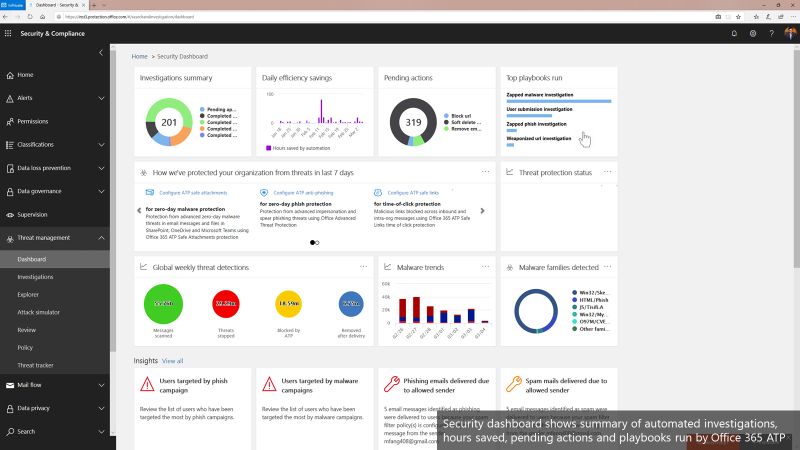
Office 365 ATP offers unparalleled protection from targeted and zero-day attacks over email and other collaboration vectors. Building over the massive threat intelligence signal available in the Microsoft Intelligent Security Graph and pairing it with sophisticated Machine Learning algorithms, Office 365 ATP offers security teams best-in-class prevention, detection and response capabilities to keep their organizations secure with stellar effectiveness and efficiency. And today we’re extremely excited to announce new Automation capabilities in Office 365 ATP that further amplify the efficiency of security teams as they investigate and respond to threats within their organization.
The broad intelligence of the Microsoft Security Graph that supports all of the Advanced Threat Protection products from Microsoft and the deep integration between them forms the backbone of Microsoft Threat Protection that offers security teams amazing capabilities to protect their organizations across their users, devices, email, applications, data and infrastructure. And the automation capabilities we’re announcing today further strengthen the overall automation story of Microsoft Threat Protection.
Security Dashboard showing summary of automated investigations
Challenges faced by SecOps today
To set some context, we continue to hear from customers that dealing with incident response quickly and effectively is a big challenge facing their SecOps teams. One key issue is the lack of available resources and expertise needed to analyze signals and respond to incidents in an efficient way. There are just too many alerts to investigate and signals to correlate. And SecOps teams are constantly struggling with budget and time.
A typical Security team member goes through the following cycle of investigation day in and day out.
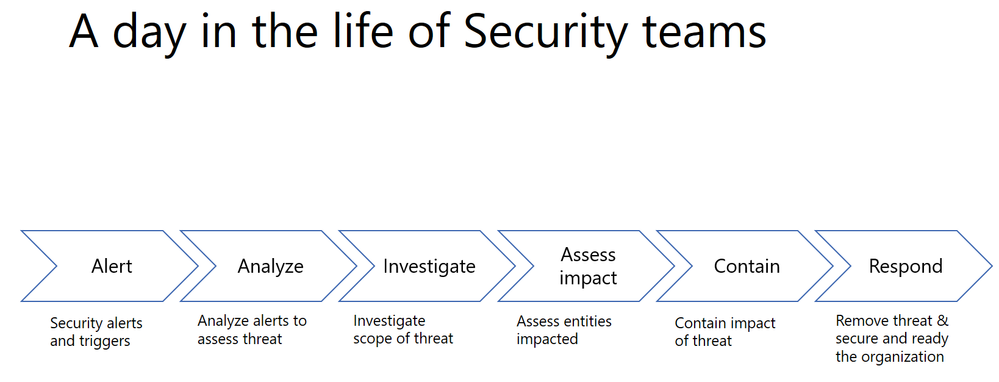
Every single security alert goes through the above process and with the huge volume of alerts that need to be looked at, it can quickly become challenging for security teams to scale. Intelligent correlation of signals and automatic investigation of alerts can significantly reduce the manual effort and time for incident response.
Automation can significantly reduce the time, effort and resources needed for incident response
Last year, we shared how Office 365 ATP can help security teams become more effective and efficient in the threat investigation and response process. This research from Forrester also revealed huge cost savings when using our Office 365 Threat Intelligence service.

The new automation capabilities in Office 365 ATP goes even further in being able to bring more effectiveness and efficiency into SecOps flows.
Introducing new security playbooks within Office 365 ATP
Security playbooks are the foundation of automated incident response. They are the back-end policies that admins can select to trigger automatic investigation. The playbooks are built off our experience with real-world security scenarios. Based on our visibility and experience into the threat landscape we’ve designed these playbooks which tackle the most frequent threats.
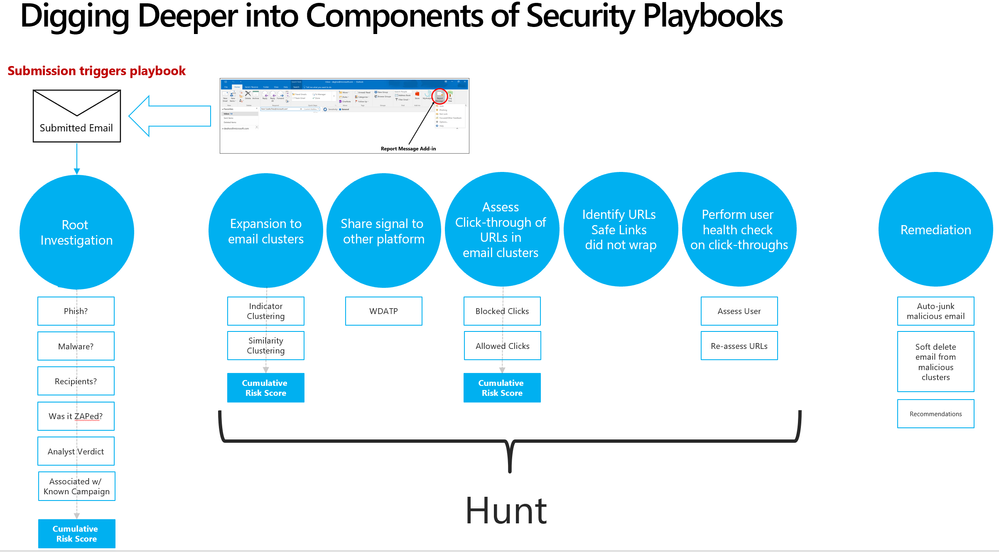 Security playbooks are the foundation of AIR
We’re delighted to announce the public preview of two playbooks that help investigate key threats and alerts within Office 365 with recommended actions for containment and mitigation.
- User reports a phishing email— This alert will trigger an automatic investigation using the User Reported Messages Playbook when users use the “Report Message” button to report a phishing email.
- User clicks on a malicious link— This alert will trigger an automatic investigation using the Weaponized URL playbook when an Office 365 ATP Safe Links protected URL clicked by a user is determined to be malicious through detonation (change in verdict) or if the user overrides (clicks through) the Office 365 ATP Safe Links warning pages.
Over the new few weeks and months we’ll continue to add even more playbooks.
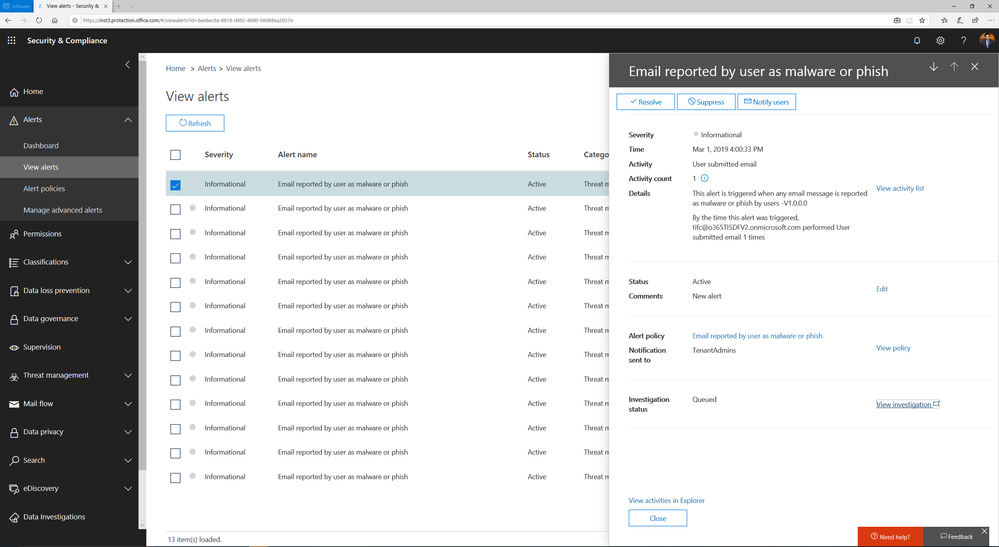 Alert automatically triggers investigation when a user reports an email as phish
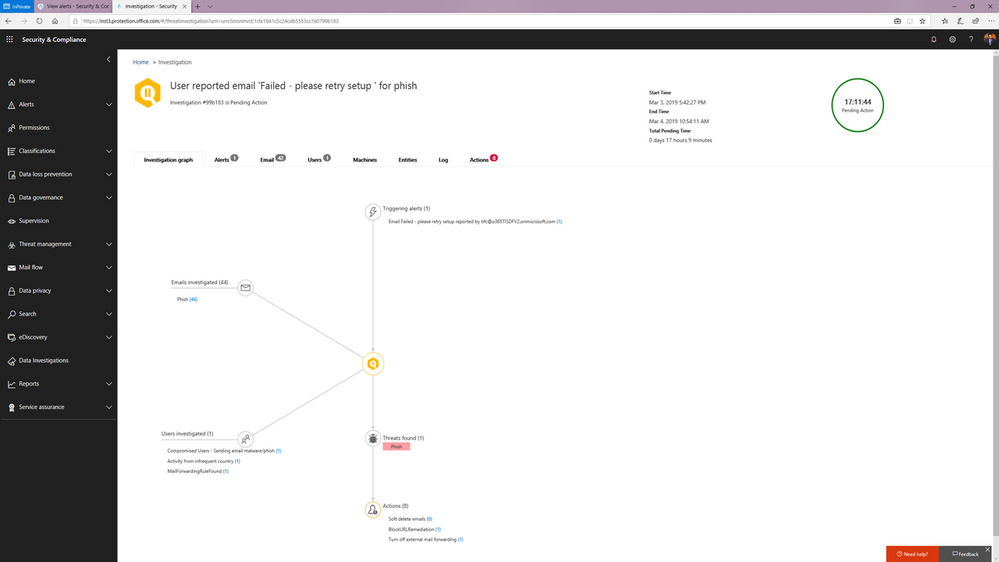 Investigation graph showing a summary of relevant emails and users with threats and recommended actions.
You can learn more about how the SecOps teams can use these playbooks in this article.
Watch below:
to see the playbooks in action.
Triggering an automated investigation from the Threat Explorer
In addition to these playbooks, we’re also adding the ability to manually trigger automated investigations from the Threat Explorer. The Threat Explorer has become an invaluable tool for many security teams to hunt for and investigate threats within the O365 productivity suite as security teams use it to search for bad actors or IOCs. With the new ability to trigger an automatic investigation from within the Threat Explorer, security teams can leverage the efficiency and effectiveness gains that come with automation as part their hunting/investigation flow. This allows them to gain visibility into any potential threat instantly with relevant recommendations.
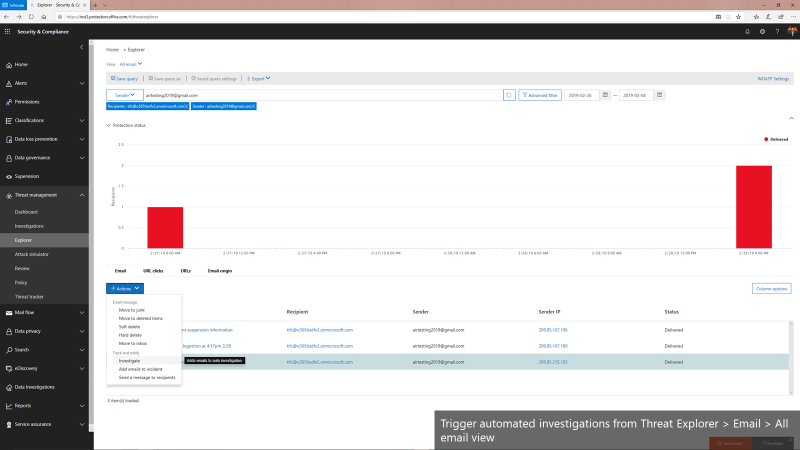 Triggering automated investigations from the Threat Explorer for All email view
We’re only getting started
Automation for incident response will become a much more important part of an enterprise-grade security solution. It can help mitigate more threats in real-time, reduce the time for detection and recovery, and ultimately, improve the efficiency, accuracy, and overall security for any organization. Just as important, it frees up time for the organization’s key security expertise to focus on more complicated problems – getting more out of their most trained experts.
The automation capabilities announced today paired with the automation within the Microsoft Defender Advanced Threat Protection offering form the backbone of the powerful integrated automated protection that comes as part of the Microsoft Threat Protection stack to enable better
detection, more insightful investigations, and more rapid remediation across multiple vectors such as emails, users and devices.
This is just the beginning. We’ll be rolling out more playbooks to address the most common threat scenarios. We invite you to try these playbooks out and provide feedback.
Office 365 ATP offers unparalleled protection from targeted and zero-day attacks over email and other collaboration vectors. Building over the massive threat intelligence signal available in the Microsoft Intelligent Security Graph and pairing it with sophisticated Machine Learning algorithms, Office 365 ATP offers security teams best-in-class prevention, detection and response capabilities to keep their organizations secure with stellar effectiveness and efficiency. And today we’re extremely excited to announce new Automation capabilities in Office 365 ATP that further amplify the efficiency of security teams as they investigate and respond to threats within their organization.
The broad intelligence of the Microsoft Security Graph that supports all of the Advanced Threat Protection products from Microsoft and the deep integration between them forms the backbone of Microsoft Threat Protection that offers security teams amazing capabilities to protect their organizations across their users, devices, email, applications, data and infrastructure. And the automation capabilities we’re announcing today further strengthen the overall automation story of Microsoft Threat Protection.
Security Dashboard showing summary of automated investigations
Challenges faced by SecOps today
To set some context, we continue to hear from customers that dealing with incident response quickly and effectively is a big challenge facing their SecOps teams. One key issue is the lack of available resources and expertise needed to analyze signals and respond to incidents in an efficient way. There are just too many alerts to investigate and signals to correlate. And SecOps teams are constantly struggling with budget and time.
A typical Security team member goes through the following cycle of investigation day in and day out.
Every single security alert goes through the above process and with the huge volume of alerts that need to be looked at, it can quickly become challenging for security teams to scale. Intelligent correlation of signals and automatic investigation of alerts can significantly reduce the manual effort and time for incident response.
Automation can significantly reduce the time, effort and resources needed for incident response
Last year, we shared how Office 365 ATP can help security teams become more effective and efficient in the threat investigation and response process. This research from Forrester also revealed huge cost savings when using our Office 365 Threat Intelligence service.
The new automation capabilities in Office 365 ATP goes even further in being able to bring more effectiveness and efficiency into SecOps flows.
Introducing new security playbooks within Office 365 ATP
Security playbooks are the foundation of automated incident response. They are the back-end policies that admins can select to trigger automatic investigation. The playbooks are built off our experience with real-world security scenarios. Based on our visibility and experience into the threat landscape we’ve designed these playbooks which tackle the most frequent threats.
Security playbooks are the foundation of AIR
We’re delighted to announce the public preview of two playbooks that help investigate key threats and alerts within Office 365 with recommended actions for containment and mitigation.
- User reports a phishing email— This alert will trigger an automatic investigation using the User Reported Messages Playbook when users use the “Report Message” button to report a phishing email.
- User clicks on a malicious link— This alert will trigger an automatic investigation using the Weaponized URL playbook when an Office 365 ATP Safe Links protected URL clicked by a user is determined to be malicious through detonation (change in verdict) or if the user overrides (clicks through) the Office 365 ATP Safe Links warning pages.
Over the new few weeks and months we’ll continue to add even more playbooks.
Alert automatically triggers investigation when a user reports an email as phish
Investigation graph showing a summary of relevant emails and users with threats and recommended actions.
You can learn more about how the SecOps teams can use these playbooks in this article.
Watch below:
to see the playbooks in action.
Triggering an automated investigation from the Threat Explorer
In addition to these playbooks, we’re also adding the ability to manually trigger automated investigations from the Threat Explorer. The Threat Explorer has become an invaluable tool for many security teams to hunt for and investigate threats within the O365 productivity suite as security teams use it to search for bad actors or IOCs. With the new ability to trigger an automatic investigation from within the Threat Explorer, security teams can leverage the efficiency and effectiveness gains that come with automation as part their hunting/investigation flow. This allows them to gain visibility into any potential threat instantly with relevant recommendations.
Triggering automated investigations from the Threat Explorer for All email view
We’re only getting started
Automation for incident response will become a much more important part of an enterprise-grade security solution. It can help mitigate more threats in real-time, reduce the time for detection and recovery, and ultimately, improve the efficiency, accuracy, and overall security for any organization. Just as important, it frees up time for the organization’s key security expertise to focus on more complicated problems – getting more out of their most trained experts.
The automation capabilities announced today paired with the automation within the Microsoft Defender Advanced Threat Protection offering form the backbone of the powerful integrated automated protection that comes as part of the Microsoft Threat Protection stack to enable better
detection, more insightful investigations, and more rapid remediation across multiple vectors such as emails, users and devices.
This is just the beginning. We’ll be rolling out more playbooks to address the most common threat scenarios. We invite you to try these playbooks out and provide feedback.
Office 365 ATP offers unparalleled protection from targeted and zero-day attacks over email and other collaboration vectors. Building over the massive threat intelligence signal available in the Microsoft Intelligent Security Graph and pairing it with sophisticated Machine Learning algorithms, Office 365 ATP offers security teams best-in-class prevention, detection and response capabilities to keep their organizations secure with stellar effectiveness and efficiency. And today we’re extremely excited to announce new Automation capabilities in Office 365 ATP that further amplify the efficiency of security teams as they investigate and respond to threats within their organization.
The broad intelligence of the Microsoft Security Graph that supports all of the Advanced Threat Protection products from Microsoft and the deep integration between them forms the backbone of Microsoft Threat Protection that offers security teams amazing capabilities to protect their organizations across their users, devices, email, applications, data and infrastructure. And the automation capabilities we’re announcing today further strengthen the overall automation story of Microsoft Threat Protection.
Security Dashboard showing summary of automated investigations
Challenges faced by SecOps today
To set some context, we continue to hear from customers that dealing with incident response quickly and effectively is a big challenge facing their SecOps teams. One key issue is the lack of available resources and expertise needed to analyze signals and respond to incidents in an efficient way. There are just too many alerts to investigate and signals to correlate. And SecOps teams are constantly struggling with budget and time.
A typical Security team member goes through the following cycle of investigation day in and day out.
Every single security alert goes through the above process and with the huge volume of alerts that need to be looked at, it can quickly become challenging for security teams to scale. Intelligent correlation of signals and automatic investigation of alerts can significantly reduce the manual effort and time for incident response.
Automation can significantly reduce the time, effort and resources needed for incident response
Last year, we shared how Office 365 ATP can help security teams become more effective and efficient in the threat investigation and response process. This research from Forrester also revealed huge cost savings when using our Office 365 Threat Intelligence service.
The new automation capabilities in Office 365 ATP goes even further in being able to bring more effectiveness and efficiency into SecOps flows.
Introducing new security playbooks within Office 365 ATP
Security playbooks are the foundation of automated incident response. They are the back-end policies that admins can select to trigger automatic investigation. The playbooks are built off our experience with real-world security scenarios. Based on our visibility and experience into the threat landscape we’ve designed these playbooks which tackle the most frequent threats.
Security playbooks are the foundation of AIR
We’re delighted to announce the public preview of two playbooks that help investigate key threats and alerts within Office 365 with recommended actions for containment and mitigation.
- User reports a phishing email— This alert will trigger an automatic investigation using the User Reported Messages Playbook when users use the “Report Message” button to report a phishing email.
- User clicks on a malicious link— This alert will trigger an automatic investigation using the Weaponized URL playbook when an Office 365 ATP Safe Links protected URL clicked by a user is determined to be malicious through detonation (change in verdict) or if the user overrides (clicks through) the Office 365 ATP Safe Links warning pages.
Over the new few weeks and months we’ll continue to add even more playbooks.
Alert automatically triggers investigation when a user reports an email as phish
Investigation graph showing a summary of relevant emails and users with threats and recommended actions.
You can learn more about how the SecOps teams can use these playbooks in this article.
Watch below:
to see the playbooks in action.
Triggering an automated investigation from the Threat Explorer
In addition to these playbooks, we’re also adding the ability to manually trigger automated investigations from the Threat Explorer. The Threat Explorer has become an invaluable tool for many security teams to hunt for and investigate threats within the O365 productivity suite as security teams use it to search for bad actors or IOCs. With the new ability to trigger an automatic investigation from within the Threat Explorer, security teams can leverage the efficiency and effectiveness gains that come with automation as part their hunting/investigation flow. This allows them to gain visibility into any potential threat instantly with relevant recommendations.
Triggering automated investigations from the Threat Explorer for All email view
We’re only getting started
Automation for incident response will become a much more important part of an enterprise-grade security solution. It can help mitigate more threats in real-time, reduce the time for detection and recovery, and ultimately, improve the efficiency, accuracy, and overall security for any organization. Just as important, it frees up time for the organization’s key security expertise to focus on more complicated problems – getting more out of their most trained experts.
The automation capabilities announced today paired with the automation within the Microsoft Defender Advanced Threat Protection offering form the backbone of the powerful integrated automated protection that comes as part of the Microsoft Threat Protection stack to enable better
detection, more insightful investigations, and more rapid remediation across multiple vectors such as emails, users and devices.
This is just the beginning. We’ll be rolling out more playbooks to address the most common threat scenarios. We invite you to try these playbooks out and provide feedback.
Office 365 ATP offers unparalleled protection from targeted and zero-day attacks over email and other collaboration vectors. Building over the massive threat intelligence signal available in the Microsoft Intelligent Security Graph and pairing it with sophisticated Machine Learning algorithms, Office 365 ATP offers security teams best-in-class prevention, detection and response capabilities to keep their organizations secure with stellar effectiveness and efficiency. And today we’re extremely excited to announce new Automation capabilities in Office 365 ATP that further amplify the efficiency of security teams as they investigate and respond to threats within their organization.
The broad intelligence of the Microsoft Security Graph that supports all of the Advanced Threat Protection products from Microsoft and the deep integration between them forms the backbone of Microsoft Threat Protection that offers security teams amazing capabilities to protect their organizations across their users, devices, email, applications, data and infrastructure. And the automation capabilities we’re announcing today further strengthen the overall automation story of Microsoft Threat Protection.
Security Dashboard showing summary of automated investigations
Challenges faced by SecOps today
To set some context, we continue to hear from customers that dealing with incident response quickly and effectively is a big challenge facing their SecOps teams. One key issue is the lack of available resources and expertise needed to analyze signals and respond to incidents in an efficient way. There are just too many alerts to investigate and signals to correlate. And SecOps teams are constantly struggling with budget and time.
A typical Security team member goes through the following cycle of investigation day in and day out.
Every single security alert goes through the above process and with the huge volume of alerts that need to be looked at, it can quickly become challenging for security teams to scale. Intelligent correlation of signals and automatic investigation of alerts can significantly reduce the manual effort and time for incident response.
Automation can significantly reduce the time, effort and resources needed for incident response
Last year, we shared how Office 365 ATP can help security teams become more effective and efficient in the threat investigation and response process. This research from Forrester also revealed huge cost savings when using our Office 365 Threat Intelligence service.
The new automation capabilities in Office 365 ATP goes even further in being able to bring more effectiveness and efficiency into SecOps flows.
Introducing new security playbooks within Office 365 ATP
Security playbooks are the foundation of automated incident response. They are the back-end policies that admins can select to trigger automatic investigation. The playbooks are built off our experience with real-world security scenarios. Based on our visibility and experience into the threat landscape we’ve designed these playbooks which tackle the most frequent threats.
Security playbooks are the foundation of AIR
We’re delighted to announce the public preview of two playbooks that help investigate key threats and alerts within Office 365 with recommended actions for containment and mitigation.
- User reports a phishing email— This alert will trigger an automatic investigation using the User Reported Messages Playbook when users use the “Report Message” button to report a phishing email.
- User clicks on a malicious link— This alert will trigger an automatic investigation using the Weaponized URL playbook when an Office 365 ATP Safe Links protected URL clicked by a user is determined to be malicious through detonation (change in verdict) or if the user overrides (clicks through) the Office 365 ATP Safe Links warning pages.
Over the new few weeks and months we’ll continue to add even more playbooks.
Alert automatically triggers investigation when a user reports an email as phish
Investigation graph showing a summary of relevant emails and users with threats and recommended actions.
You can learn more about how the SecOps teams can use these playbooks in this article.
Watch below:
to see the playbooks in action.
Triggering an automated investigation from the Threat Explorer
In addition to these playbooks, we’re also adding the ability to manually trigger automated investigations from the Threat Explorer. The Threat Explorer has become an invaluable tool for many security teams to hunt for and investigate threats within the O365 productivity suite as security teams use it to search for bad actors or IOCs. With the new ability to trigger an automatic investigation from within the Threat Explorer, security teams can leverage the efficiency and effectiveness gains that come with automation as part their hunting/investigation flow. This allows them to gain visibility into any potential threat instantly with relevant recommendations.
Triggering automated investigations from the Threat Explorer for All email view
We’re only getting started
Automation for incident response will become a much more important part of an enterprise-grade security solution. It can help mitigate more threats in real-time, reduce the time for detection and recovery, and ultimately, improve the efficiency, accuracy, and overall security for any organization. Just as important, it frees up time for the organization’s key security expertise to focus on more complicated problems – getting more out of their most trained experts.
The automation capabilities announced today paired with the automation within the Microsoft Defender Advanced Threat Protection offering form the backbone of the powerful integrated automated protection that comes as part of the Microsoft Threat Protection stack to enable better
detection, more insightful investigations, and more rapid remediation across multiple vectors such as emails, users and devices.
This is just the beginning. We’ll be rolling out more playbooks to address the most common threat scenarios. We invite you to try these playbooks out and provide feedback.
Exchange Mailbox Auditing has now been enabled by default and rolled out worldwide, with the rollout to Unified Audit Log in Security and Compliance Center still in progress. If you are an Office 365 Customer, you should be able to search and retrieve your audit data with Search-MailboxAuditLog.
As part of this change, we are also introducing the DefaultAuditSet parameter which would help you get back to the default set of verbs. DefaultAuditSet can be used to set the different action sets (Owner, Admin, Delegate) back to the service default audit events on a per-mailbox basis.
As an example, If you want to bring Owner action sets back to default for a mailbox which was on custom events for all action sets, you perform the following operations:
Set-Mailbox [username] -DefaultAuditSet Owner
Now if you verify this through Get-Mailbox, you will be able to see that AuditOwner is set to the default set of actions:
Get-Mailbox [username] | fl AuditOwner, AuditAdmin, AuditDelegate
Output:
AuditOwner : {Update, MoveToDeletedItems, SoftDelete, HardDelete, UpdateFolderPermissions, UpdateInboxRules, UpdateCalendarDelegation}
AuditAdmin : {Update, MoveToDeletedItems, SoftDelete, HardDelete, SendAs, SendOnBehalf,
UpdateCalendarDelegation}
AuditDelegate : {Move}
To remove a mailbox from the default audit set event, you can go ahead, and add custom actions to the mailbox. This would remove it from the default set of actions. However, this would also mean, that any future audit events added to the default set would not be available automatically by default, and would need to be added manually.
Find more information:
Exchange Mailbox Auditing has now been enabled by default and rolled out worldwide, with the rollout to Unified Audit Log in Security and Compliance Center still in progress. If you are an Office 365 Customer, you should be able to search and retrieve your audit data with Search-MailboxAuditLog.
As part of this change, we are also introducing the DefaultAuditSet parameter which would help you get back to the default set of verbs. DefaultAuditSet can be used to set the different action sets (Owner, Admin, Delegate) back to the service default audit events on a per-mailbox basis.
As an example, If you want to bring Owner action sets back to default for a mailbox which was on custom events for all action sets, you perform the following operations:
Set-Mailbox [username] -DefaultAuditSet Owner
Now if you verify this through Get-Mailbox, you will be able to see that AuditOwner is set to the default set of actions:
Get-Mailbox [username] | fl AuditOwner, AuditAdmin, AuditDelegate
Output:
AuditOwner : {Update, MoveToDeletedItems, SoftDelete, HardDelete, UpdateFolderPermissions, UpdateInboxRules, UpdateCalendarDelegation}
AuditAdmin : {Update, MoveToDeletedItems, SoftDelete, HardDelete, SendAs, SendOnBehalf,
UpdateCalendarDelegation}
AuditDelegate : {Move}
To remove a mailbox from the default audit set event, you can go ahead, and add custom actions to the mailbox. This would remove it from the default set of actions. However, this would also mean, that any future audit events added to the default set would not be available automatically by default, and would need to be added manually.
Find more information:
Exchange Mailbox Auditing has now been enabled by default and rolled out worldwide, with the rollout to Unified Audit Log in Security and Compliance Center still in progress. If you are an Office 365 Customer, you should be able to search and retrieve your audit data with Search-MailboxAuditLog.
As part of this change, we are also introducing the DefaultAuditSet parameter which would help you get back to the default set of verbs. DefaultAuditSet can be used to set the different action sets (Owner, Admin, Delegate) back to the service default audit events on a per-mailbox basis.
As an example, If you want to bring Owner action sets back to default for a mailbox which was on custom events for all action sets, you perform the following operations:
Set-Mailbox [username] -DefaultAuditSet Owner
Now if you verify this through Get-Mailbox, you will be able to see that AuditOwner is set to the default set of actions:
Get-Mailbox [username] | fl AuditOwner, AuditAdmin, AuditDelegate
Output:
AuditOwner : {Update, MoveToDeletedItems, SoftDelete, HardDelete, UpdateFolderPermissions, UpdateInboxRules, UpdateCalendarDelegation}
AuditAdmin : {Update, MoveToDeletedItems, SoftDelete, HardDelete, SendAs, SendOnBehalf,
UpdateCalendarDelegation}
AuditDelegate : {Move}
To remove a mailbox from the default audit set event, you can go ahead, and add custom actions to the mailbox. This would remove it from the default set of actions. However, this would also mean, that any future audit events added to the default set would not be available automatically by default, and would need to be added manually.
Find more information:
Exchange Mailbox Auditing has now been enabled by default and rolled out worldwide, with the rollout to Unified Audit Log in Security and Compliance Center still in progress. If you are an Office 365 Customer, you should be able to search and retrieve your audit data with Search-MailboxAuditLog.
As part of this change, we are also introducing the DefaultAuditSet parameter which would help you get back to the default set of verbs. DefaultAuditSet can be used to set the different action sets (Owner, Admin, Delegate) back to the service default audit events on a per-mailbox basis.
As an example, If you want to bring Owner action sets back to default for a mailbox which was on custom events for all action sets, you perform the following operations:
Set-Mailbox [username] -DefaultAuditSet Owner
Now if you verify this through Get-Mailbox, you will be able to see that AuditOwner is set to the default set of actions:
Get-Mailbox [username] | fl AuditOwner, AuditAdmin, AuditDelegate
Output:
AuditOwner : {Update, MoveToDeletedItems, SoftDelete, HardDelete, UpdateFolderPermissions, UpdateInboxRules, UpdateCalendarDelegation}
AuditAdmin : {Update, MoveToDeletedItems, SoftDelete, HardDelete, SendAs, SendOnBehalf,
UpdateCalendarDelegation}
AuditDelegate : {Move}
To remove a mailbox from the default audit set event, you can go ahead, and add custom actions to the mailbox. This would remove it from the default set of actions. However, this would also mean, that any future audit events added to the default set would not be available automatically by default, and would need to be added manually.
Find more information:
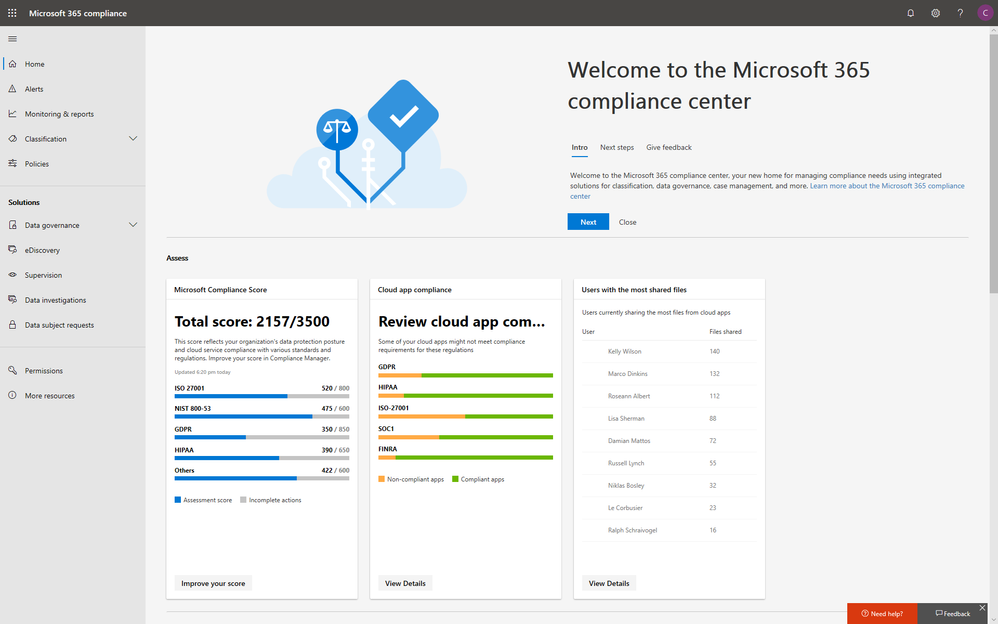
With electronic data growing exponentially across the digital estate and the increased number of new privacy regulations emerging, consumers are more aware of their privacy rights now more than ever. Compliance and privacy professionals need more tools to help them safeguard sensitive information and reduce compliance risks. To empower organizations to more effectively and efficiently take control of their data privacy, we introduced the new Microsoft 365 compliance center in January and are excited to announce its general availability today!
The new Microsoft 365 compliance center enables you to assess compliance risks and posture, protect and govern your data, and respond to data discovery requests in a timely manner. Here, we highlight several key compliance capabilities in the three scenarios below.
Simplify assessment of compliance risks and posture with actionable insights
On the Microsoft 365 compliance center homepage, you can easily find actionable insights in the Assess, Protect, and Respond sections with signals across the Microsoft 365 feature set. The homepage is the go-to dashboard for compliance and privacy teams to examine their organization’s data compliance posture.
To help with your regulatory compliance, we’ve brought in score insights from Compliance Manager, a cloud-based tool that helps you perform on-going risk assessments, and provides step-by-step guidance on implementing compliance controls. It also tracks and records your compliance activities to help you prepare for internal and external audits. On the Compliance Manager card, you can find a quick summary of your current compliance posture for regulations and standards including: GDPR, ISO 27001, and NIST 800-53. From here, you can visit Compliance Manager to improve your Microsoft Compliance Score.
In addition to the score, you can also find insights from Microsoft Cloud App Security (MCAS) including: third-party application usage, application compliance statuses, both the users and files shared most from cloud applications, and shadow IT applications as well. Additionally, with signals from Data Loss Prevention, you can quickly examine your DLP policy matches and create new policies to protect your sensitive data.
Integrated protection and governance of sensitive data across devices, apps, and cloud services
To help you better protect your digital estate across devices, apps, and cloud services, we aggregated the signals for risky compliance activities in your organization’s environment, and helped you highlight the high severity ones with details so that you take the appropriate actions to remediate risks.
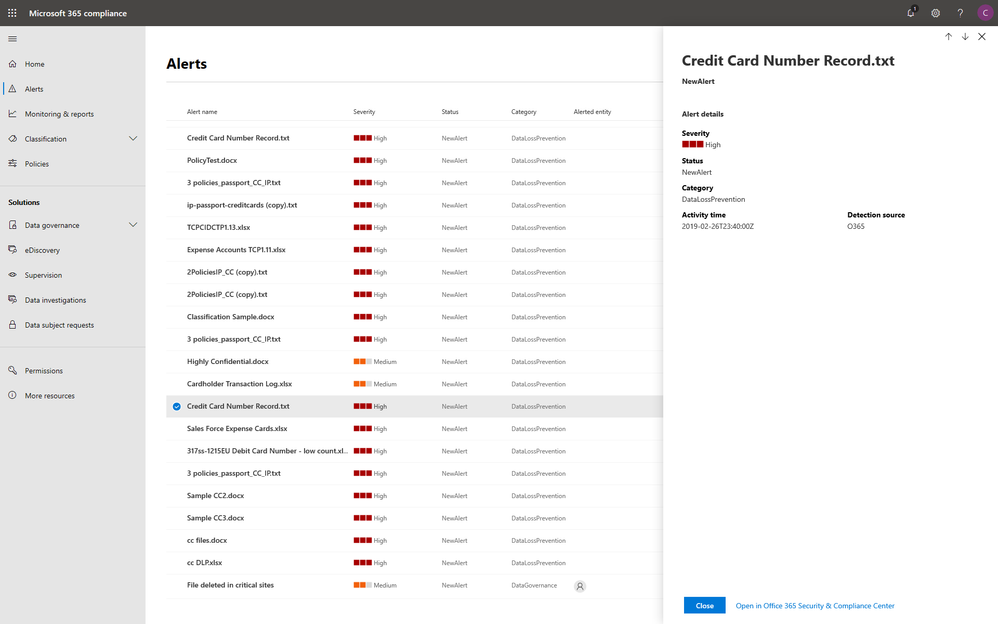
Within the new compliance center, you can also classify your most important data with sensitivity and retention labels, and configure protection and governance policies with a unified experience. Additionally, the Label analytics functionality in public preview gives you label insights across your Office 365 and non-Office 365 workloads, helping you analyze and validate your label usage.
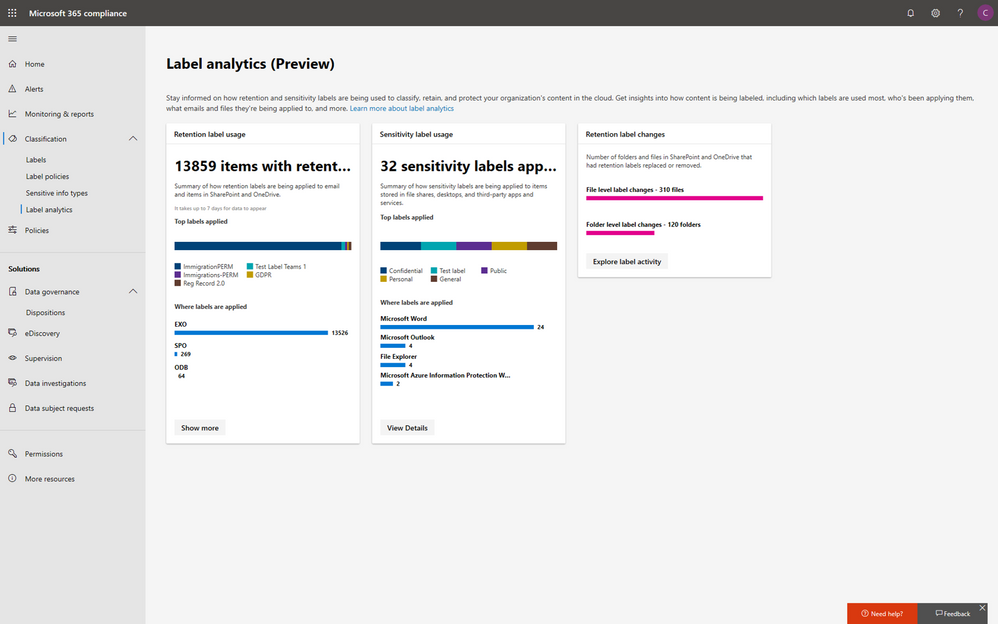
Under the solutions area, you can easily access compliance features that help you better govern your data. The disposition review under Data governance helps you review the content when it reaches the end of its retention period, for you to make a final decision about keeping or deleting the data. Additionally, Supervision helps organization meet communication-monitoring requirements to address internal policies or regulatory compliance. You can establish policies with intelligent conditions and identify Teams or users and the related channels or chat messages to be included in the supervision policy. Supervisors can then review content with the new built-in review experience to tag, escalate, and bulk resolve.
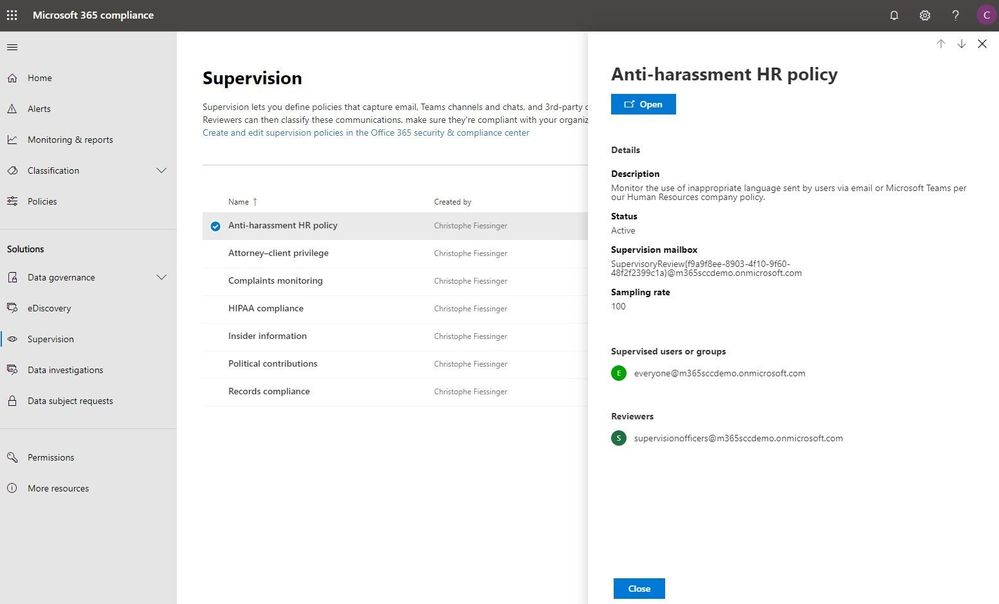
Intelligently respond to data discovery requests by leveraging AI to find the most relevant data
The cost of compliance has continuously increased in the past few years due to new regulations like GDPR, and the growing amount of electronic data. Organizations need assistance to discover the most relevant data to respond to regulatory requests like the Data Subject Access Requests (DSARs).
In the new Microsoft 365 compliance center, you can access the Data Subject Requests tool to create DSR cases and identify your employees’ personal data with built-in content search capabilities. With Advanced eDiscovery, you can reduce the cost and risk of common eDiscovery processes with custodian management, hold notifications, working sets and review and redact functionality built into Microsoft 365 directly.
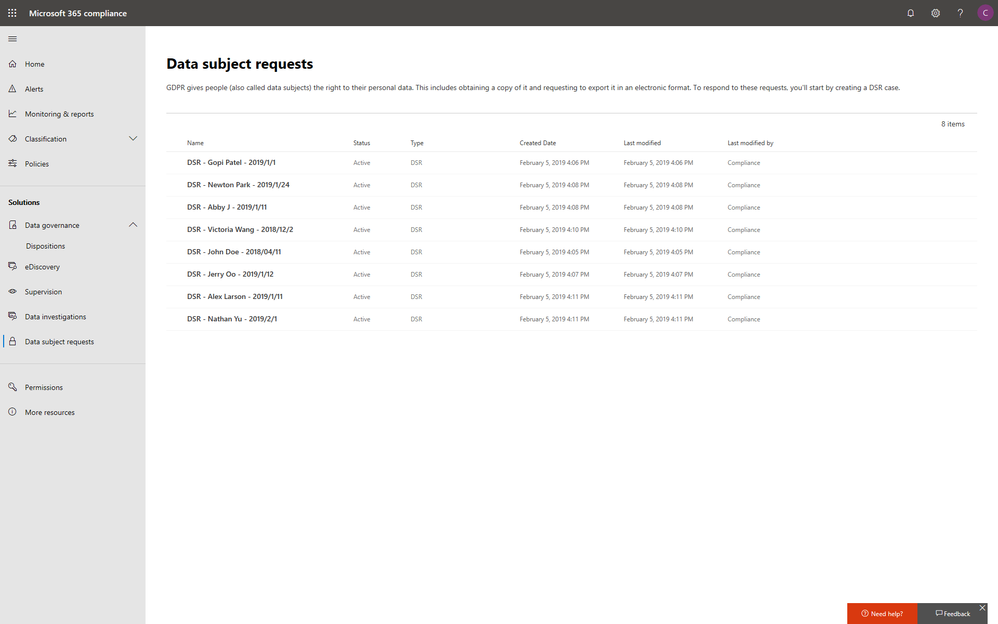
In addition to data discovery, Microsoft 365 compliance center also provides you with access to data investigations solution in preview, which helps organizations to search for leaked or unprotected sensitive data and take actions like deleting emails or documents to remediate risks.
We will keep adding more compliance solutions like audit log search, content search, retention policies, archiving and more in the Microsoft 365 compliance center soon to reach parity with the solutions we provide in Office 365 Security & Compliance Center. Please don’t hesitate to give us feedback from the feedback button in the new center.
Get started today
To get the new Microsoft 365 security center and Microsoft 365 compliance center, your organization must have a subscription to Microsoft 365 E3 or E5, or a Volume Licensing equivalent (which consists of Office 365 Enterprise E3 or E5, Enterprise Mobility + Security E3 or E5, and Windows 10 Enterprise E3/E5). We plan to expand access to additional subscriptions and license types later in the year. Users must be assigned the Global Administrator, Compliance Administrator, or Compliance Data Administrator role in Azure Active Directory to access the new Microsoft 365 compliance center.
You can start using the Microsoft 365 compliance center today by visiting compliance.microsoft.com or through the Microsoft 365 admin center. Learn more about the new experience in our technical supporting document.
With electronic data growing exponentially across the digital estate and the increased number of new privacy regulations emerging, consumers are more aware of their privacy rights now more than ever. Compliance and privacy professionals need more tools to help them safeguard sensitive information and reduce compliance risks. To empower organizations to more effectively and efficiently take control of their data privacy, we introduced the new Microsoft 365 compliance center in January and are excited to announce its general availability today!
The new Microsoft 365 compliance center enables you to assess compliance risks and posture, protect and govern your data, and respond to data discovery requests in a timely manner. Here, we highlight several key compliance capabilities in the three scenarios below.
Simplify assessment of compliance risks and posture with actionable insights
On the Microsoft 365 compliance center homepage, you can easily find actionable insights in the Assess, Protect, and Respond sections with signals across the Microsoft 365 feature set. The homepage is the go-to dashboard for compliance and privacy teams to examine their organization’s data compliance posture.
To help with your regulatory compliance, we’ve brought in score insights from Compliance Manager, a cloud-based tool that helps you perform on-going risk assessments, and provides step-by-step guidance on implementing compliance controls. It also tracks and records your compliance activities to help you prepare for internal and external audits. On the Compliance Manager card, you can find a quick summary of your current compliance posture for regulations and standards including: GDPR, ISO 27001, and NIST 800-53. From here, you can visit Compliance Manager to improve your Microsoft Compliance Score.
In addition to the score, you can also find insights from Microsoft Cloud App Security (MCAS) including: third-party application usage, application compliance statuses, both the users and files shared most from cloud applications, and shadow IT applications as well. Additionally, with signals from Data Loss Prevention, you can quickly examine your DLP policy matches and create new policies to protect your sensitive data.
Integrated protection and governance of sensitive data across devices, apps, and cloud services
To help you better protect your digital estate across devices, apps, and cloud services, we aggregated the signals for risky compliance activities in your organization’s environment, and helped you highlight the high severity ones with details so that you take the appropriate actions to remediate risks.
Within the new compliance center, you can also classify your most important data with sensitivity and retention labels, and configure protection and governance policies with a unified experience. Additionally, the Label analytics functionality in public preview gives you label insights across your Office 365 and non-Office 365 workloads, helping you analyze and validate your label usage.
Under the solutions area, you can easily access compliance features that help you better govern your data. The disposition review under Data governance helps you review the content when it reaches the end of its retention period, for you to make a final decision about keeping or deleting the data. Additionally, Supervision helps organization meet communication-monitoring requirements to address internal policies or regulatory compliance. You can establish policies with intelligent conditions and identify Teams or users and the related channels or chat messages to be included in the supervision policy. Supervisors can then review content with the new built-in review experience to tag, escalate, and bulk resolve.
Intelligently respond to data discovery requests by leveraging AI to find the most relevant data
The cost of compliance has continuously increased in the past few years due to new regulations like GDPR, and the growing amount of electronic data. Organizations need assistance to discover the most relevant data to respond to regulatory requests like the Data Subject Access Requests (DSARs).
In the new Microsoft 365 compliance center, you can access the Data Subject Requests tool to create DSR cases and identify your employees’ personal data with built-in content search capabilities. With Advanced eDiscovery, you can reduce the cost and risk of common eDiscovery processes with custodian management, hold notifications, working sets and review and redact functionality built into Microsoft 365 directly.
In addition to data discovery, Microsoft 365 compliance center also provides you with access to data investigations solution in preview, which helps organizations to search for leaked or unprotected sensitive data and take actions like deleting emails or documents to remediate risks.
We will keep adding more compliance solutions like audit log search, content search, retention policies, archiving and more in the Microsoft 365 compliance center soon to reach parity with the solutions we provide in Office 365 Security & Compliance Center. Please don’t hesitate to give us feedback from the feedback button in the new center.
Get started today
To get the new Microsoft 365 security center and Microsoft 365 compliance center, your organization must have a subscription to Microsoft 365 E3 or E5, or a Volume Licensing equivalent (which consists of Office 365 Enterprise E3 or E5, Enterprise Mobility + Security E3 or E5, and Windows 10 Enterprise E3/E5). We plan to expand access to additional subscriptions and license types later in the year. Users must be assigned the Global Administrator, Compliance Administrator, or Compliance Data Administrator role in Azure Active Directory to access the new Microsoft 365 compliance center.
You can start using the Microsoft 365 compliance center today by visiting compliance.microsoft.com or through the Microsoft 365 admin center. Learn more about the new experience in our technical supporting document.