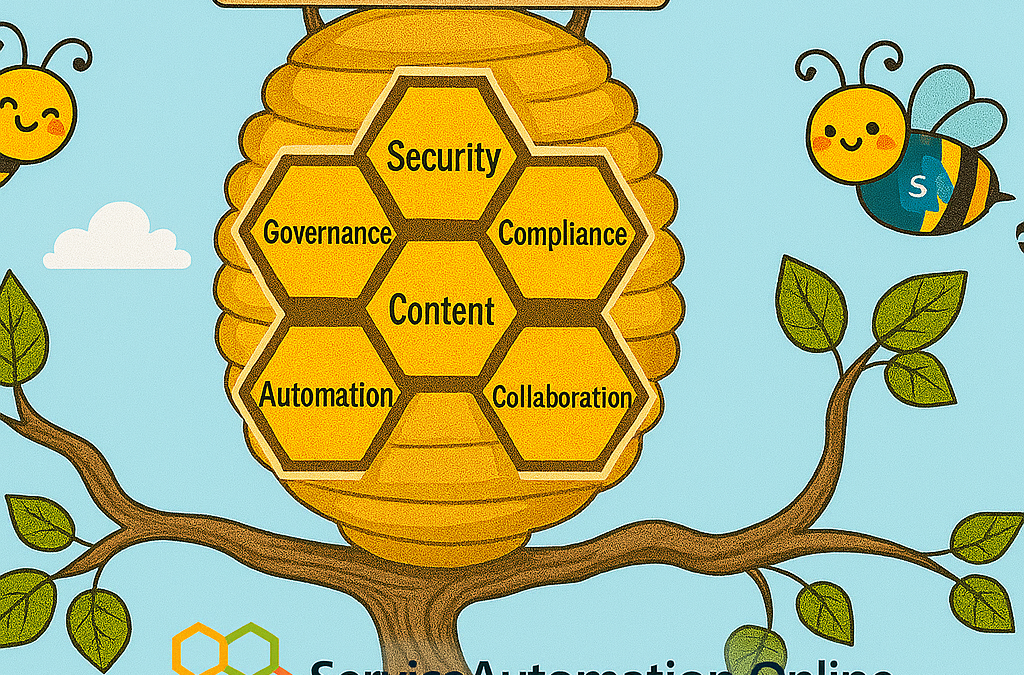
🐝 SharePoint CoPilot Governance and Beekeeping: A Buzz-Worthy Comparison
In the world of digital collaboration, SharePoint is the hive—teeming with activity, rich with resources, and vital to collaboration. But just like a real hive, it doesn’t thrive on chaos. That’s where governance comes in. And oddly enough, the best way to understand SharePoint governance might just be… beekeeping.
Let’s suit up and explore how Microsoft Copilot and good governance practices keep your SharePoint buzzing smoothly—without getting stung.
🧭 The Queen Bee: Governance Strategy
In a beehive, the queen sets the tone. She doesn’t micromanage, but her presence ensures order, purpose, and continuity. In SharePoint, your governance strategy is the queen. It defines:
Who can do what (permissions and roles)
Where things go (site architecture and taxonomy)
How things are maintained (lifecycle policies and compliance)
Without a clear strategy, your SharePoint hive risks fragmentation, duplication, and data sprawl. Copilot helps by surfacing governance insights, suggesting policy improvements, and guiding admins toward best practices—like a seasoned beekeeper whispering to the queen.
🛠️ Worker Bees: Users and Automation
Worker bees are the backbone of the hive. They gather data (nectar), build structures (combs), and keep things clean. In SharePoint, your users and automated workflows play this role.
But without guidance, even the most diligent workers can create clutter—unlabelled files, orphaned sites, or sensitive data exposed. Copilot steps in with intelligent nudges:
“This document hasn’t been accessed in 6 months—should we archive it?”
“This site has no owner—want to assign one?”
“These permissions look risky—want to review them?”
It’s like having a smart smoker tool to calm the hive and keep things orderly.
🧹 Hive Hygiene: Lifecycle and Cleanup
Beekeepers regularly inspect hives, remove dead combs, and prevent disease. SharePoint governance needs the same vigilance:
Retention policies ensure old content doesn’t clog the system
Metadata standards keep search efficient
Site reviews prevent zombie sites from haunting your intranet
Copilot assists by automating cleanup suggestions, flagging stale content, and even helping enforce naming conventions. It’s your digital hive toolset—always ready to tidy up.
🛡️ Guard Bees: Security and Compliance
Every hive has guard bees—protecting the entrance and repelling threats. In SharePoint, governance ensures your data is secure and compliant:
Sensitivity labels protect confidential info
Audit logs track who did what, when
Access reviews prevent privilege creep
Copilot helps admins monitor these defences, offering real-time insights and proactive alerts. It’s like having a swarm of vigilant guards, minus the stingers.
🌼 Pollination: Collaboration and Growth
Healthy hives don’t just survive—they pollinate. They spread value across ecosystems. SharePoint governance, when done right, enables:
Seamless collaboration across teams
Discoverability of knowledge
Scalable growth without chaos
Copilot enhances this by making governance approachable—turning complex policies into conversational guidance, and empowering users to self-serve without breaking the rules.
🐝 Final Buzz
Beekeeping isn’t just about honey—it’s about harmony. SharePoint governance, aided by Copilot, ensures your digital hive is productive, secure, and sustainable. So whether you’re an IT admin or a curious contributor, remember: good governance is the nectar that keeps collaboration sweet.
Now go forth and tend your hive—with Copilot as your trusty smoker and bee suit.
Thoughtless SharePoint Site Provisioning: The Hidden Cost of Convenience
In the age of rapid collaboration and cloud-first strategies, provisioning SharePoint sites has never been easier. But with great power comes great potential for chaos. When sites are created without proper analysis, planning, or governance, organisations often find themselves buried under a mountain of sprawl, broken workflows, and compliance nightmares.
Let’s unpack why this practice is risky—and explore real-world examples where it’s gone wrong.
🚨 The Problem: Convenience Over Strategy
Provisioning a SharePoint site is just a few clicks away. But when those clicks happen without:
Purpose definition
Information architecture planning
Governance alignment
Security and compliance review
…you’re not building a solution—you’re planting a ticking time bomb.
🔍 Real-World Failures from Poor Site Provisioning
The ROT Tsunami: Redundant, Obsolete, Trivial Data
A global consultancy allowed unrestricted site creation across departments. Within a year, they had over 2,000 SharePoint sites—many duplicating the same content. The result?
20%+ of their data was ROT (Redundant, Obsolete, Trivial)1
Search performance degraded
Storage limits were exceeded, triggering Microsoft’s read-only mode
Cleanup took six months and required external consultants
“We thought we were empowering teams. We ended up drowning in digital clutter.” — IT Manager, anonymous case study
Broken Provisioning Templates: The Automation Trap
An IT manager at a mid-sized firm used a custom provisioning tool to create sites based on PnP templates. Unfortunately, the tool wasn’t tested for edge cases. Several sites failed to provision correctly, leaving users with half-configured environments and broken permissions2.
No document libraries were created
Navigation links pointed to non-existent pages
Users lost trust in the platform
“We had to manually rebuild sites and reapply templates via PowerShell. It was a governance nightmare.” — Microsoft Q&A thread2
The Collaboration Mirage: Failed Adoption
At a large enterprise, a SharePoint site was provisioned to replace an existing intranet without stakeholder input. The new site had:
No migration plan
No redirect strategy
No training or onboarding
Despite its modern design, users clung to the legacy site. Adoption stalled, and the new site became a ghost town.
“We built a beautiful site. Nobody came.” — Curtis Hughes, Collab365 Summit3
🧭 Why Thoughtful Provisioning Matters
✅ 1. Purpose-Driven Architecture
Every site should serve a defined purpose—project, department, community—with clear content types and lifecycle expectations.
✅ 2. Governance Alignment
Provisioning should trigger automated policies for:
Retention
Sensitivity labels
External sharing controls
Audit logging
✅ 3. Information Architecture Planning
Define:
Navigation structure
Metadata taxonomy
Content types
Permissions model
✅ 4. User Experience and Adoption
Involve stakeholders early. Design with their workflows in mind. Provide training and feedback loops.
🛠️ Geoff’s Governance Checklist for Site Provisioning
Before provisioning a site, ask:
Question
Why It Matters
What is the site’s purpose?
Prevents duplication and ROT
Who owns the site?
Enables lifecycle and compliance tracking
What content types will be stored?
Drives metadata and retention policies
Who needs access?
Ensures proper permissions and security
How will the site be maintained?
Avoids orphaned or abandoned sites
Is this replacing an existing site?
Triggers migration and redirect planning
🧩 Final Thoughts
Provisioning a SharePoint site is not just a technical task—it’s a governance decision. Without thoughtful analysis, you risk building digital silos, eroding user trust, and violating compliance standards.
Stop chasing problems and start preventing them. Monitor Alerts flips the script for Power Platform admins. Instead of manually checking dashboards, you can define custom health thresholds and get notifications when apps or flows start slipping. No guesswork, no endless refresh marathons—just proactive control. Built into the Power Platform admin center and requiring no setup, Monitor Alerts works across canvas apps, model-driven apps, cloud flows, and desktop flows, giving admins the power to act before users notice a problem.
Watch how easy it is to create an alert, catch a threshold breach, and take guided action—without living on dashboards.
Why Monitor Alerts Matters
When incidents hit, every minute counts. Historically, admins had to log into Monitor and scan metrics to catch issues. Monitor Alerts changes that by letting you define what “healthy” means and notifying you when reality drifts below that bar.
Benefits include:
Fewer surprises: Alerts only when conditions you care about are met.
Faster response: Go straight from alert to action.
Focus on fixes, not hunting for issues.
Where It Lives
Monitor Alerts are available in the following context:
Audience: Tenant administrators and environment administrators
Surface: Monitor in the Power Platform admin center
Availability: Public preview
Setup: None required—start using it immediately
Monitor already provides operational health metrics and actionable recommendations. Alerts add an early-warning layer so you can react before issues escalate.
What You Can Alert On
Monitor Alerts currently supports:
Canvas apps
Model-driven apps
Cloud flows
Desktop flows
Examples include:
App load times exceeding thresholds
Spikes in flow failures in critical environments
Degradation in availability for executive-facing apps
Ever had a critical app crash at the worst possible moment, or a vital flow suddenly stop sending emails? With Monitor, you don’t have to wait for end-users to complain. Now generally available and enabled by default, no setup required, Monitor gives makers and admins real-time visibility, powerful metrics, and actionable recommendations to keep apps and automations running smoothly. From canvas and model-driven apps to cloud and desktop flows, Monitor helps you identify issues early, understand root causes, and optimize performance proactively—all from a single, integrated experience.
Power Platform Monitor enables operational insights for administratorsacross environments
Power Apps Monitor empowers makers with operational insights into the apps that they own or co-author
Monitor is available in the Power Platform admin center and in Power Apps at make.powerapps.com. This is a must-have business tool that will empower makers and administrators with deeper visibility into the operational health of their business-critical apps and automations.
Visibility that scales with your role
Monitor is designed to meet the needs of makers, Center of Excellence teams, Operations teams, and administrators. Makers can now access performance and health insights for the apps they own or co-author directly in make.powerapps.com. Additionally, people with administrative and governance responsibilities can use Monitor in the Power Platform admin center to monitor resources, enabling cross-tenant oversight.
This dual-surface approach ensures that everyone, from individual app builders to Center of Excellence teams, can identify issues faster, understand root causes, and take informed action.
What’s included
Monitor supports operational health metrics and recommendations for:
Canvas apps – available in both Power Apps and Power Platform Monitor
Model-driven apps – available in both surfaces
Cloud flows – available in Power Platform Monitor
Desktop flows – available in Power Platform Monitor
These insights go beyond raw telemetry. Monitor surfaces contextual recommendations, such as optimizing Power FX code to improve load time in canvas apps or identifying bottlenecks in flow execution, so you can improve performance and reliability without guesswork. We’re also excited to introduce configurable alerts, coming soon! These alerts will proactively monitor the health of your resources and notify you when the performance dips, so you can take action before issues escalate.
Built for action, not just observation
Monitor isn’t just about dashboards, it’s about driving outcomes. With this release, you can:
Quickly identify underperforming resources
Understand the impact of issues on users and business processes
Take guided steps to resolve problems before they escalate
And because Monitor is integrated into the tools you already use, there’s no need to switch contexts or learn a new interface.
Available now & no setup required
Monitor is now generally available and enabled by default. No configuration is needed to get started. Simply head to:
We’re entering the age of AI agents, a transformative moment reshaping the landscape of business applications and platforms. AI agents aren’t just making incremental improvements, they’re helping to redefine productivity and can fundamentally change how work gets done.
Published today, the 2025 release wave 2 for Microsoft Dynamics 365, Microsoft Power Platform, and Copilot offerings introduces new and improved capabilities that help organizations to harness the full potential of this new era. These plans compile new capabilities slated for release between October 2025 and March 2026. Integral to the wave 2 plans, AI assistants and agents not only help humans with day-to-day tasks, but also act as proactive partners to drive better business outcomes. Our upcoming release brings that vision to life, helping to make AI not just accessible but an essential component in daily operations. Whether it’s enabling sellers to close deals faster, providing service teams real-time trusted knowledge, or empowering finance professionals with AI-driven reconciliation and analysis, these enhancements can be transformative to the way we all work.
Be sure to stay updated on the latest features and create your personalized release plan using the release planner.
Highlights from Dynamics 365
The 2025 release wave 2 for Dynamics 365 brings new innovation to transform functions across your business.
Microsoft Dynamics 365 Customer Insights – Data enhances Microsoft Copilot and agents with real-time, unified customer profiles, enabling teams to act on insights within their workflow. With enriched data, seamless platform integration, and faster processing, businesses can deliver timely, personalized experiences that boost engagement and conversions.
Microsoft Dynamics 365 Customer Insights – Journeys empowers businesses to craft personalized, AI-driven customer experiences across all touchpoints. With Copilot, agents, and enhanced orchestration tools, teams can engage the right audiences at scale, streamline lead generation, and accelerate growth.
Microsoft Dynamics 365 Sales brings the power of AI to help sellers achieve their targets and automate busywork. Microsoft Copilot delivers actionable insights in the flow of work, while AI agents research and engage leads, drive purchase intent, and proactively bring key insights and emergent deal risks—helping sellers close more deals faster. A reimagined interface reorients sellers from data to insights. Watch this video to discover the new and enhanced features in this release wave for Dynamics 365 Sales.
Microsoft Dynamics 365 Customer Service continues to enhance agentic and Copilot capabilities for case and knowledge management, as well as AI-driven routing.
Microsoft Dynamics 365 Contact Center continues to enhance agentic and Copilot capabilities to automate the service journey across digital and voice channels, along with the introduction of new omnichannel and supervisor capabilities in the 2025 release wave 2.
Microsoft Dynamics 365 Field Service will deliver AI agents, enhanced scheduling tools, mobile usability improvements, and deeper Microsoft 365 integration in the upcoming release wave. With innovations across inspections, vendor coordination, and connectivity with Microsoft Dynamics 365 Project Operations, Field Service empowers organizations to deliver smarter, faster, and more seamless service at scale.
Microsoft Dynamics 365 Finance brings global-scale finance and agentic operations to our customers, including agents that can lead to faster financial close, and provide additional automation and optimization across large scale operations, as well as enhancements to business performance analytics and planning solutions.
Microsoft Dynamics 365 Supply Chain Management can enhance demand planning with event and promotion forecasting, and help improve quality management for sample handling; and the Supplier Communications Agent will automate vendor interactions. New supplier engagement tools and warehouse app upgrades will also be introduced to further streamline operations and boost efficiency.
Microsoft Dynamics 365 Project Operations will continue to deliver powerful enhancements across the project lifecycle. These include improved mobile and browser experiences for time and expense, better project planning with enterprise custom fields, streamlined billing and invoicing workflows, and expanded support for stocked items, investment projects, and migrations to the modern architecture.
Microsoft Dynamics 365 Human Resources can enhance the hire-to-retire journey with Microsoft Entra ID and Microsoft Viva Connections integration to help reduce duplication. New agentic capabilities will be introduced to streamline onboarding with guided experiences and automation. Recruiter assist will also now support job description generation and interview assistance, helping to improve efficiency across hiring and onboarding.
Microsoft Dynamics 365 Commerce advances in-store experiences by providing a mobile-first point-of-sale that provides business continuity even during a business outage. Improvements to the Adyen payment connector allows modern payments like Pay by Link across channels, offering more purchasing options for omnichannel customers. Additionally, omnichannel unified pricing enables retailers to establish more intricate pricing structures, helping them remain competitive.
Microsoft Dynamics 365 Business Central introduces AI agents to enhance efficiency and automation in the 2025 release wave 2. These agents seamlessly integrate to execute complex tasks, generate reports, automate processes, and optimize order creation using natural language processing. Additionally, this release focuses on quality management, subcontracting, sustainability, and e-document capabilities.
Highlights from Microsoft Power Platform and Microsoft Copilot Studio
2025 release wave 2 updates for Microsoft Power Platform bring new and updated ways for organizations to analyze, act on, and automate data to digitally transform their businesses.
Microsoft Copilot Studio continues its journey to make agent creation and operation even easier and more powerful with autonomous agents in Microsoft 365 Copilot, the ability to build complete teams of agents that work seamlessly together, and improved governance for enterprise scalability. Copilot Studio will offer even deeper integration with Azure AI Foundry and the Microsoft Graph, helping to ensure your agents can use the latest AI technology in coordination with your data in Microsoft Graph. Watch this video to discover how the latest enhancements to Copilot Studio can benefit your business.
Microsoft Power Apps enhances human and agent collaboration with a new agent feed to supervise the work of agents and extensible built-in agents for common tasks like enter, explore, visualize, and summarize data. Bring business problems to Plan Designer and a team of agents will help you build enterprise solutions, including apps, agents, Microsoft Power BI reports, and more. Vibe code with the App Agent to create data-connected experiences—just describe what you need or provide an image, and it can be done.
Microsoft Power Pages enables businesses to build secure, data-driven portals effortlessly. In this wave, we will further expedite site building for low-code makers and pro developers to help build intelligent sites for your employees, customers, and partners. The introduction of enhanced security agent features will further empower low-code makers, pro developers, and admins with actionable insights and abilities for securing their websites.
Microsoft Power Automate is transforming how enterprises automate complex business processes through new human-in-the-loop experiences, such as advanced approvals and AI-native capabilities, such as generative actions and intelligent document processing. To manage complex automations at scale, a comprehensive suite of governance, observability, and security controls will be introduced to the Automation Center and Power Platform admin center.
Microsoft Dataverse continues to serve as a trusted low-code data platform, enabling the creation of scalable agents, Copilot applications, and automations. This update introduces enhancements to core agentic capabilities, including Dataverse for Agents and Dataverse Search to support smarter, AI-ready experiences. New features such as Dataverse Model Context Protocol (MCP) Server and AI-powered business logic tools further expand the ability to build dynamic, intelligent solutions grounded in enterprise data.
Microsoft Power Platformgovernance and administration will become the unified governance hub for managing intelligent agents, agent-driven apps, and automated workflows across the Microsoft ecosystem in this release wave. This will provide a secure, governable, reliable platform for agent development.
Updates to Copilot offerings
Agents for Microsoft 365 Copilot help maximize business impact across sales, service, and finance. Learn more about the 2025 release wave 2 updates for Copilot offerings. Agent updates for sales will help sellers work smarter, engage strategically, and close deals faster. Agent updates for service will expand CRM connectivity and enhance email insights and drafting—all within the tools reps use daily. Updates for finance will offer easily customizable agents that can be launched from familiar tools like Excel, boosting efficiency and insight.
Starting August 4, 2025, customers and partners can validate the latest features in a non-production environment. These updates include user experience enhancements that will be automatically enabled in production environments by October 2025. Take advantage of the early access period to test these updates and effectively plan for your customer rollout. Explore the 2025 release wave 2 early access features for Dynamics 365 and Microsoft Power Platform or visit the early access FAQ page for more information.
For a complete list of new capabilities, please refer to the Dynamics 365 2025 release wave 2 plan, the Microsoft Power Platform 2025 release wave 2 plan, and Copilot offerings 2025 release wave 2. We also encourage you to share your feedback in the community forums for Dynamics 365 and Microsoft Power Platform.
Long-Term Retention (LTR) is one of data management tools that helps enterprises effectively manage their growing data estates while ensuring compliance with regulatory requirements. By archiving less frequently accessed data, LTR optimizes Dataverse storage usage and reduces costs.
Long-Term Retention (LTR) in Dataverse helps organizations retain data that’s no longer actively used but still required for regulatory or business purposes. Whether it’s for archiving operational records or meeting audit requirements like 5-year retention mandates, LTR ensures data remains secure, immutable, and compliant—at a fraction of the storage cost.
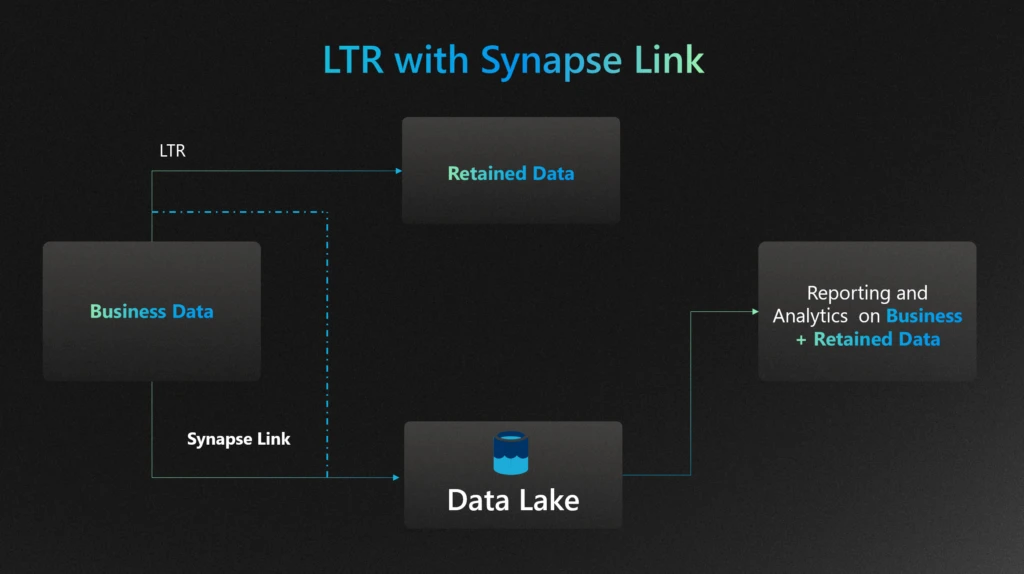
But LTR isn’t just about storage—it’s also built for analytics. Retained data is treated as a first-class citizen in Dataverse, seamlessly integrated into the real-time data warehouse. With Microsoft Fabric’s OneLake Shortcuts, you can analyze both live and archived data without copying or duplicating it. For customers preferring their own data lake, Synapse Link offers a flexible alternative for reporting and analytics on business and retained data.
This blog will focus on how implementing LTR can significantly reduce storage costs for enterprises, providing practical insights and strategies for leveraging LTR to achieve cost efficiency. We will also discuss how you can get deep insights from the retained data.
What is LTR and how can you enable
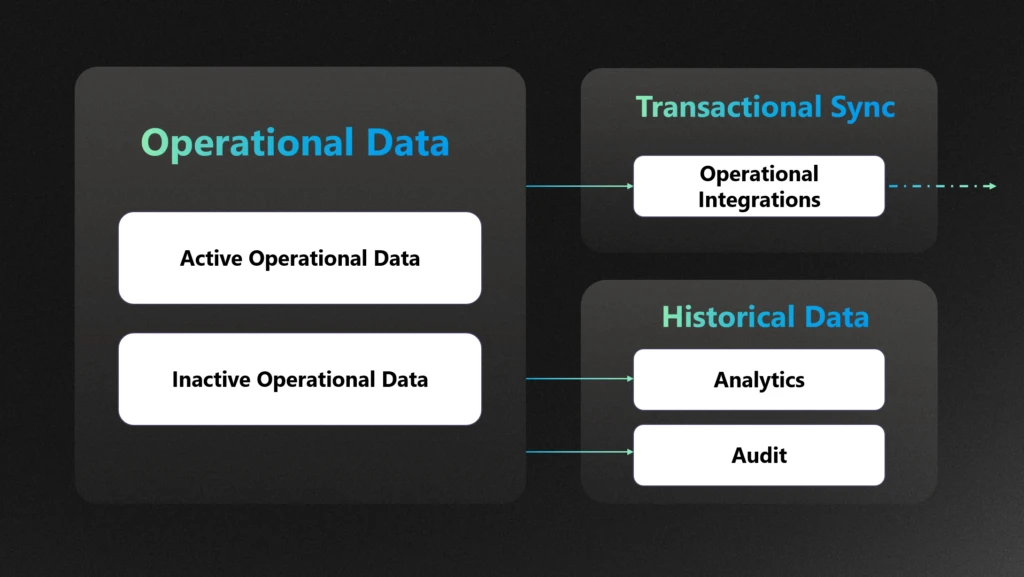
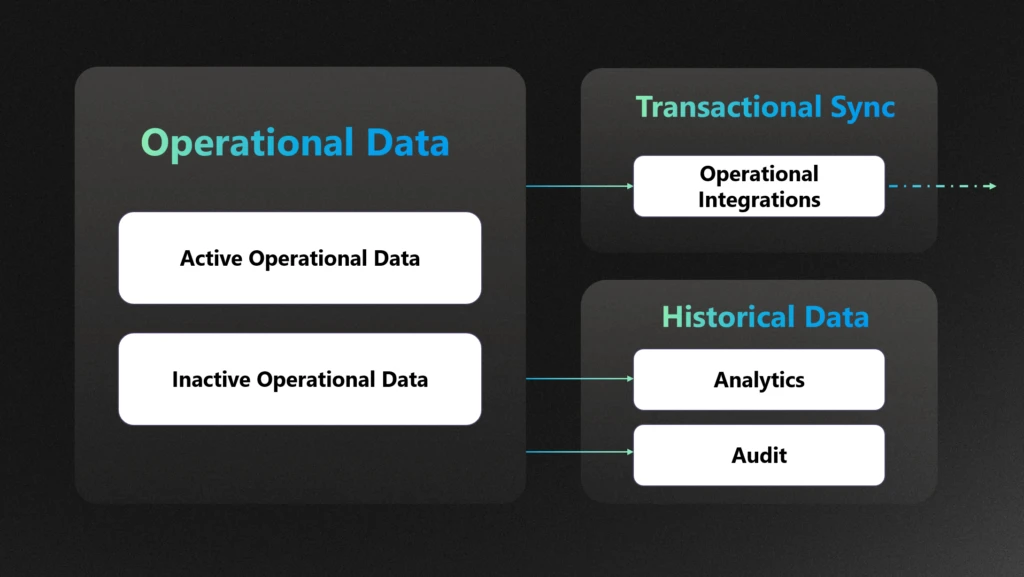
Long-Term Data Retention (LTR) streamlines your data strategy by automatically moving historical records from Microsoft Dataverse and Dynamics 365 Finance & Operations (F&O) into a managed data lake (MDL). This approach ensures efficient, scalable storage—freeing up space in your transactional databases while keeping retained data accessible for analytics and compliance.
Long-Term Retention (LTR) is a powerful tool for managing storage in Dataverse and Dynamics 365 Finance & Operations (F&O), but its value is maximized when applied to the right scenarios. LTR allows organizations to move inactive, compliance-bound, or infrequently accessed data to a cost-optimized, read-only storage tier—freeing up space in the primary database while maintaining access for reporting and audits.
Here’s when LTR is especially relevant:
✅ 1. Compliance-Driven Data Retention
If your organization operates in a regulated industry (e.g., finance, healthcare, public sector), you likely need to retain data for 5–10 years or more. LTR ensures that this data remains immutable and accessible for audits, without bloating your operational database.
Example: Financial records, customer invoices, and customer contracts that must be retained for legal or regulatory reasons.
✅ 2. Analytics on Historical Data
LTR doesn’t mean your data is locked away. Retained data can still be queried for trend analysis, forecasting, and AI workloads—especially when integrated with tools like Azure Synapse Link or OneLake shortcuts. This enables long-term insights without compromising performance.
Example: Analysing 7 years of sales data to forecast seasonal demand patterns.
✅ 3. Data Relevancy and Lifecycle Management
Not all data needs to be live forever. LTR helps you separate high-value, frequently accessed data from historical records that are still important but rarely used. This improves system responsiveness and reduces noise in day-to-day operations.
Example: Archiving closed cases, completed orders, or inactive customer records.
⚠️ What LTR Does Not Do
While LTR reduces your operational storage footprint, it does not reduce the size of your analytics store. If you’re exporting data to Synapse, OneLake, or other analytical platforms, you’ll still need to manage retention and tiering strategies there separately.
Cost savings with LTR
One of the most impactful benefits of implementing Long-Term Retention (LTR) in Dynamics 365 is the significant reduction in storage costs. On average, LTR compresses archived data by up to 80% and in some cases up to 90%, which can translate into substantial savings. For instance, archiving 1,000 GB of database data could reduce storage expenses from $80,000 to $10,000—a game-changer for data-heavy organizations.
Here are a few real-world examples of how customers are reaping the rewards:
🥨 A major American food company leveraged LTR to archive historical data in Finance & Operations (F&O), achieving a 50% reduction in data size and freeing up valuable system resources.
🧥 A global leader in outdoor apparel and equipment adopted LTR as part of a broader data archival strategy. By offloading historical records from core transactional systems, they not only cut storage costs but also improved overall system performance.
🍿 The largest private snack food company in the U.S. reduced their InventTrans table from 1.1 TB to 549 GB using LTR—again, a 50% reduction that directly impacted their bottom line.
A leading enterprise in the finance and operations space, they faced mounting challenges with data volume and storage costs. As part of their digital optimization strategy, they implemented Long-Term Retention (LTR) to offload historical data from their Dynamics 365 Finance & Operations (F&O) environment into a managed data lake—achieving a remarkable storage reduction of over 90%.
Seamless insights with combined data
With Long-Term Retention (LTR), your historical data is securely stored in a Managed Data Lake—keeping storage costs low. But that doesn’t mean you lose visibility.
Thanks to OneLake shortcuts and Synapse Link, you can seamlessly analyze both live and retained data together. This means you get a complete picture of your business—past and present—without sacrificing performance or budget.
Whether you’re running reports, building dashboards, or training models, your insights stay connected, and your costs stay optimized.
We’ll explore further in this blog, how to unlock seamless insights by combining live and retained data using OneLake shortcuts and Synapse Link. These tools allow you to query both retained and real-time data effortlessly—without compromising on performance or cost efficiency.
Strategy to use LTR to manage the storage
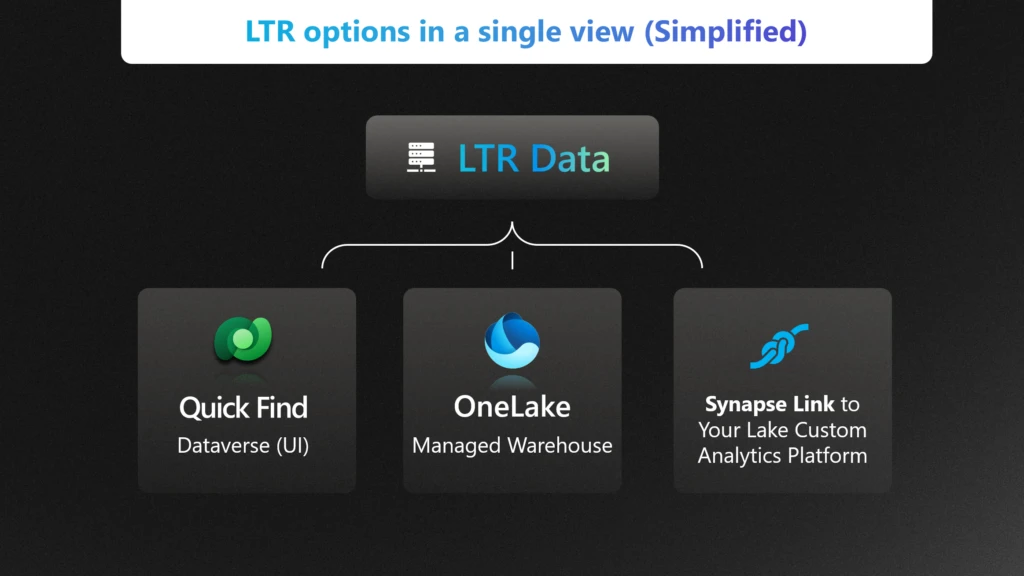
LTR integrates seamlessly with Quick find in the Dataverse, Bring Your Own Lake (BYOL) for Synapse Link and OneLake for both Dataverse and Finance & Operations (F&O) scenarios.
Quick Find: Instantly search archived data directly within Dataverse—no setup required.
OneLake: For integrated analytics using Microsoft Fabric OneLake.
Synapse Link: For syncing retained data to your own data lake for custom analytics and storage.
In this section, we will discuss how each strategy helps manage the storage, cost and meet the compliance requirements.
Quick find
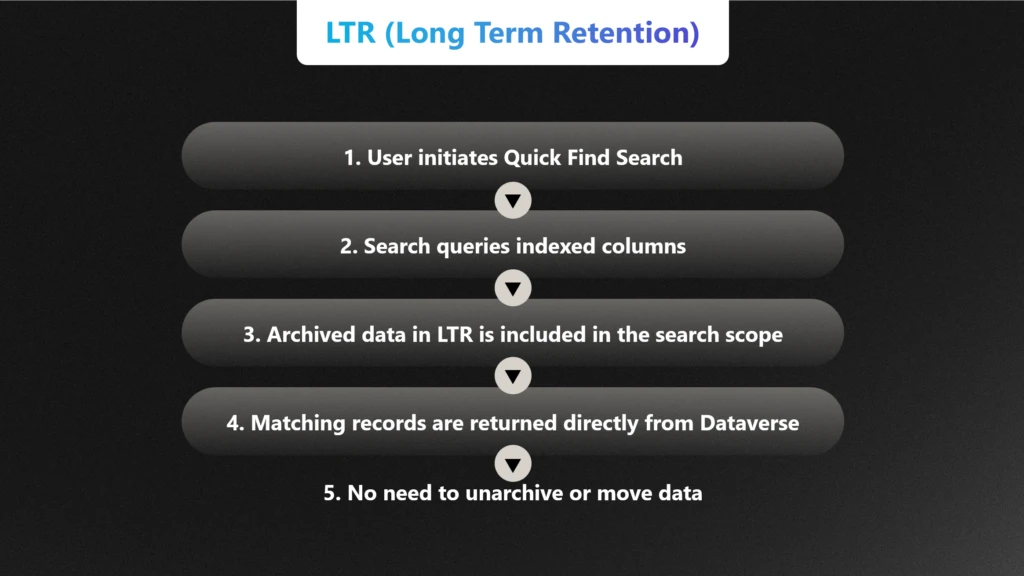
Quick Find allows users to search across Dataverse tables using indexed columns. Even when data is archived via LTR, it remains within the Dataverse boundary and is still queryable through Quick Find—provided the relevant columns are indexed and the data is not purged. This means:
No need to unarchive: Users can locate, and view retained records directly through the familiar Dataverse UI.
No pipeline or duplication required: Unlike analytics scenarios that use OneLake or Synapse Link, Quick Find works natively within Dataverse
Use OneLake shortcut with LTR for Data Warehousing
Enterprises adopting new technologies like OneLake shortcut can continue to use Long-Term Retention (LTR) to manage data storage, costs, and compliance by archiving historical data into Managed Lake storage. Archiving data in Managed Lake preserves cost savings for the scenario that involves accessing historical data while allowing enterprises to perform analytics by moving the data out to reporting and analytical databases.
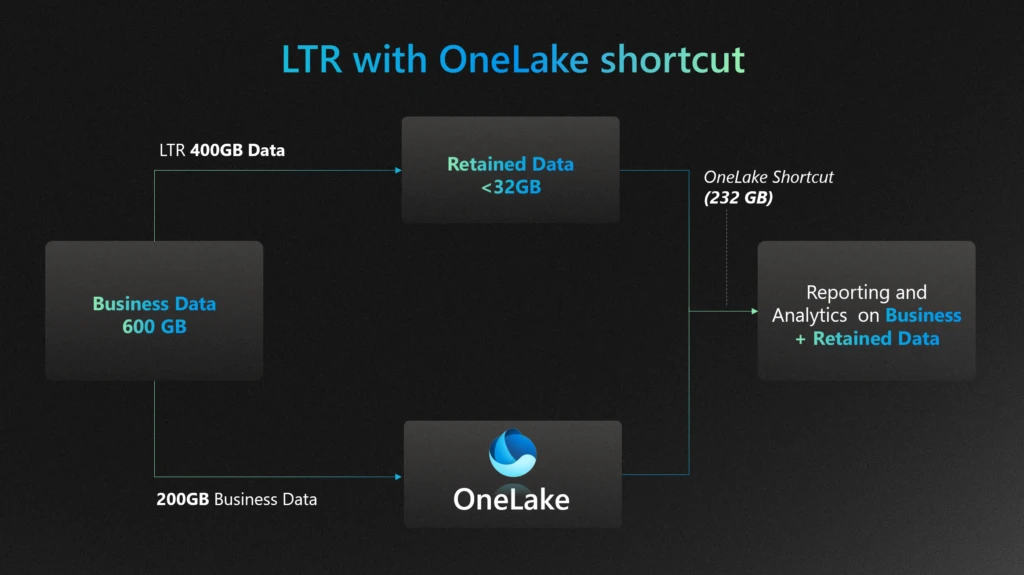
If your enterprise has already invested in OneLake, you can further optimize your data strategy by leveraging OneLake shortcut. Unlike the full OneLake, which syncs data into OneLake, the Shortcut creates a pointer to your data—allowing Fabric to query it in place without duplicating storage or compromising data security.
This means you can continue to run analytics on both live and retained data while preserving the cost benefits of Long-Term Retention (LTR).
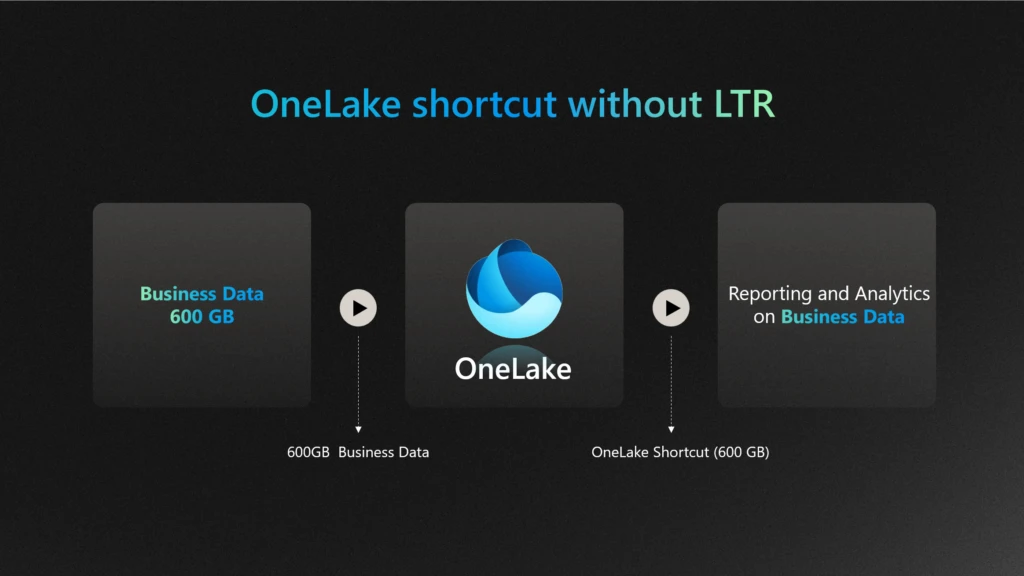
📊 In the diagram below, we illustrate how an enterprise can reduce storage costs by up to 80%—for example, compressing a 400GB business data down to less than 32GB using LTR—while still enabling seamless insights without incurring additional costs or compromising data security.
Since no data is physically moved, it also helps preserve LTR savings by avoiding duplication.
Without LTR:
With LTR:
Synapse link works seamlessly with LTR
Enterprises that have invested in Bring Your Own Lake (BYOL) with Synapse Link can continue to leverage this setup for their data archival scenarios to manage storage, costs, and compliance. However, note that if the Synapse Link is created after the Long-Term Retention (LTR) process has already occurred, it will not include previously retained data. This approach allows enterprises to utilize LTR with their existing Synapse Link investment.
If your enterprise is already invested in Synapse Link, there’s an opportunity to take your data strategy even further. By pairing it with Long-Term Retention (LTR), you can maintain seamless access to both live and retained data—without duplicating storage or compromising security.
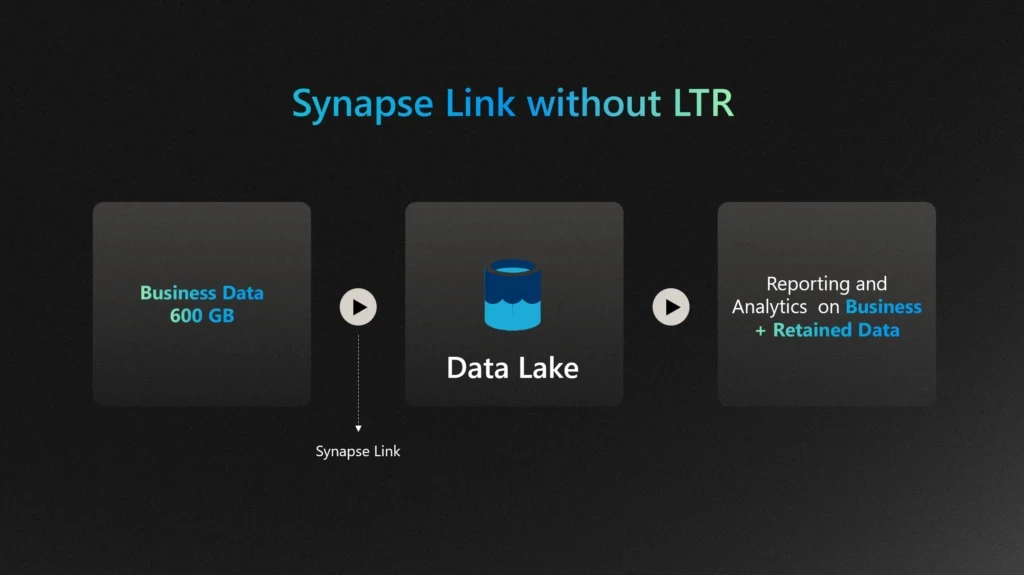
📊 In the diagram below, we illustrate how an enterprise can utilize their existing investment in synapse link while using LTR. For example, business data is retained in Managed Data Lake — while still enabling powerful analytics through Synapse Link, without incurring additional costs. This approach ensures your insights stay rich, your data stays secure, and your budget stays intact.
Without LTR:
With LTR:
Summary of Benefits
Throughout this blog, we have explored how Long-Term Retention (LTR) can significantly reduce storage costs for enterprises. By archiving less frequently accessed data, LTR optimizes storage usage, leading to substantial cost savings. Additionally, LTR ensures compliance with regulatory requirements, making it a crucial strategy for effective data management. Whether using Synapse Link or OneLake, LTR provides a seamless and efficient way to manage data storage and compliance needs.
Call to Action
We encourage you to consider implementing LTR in your organization to take advantage of these benefits. For further assistance or more information on how to get started with LTR, please visit our LTR article. Implementing LTR can help you achieve cost efficiency and compliance, ensuring your data management strategy is both effective and sustainable.
We’re excited to announce that Power Pages AI usage analytics and governance controls are now available in public preview through the Copilot Hub in the Power Platform admin center
With AI capabilities becoming core to digital experiences, organizations need visibility and control over how these features are used. The Copilot Hub in the Power Platform admin center answers this need by offering a centralized dashboard for AI usage analytics and governance across Power Platform products. Power Pages now integrates with the Copilot Hub to help admins:
Track adoption of AI-powered features
Gain actionable insights
Control exposure based on org needs and compliance
Deep Dive into Usage Insights
Admins can switch between Maker Copilot and End User Copilot views to understand how AI features are used by site builders and site visitors.
Maker Copilot Analytics include:
Monthly active makers using Studio Copilot or Pro Dev Copilot
Sites with Copilot enabled
Most-used AI features
Usage trends over time
End User Copilot Analytics provide insights on:
Chat agent (Site Copilot) usage
Search summaries and query volume
Summarization API usage
AI-powered form fill assistance
Generative summaries for list views
AI Governance – In Your Control
The Copilot Hub empowers admins to control AI feature availability at both environment and site levels, with settings to:
Enable/disable features for makers or end users
Allow granular control per feature (e.g., chatbot, summaries etc)
AI features can be enabled across all sites, specific sites, or excluded sites
Visibility into configurations across environments
Warnings and fallbacks when features are blocked due to org policies
Transition to the Copilot Hub
Important: Governance settings for Power Pages AI features are now managed exclusively in the Copilot Hub. Existing settings are retained, but we recommend reviewing and aligning them in the new experience to ensure consistency.
Maker & End User Experience
Makers see clear messages in Design Studio when AI features are disabled by admins. End users experience fallback behaviors (e.g., standard search results instead of AI summary) without disruption or confusion
The Next Generation of Power Platform Adoption Guidance is here
Successfully adopting Microsoft Power Platform is about more than just deploying tools. It’s about building a strategy that empowers people, ensures governance, and delivers lasting business value. And to support you on your successful adoption journey, we’re excited to announce the launch of the newly refreshed Power Platform Adoption Guidance.
This update is the most significant evolution of our adoption content to date. It reflects insights from real-world customer experiences, partner feedback, MVP expertise, and Power CAT programs, all to deliver practical, actionable guidance at every stage of your journey. Whether you’re just getting started or looking to mature your platform strategy, this guidance is designed to help you activate business-led innovation with confidence.
What’s new?
Eight Pillars of Adoption: The guidance is now structured across eight strategic pillars, making it easier to plan, scale, and sustain your adoption journey.
Redesigned Experience: We’ve overhauled the information architecture and user experience so you can find what you need faster and more intuitively.
Expanded Content: The update includes over 200 pages of fresh content, covering everything from defining vision and metrics to managing mission-critical workloads and building thriving maker communities.
Actionable Tools: The updated Adoption Workbook now includes exercises and templates that you can work through with your stakeholders to guide the development of a strategy and action plan, based on real-world customer experiences.
Why it matters
To be sure, this guidance is more than a documentation refresh. It’s a strategic resource for Power Platform product owners, adoption leads, change managers, and Center of Excellence (CoE) teams. The guidance helps you:
The newly refreshed Adoption Guidance site includes other resources as well. Real-world case studies, toolkits documentation, and white papers aim to help you be successful with Power Platform.
Get started
Explore the new guidance at https://aka.ms/PowerPlatformGuidance. Share it with your teams. Use it to shape your strategy. And most importantly, let it guide you as you build what’s next with Power Platform.
Get ready for an incredible experience at Microsoft Build 2025. We’re pumped to showcase the latest advancements in Microsoft Power Pages, a platform that empowers enterprises to rapidly build secure, scalable business portals powered by agentic AI.
This week at Microsoft Build 2025, explore how Power Pages enables global scalability and availability with its robust security, administration, and governance. The native integration with Microsoft Copilot and Microsoft Copilot Studio transforms Power Pages portal design by combining conversational AI, intelligent suggestions, and contextual guidance. With generative user experience (UX) and role-based personalization, portals dynamically adapt to user behavior and context—delivering the right information at the right time to streamline workflows and elevate user engagement.
Now is the moment to see how enterprises can plan, build, and run business portals with dynamically tailored experiences.
Introducing cutting-edge security in Power Pages
Security isn’t just a feature—it’s a foundation. That’s why we’re thrilled to unveil the new security agent in Power Pages, now available in public preview. This is a game-changer for business users and admins who need to stay ahead of evolving threats without compromising agility.
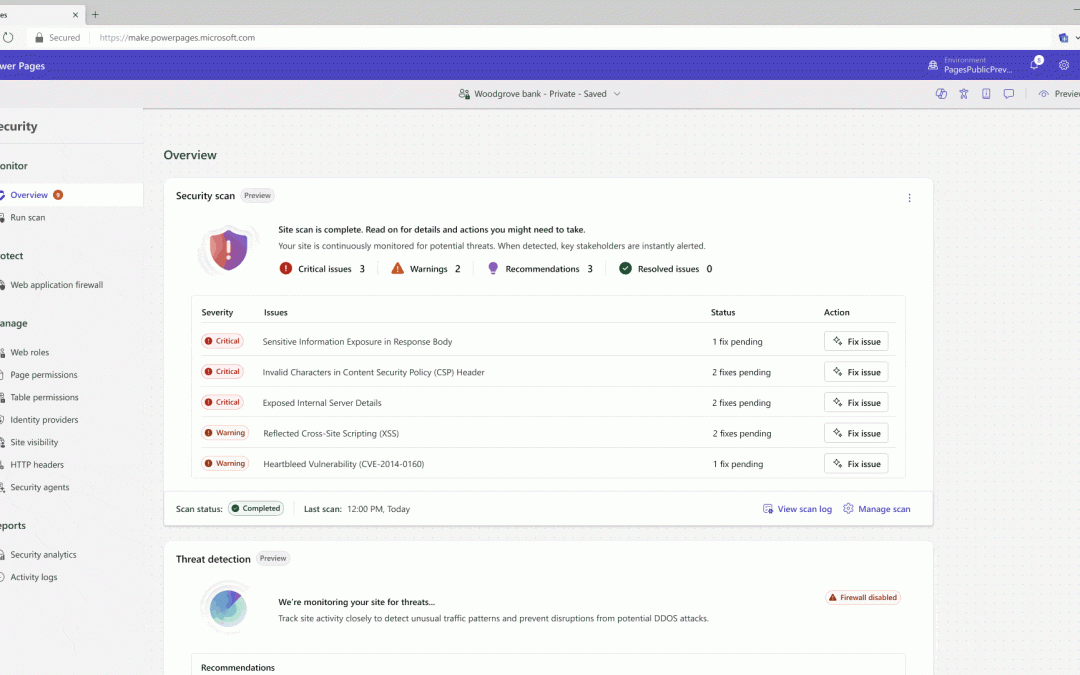
Powered by Microsoft Sentinel, the security agent continuously monitors for anomalous traffic patterns and proactively detects potential Distributed Denial of Service (DDoS) attacks. But it doesn’t stop at detection—it empowers action. Business users and admins receive real-time alerts and actionable recommendations with Microsoft Outlook and Microsoft Teams, helping them respond swiftly and confidently.
This is more than just protection—it’s intelligent, integrated defense that brings enterprise-grade security directly into your Power Pages experience.
Image represents current UI for a public preview feature. UI is subject to change.
Improving developer productivity and enabling next-generation user experiences
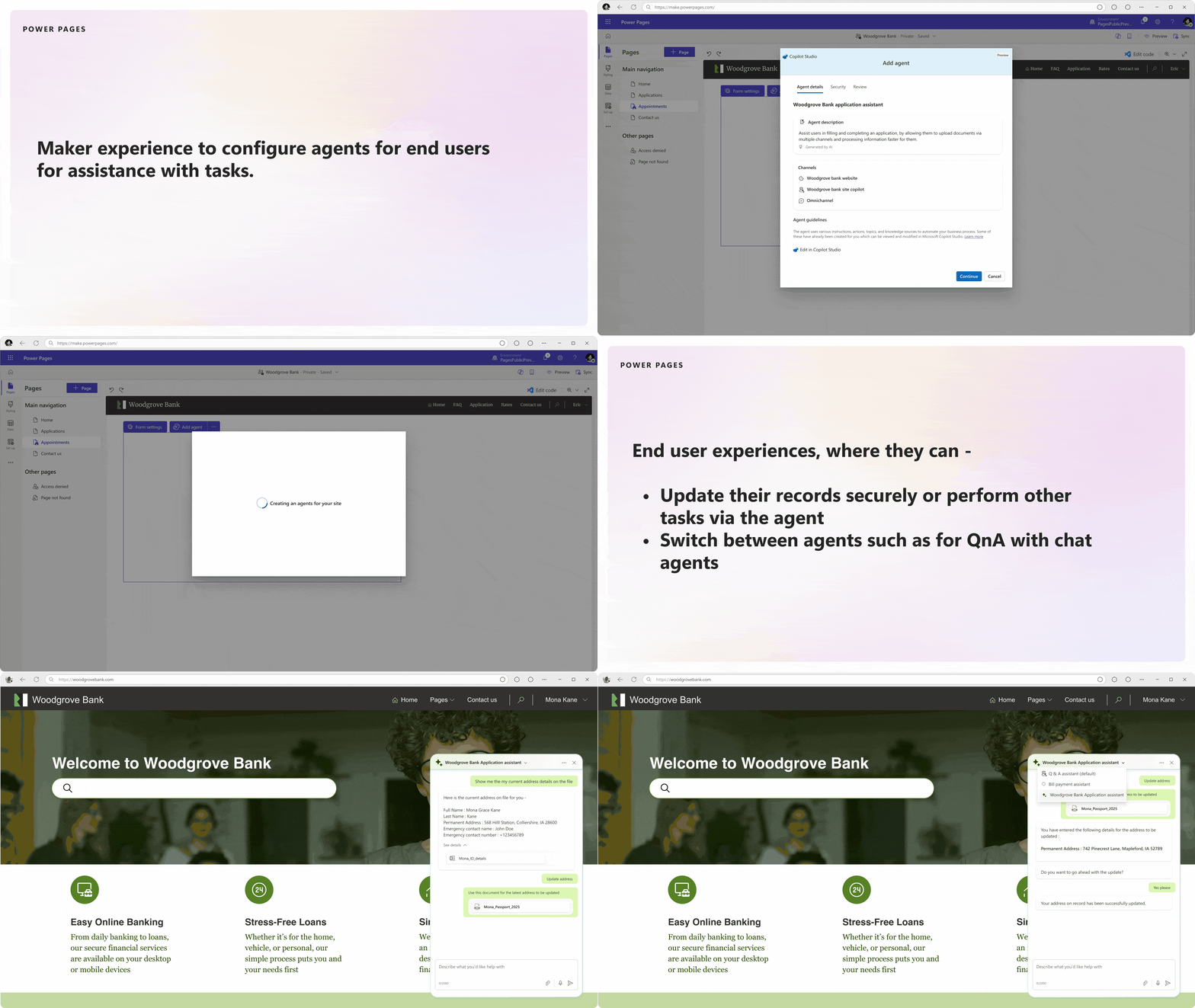
Next, we have exciting new updates for all Power Pages creators. We’re introducing the ability to integrate Copilot Studio agents in Power Pages—enabling creators to embed multiple agents into their site. This capability greatly enhances the conversational chat experience and enables end users to perform, create, and update operations on their business data. Developers also get the ability to use these agents as an API, enabling them to build complex business logic with ease and power next-generation user experiences.
Now in public preview, users can bring their own code to Power Pages using third-party, next-generation code generation tools. This unlocks a new era of “vibe coding”—where natural language becomes the interface, and the user becomes the orchestrator. Instead of writing every line, developers guide, test, and refine AI-generated code, making the process more intuitive, creative, and aligned with enterprise-grade standards.
Power Pages is also expanding its multilingual support, allowing customers to create portals in any number of custom languages. This functionality allows all out-of-the-box components like forms, lists, multistep forms, and card galleries to use content snippets for specifying content translation, allowing customers to build websites in a language of their choice. This feature will be generally available and is set to uplevel the creation process for multilingual portals.
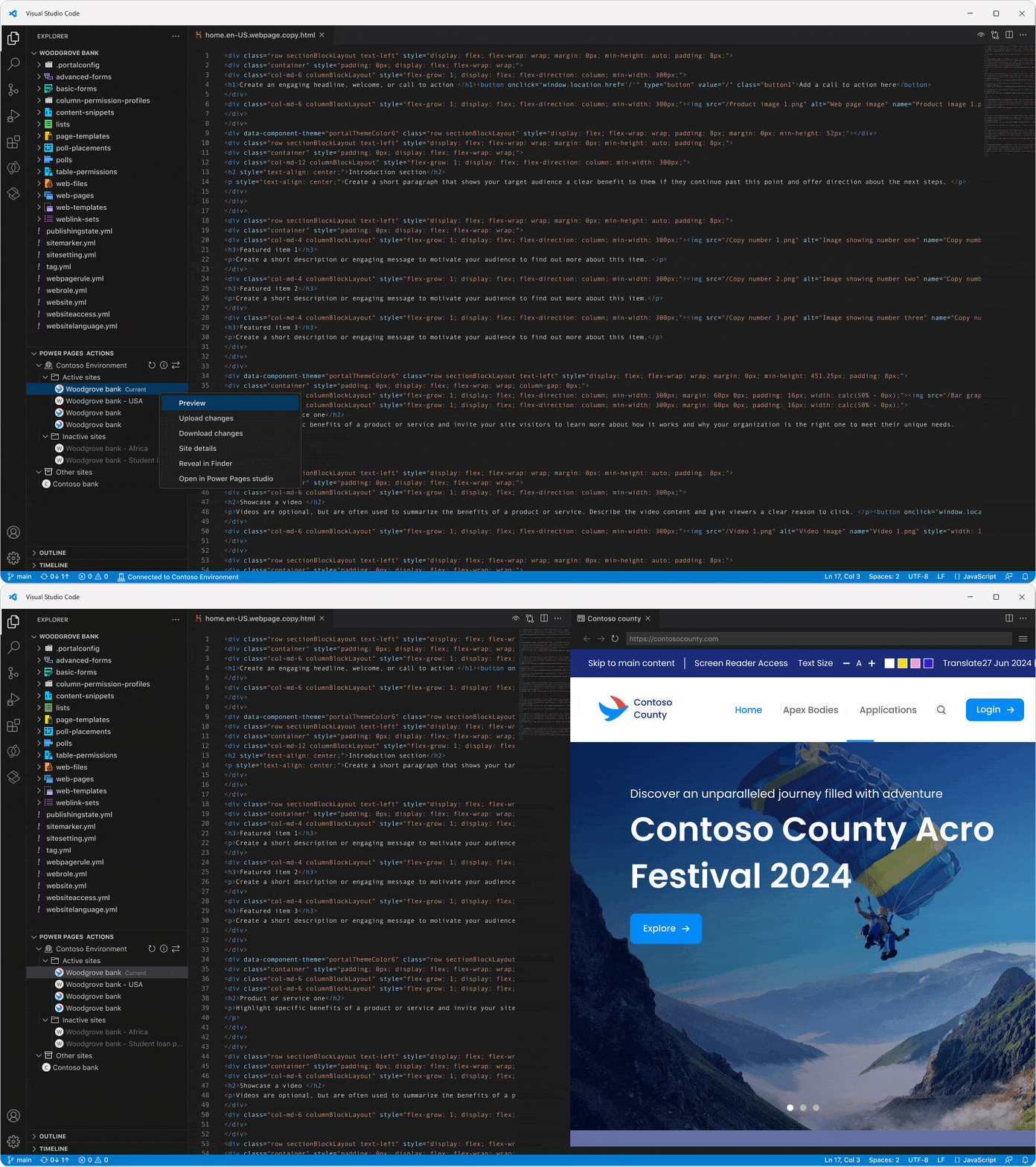
Additionally, the inline portal preview in Visual Studio Code is now in public preview. This feature lets you preview your Power Pages portals without ever leaving your development environment. With built-in user interface (UI) actions to run command-line interface (CLI) commands and switch environments, it streamlines development and testing.
Power Pages now supports Dataverse Git integration in public preview. This integration ensures that your Power Pages content is stored in a easy to read format. The file structure and naming conventions align closely with the experience provided by the Power Pages Visual Studio Code web and desktop. This integration significantly simplifies the process of reviewing, understanding, and managing your Power Pages content, enabling easier collaboration and version control.
Our event management template is also now in public preview. This template, along with custom components, is designed to streamline your development process and enhance portal capabilities, making event management more efficient and effective.
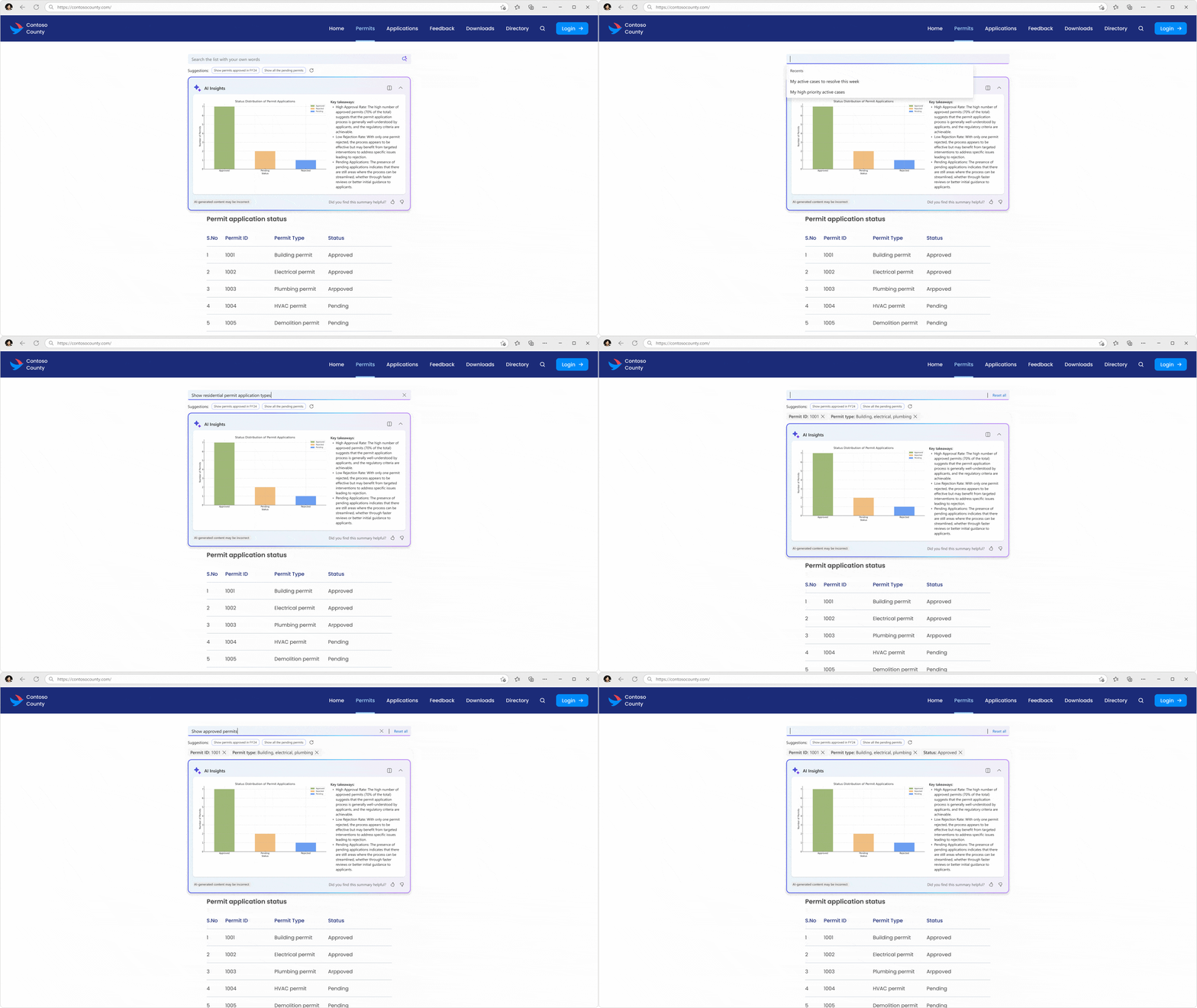
We’re also introducing the new intelligent list search and customization feature in Power Pages. This feature uses natural language to query large datasets and get filtered information. It also allows for customization of the AI insights to make data interaction more intuitive and efficient. This feature is currently in public preview.
Finally, multistep forms with Copilot in Power Pages is now generally available. This AI-assisted experience lets you design and build forms with natural language prompts, making it easier to create more dynamic and interactive forms.
Elevating admin capabilities with advanced governance and compliance tools
Now, let’s dive into some powerful tools designed to transform the administrative experience.
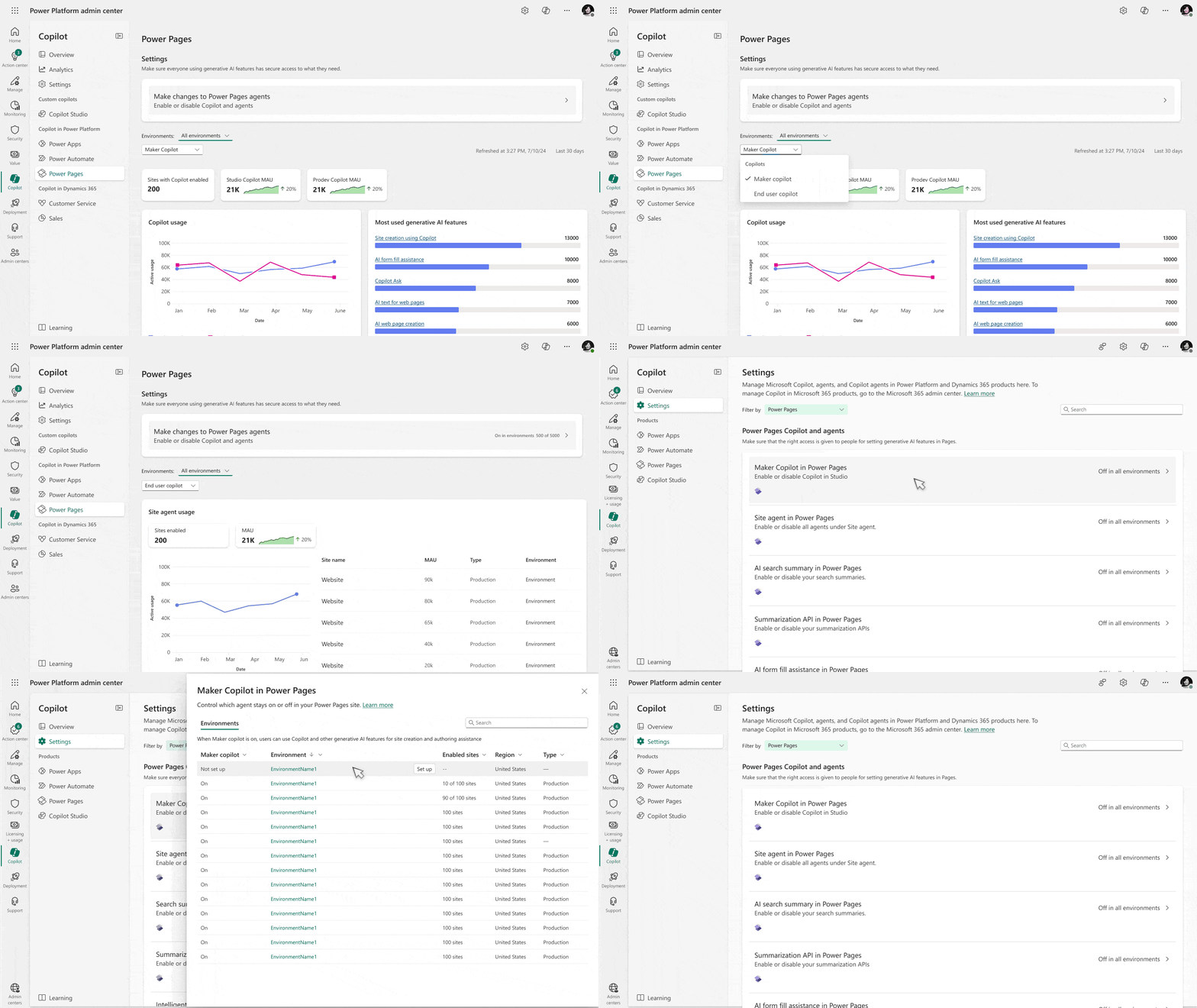
The Copilot hub is a game-changer for admins. It provides visibility into AI usage at the feature level, empowering data-driven decisions and policy enforcement. Admins can control individual AI features, such as turning specific Copilot capabilities on or off at the environment or portal level. Currently in public preview, the Copilot hub is poised to significantly enhance administrative capabilities, fostering trust and compliance.
Image represents current UI for a public preview feature. UI is subject to change.
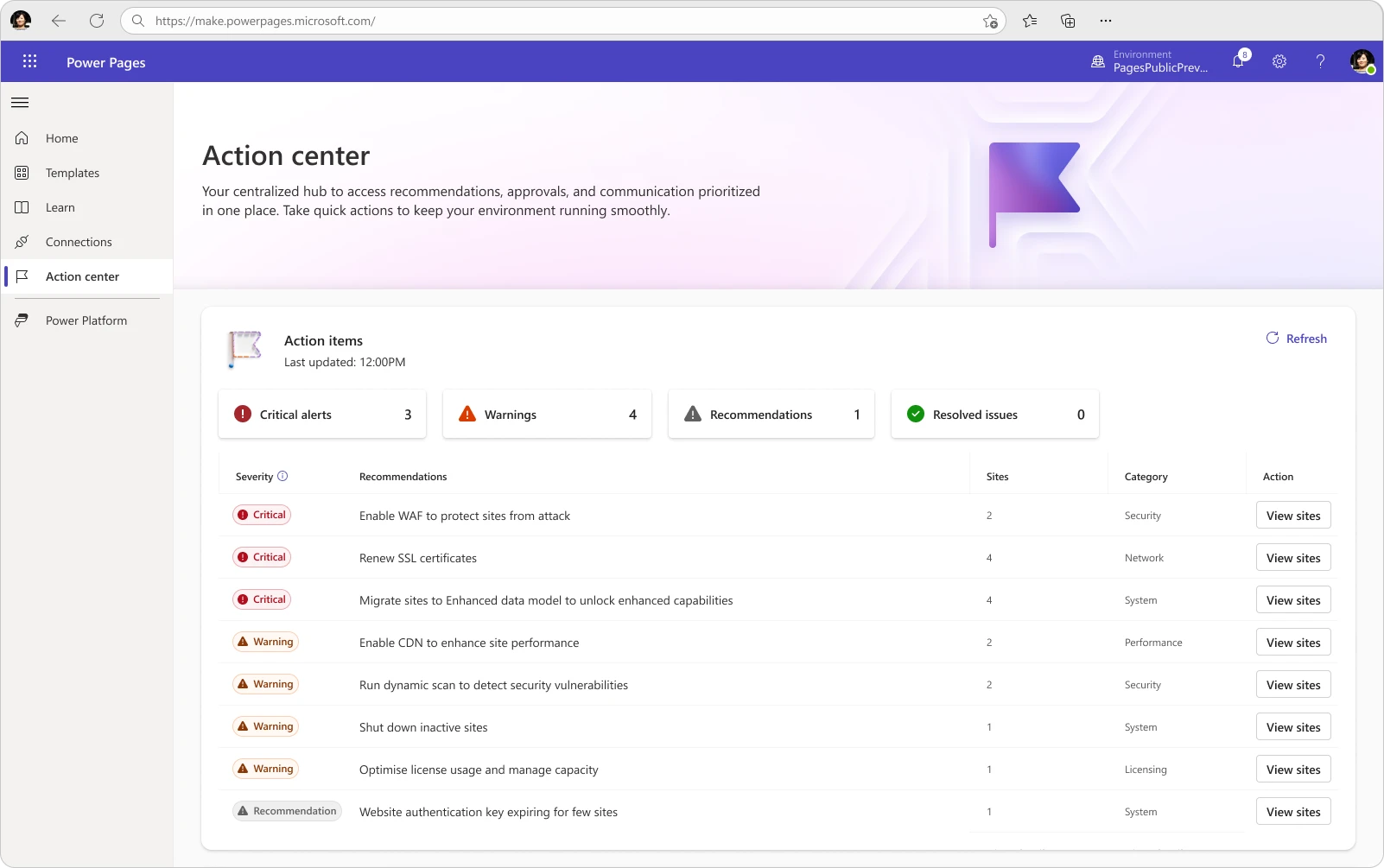
Next, the action center in the Power Pages homepage is another exciting addition to our suite of tools. This centralized hub is designed specifically for users and system admins, surfacing recommendations and actions that are applied within the Power Pages platform environment where applications, data, and resources are managed. Whether it’s enabling Web Application Firewall (WAF), renewing secure sockets layer (SSL) certificates, converting trials to production, or shutting down portals, this feature provides the insights you need to take action. It’s in public preview and ready to streamline your administrative tasks.
Image represents current UI for a public preview feature. UI is subject to change.
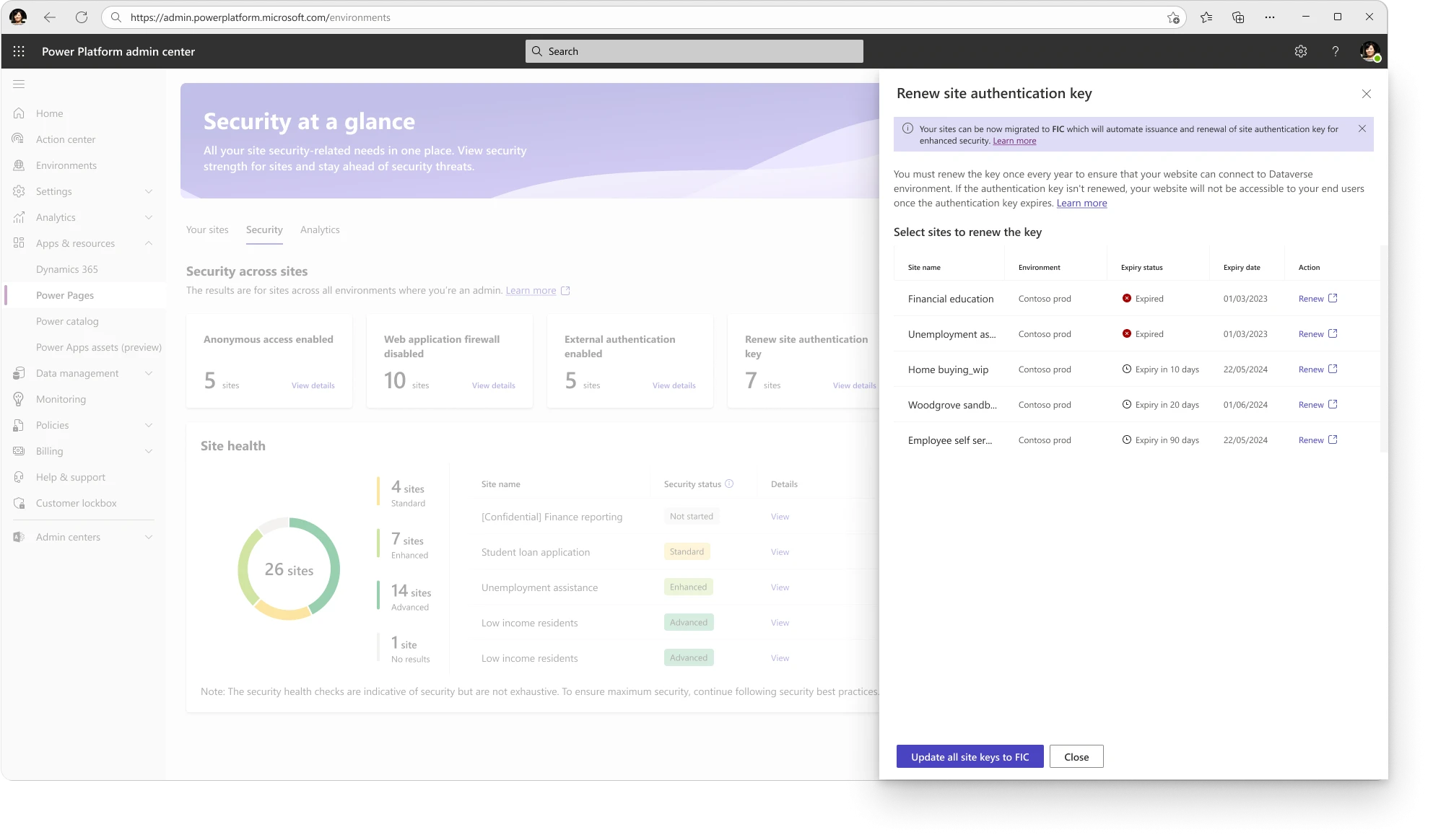
We’re also excited to introduce the self-service identity (SFI)—web authentication key renewal experience in the Power Pages Admin Center (PPAC), transitioning from certificate-based authentication to federated credentials. A one-time activity will be required to update the authentication key in PPAC. This update will be generally available and is designed to simplify and streamline your authentication processes.
Additionally, we can now surface insights and recommendations related to security scans in the PPAC security hub. This feature, currently inpublic preview, is designed to help keep your business portal secure and compliant.
Power Pages is helping organizations around the world build and enhance their online presence with remarkable efficiency
Check out how our customers have been using Power Pages across industries to create transformative business portal experiences:
Fortune Brand Innovations:Discover how Fortune Brands Innovations streamlined their customer experience across multiple brands using Power Pages and Microsoft Dynamics 365 Customer Service, creating a unified digital portal that integrates payment and enterprise resource planning system.
Belgotex:Learn how Belgotex Carpets transformed their operations and enhanced customer engagement by implementing Power Pages, Dynamics 365 Finance, Microsoft Power BI, and Microsoft Fabric, unifying their sales and manufacturing processes.
US Small Business Administration:Explore how the US Small Business Administration saved millions annually and improved disaster using recovery services by Power Pages, Dynamics 365 Customer Service, Power Automate, and Power BI to automate processes and enhance service delivery.
Okuma: Okuma has enhanced their customer and field service operations with Power Pages, unlocking new levels of efficiency and expertise utilization.
All Pro Electrical: All Pro Electrical harnesses Power Pages to streamline operations, driving efficiency and safety, with Power Automate adding seamless end-to-end automation.
Veterans’ Wellbeing Network:Discover how the Veterans’ Wellbeing Network significantly improved support for Australian service members by implementing Power Pages, Power Apps, and Power Automate to create a custom client management system that reduces case processing time by up to 40% and enhances collaboration among advocates.
How to get started with Power Pages
Power Pages offers a comprehensive set of tools designed with security at the forefront for both developers and users. Join us as we reshape the portal-building experience, empowering organizations to create secure, AI-powered business portals that scale.
As we gear up for Microsoft Build 2025, excitement is building around the latest advancements in agent governance, security, and management. This year, we’re bringing you groundbreaking insights and tools to enhance your experience with Microsoft Copilot and ensure robust governance and security for your AI agents. Join us at the booth and discover how our new offerings align with our comprehensive governance strategy for Copilot.
Come Find Us at the Copilot Control System Booth
At Microsoft Build 2025, our booth will be the hub of innovation and learning. Come and find us to explore our latest tools and strategies for agent governance, security, and management. Our experts will be on hand to discuss how these new features integrate in your agent adoption strategy.
Learn from Industry Leaders
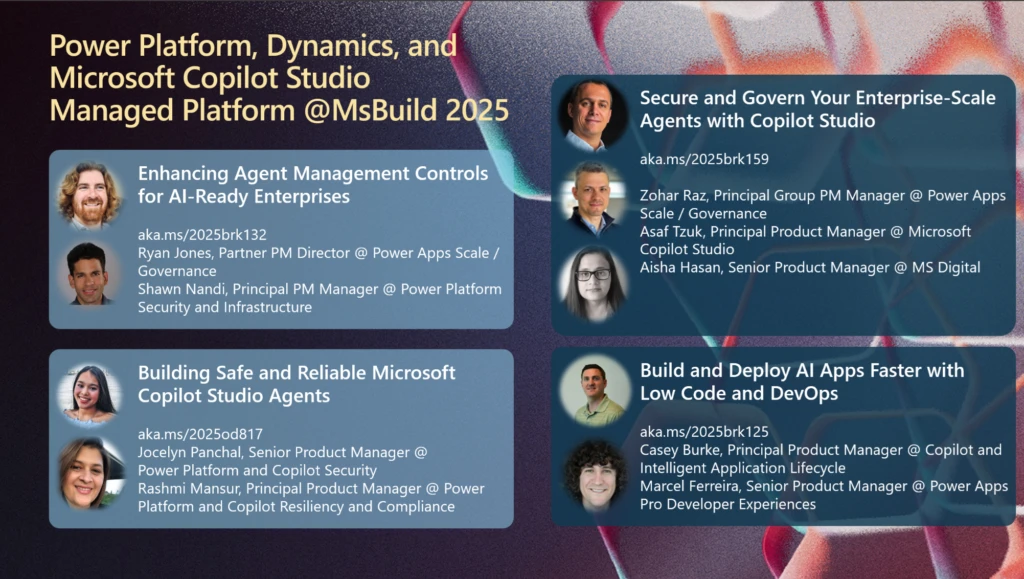
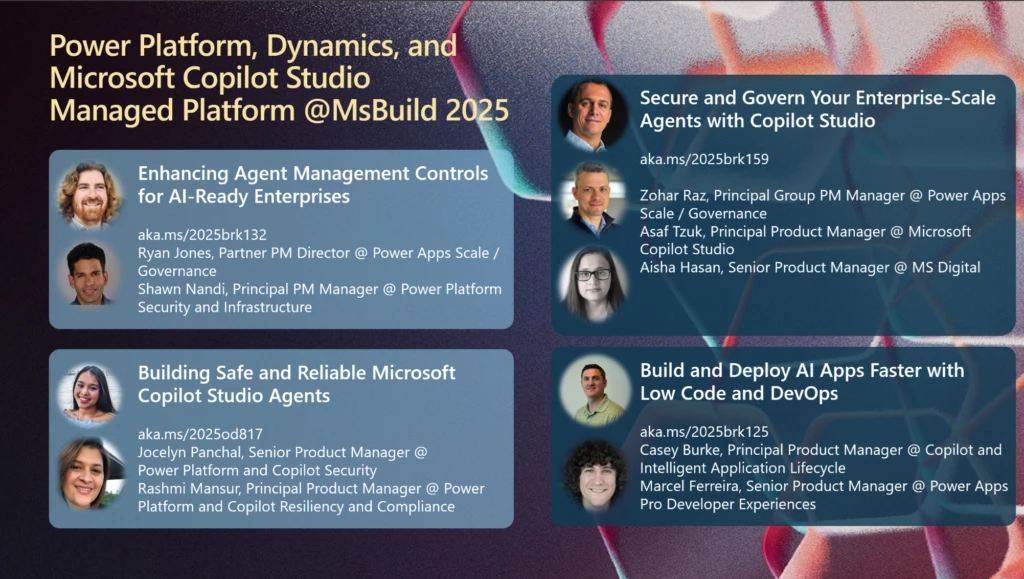
Don’t miss the opportunity to attend sessions led by industry leaders like Zohar Raz, Shawn Nandi, Ryan Jones, Jocelyn Panchal, Casey Burke, Asaf Tzuk, Rashmi Mansur, and Marcel Ferreira. These sessions will provide invaluable insights into building, managing, and governing secure agents. You’ll learn best practices for managing agent lifecycle, implementing security measures, and ensuring compliance with organizational policies. Whether you’re a seasoned developer or new to AI, these sessions will equip you with the knowledge to excel in agent governance.
Discover how to secure Microsoft Copilot Studio agents using Power Platform security and governance capabilities, Microsoft Purview, and Microsoft Admin Center. This session explores best practices for managing data access, compliance, and risk mitigation while ensuring responsible AI use. Learn how to enforce policies, monitor agent activity, and safeguard enterprise data. Gain insights into securing Copilot agents at scale while maintaining agility and innovation.
Join us as we delve into agent management controls. We’ll focus on enterprise-grade security, maintaining healthy and seamless operations, and governing at scale. Attendees will gain insights into best practices, tools, and strategies to ensure their organization is AI-ready. Discover how to leverage a robust management suite to enhance your development processes and secure your enterprise environment.
Learn how your development team can build AI enabled applications faster with Power Platform and DevOps. We’ll show you how the new developer capabilities combined with DevOps best practices can empower your team to build, test, and deploy enterprise-grade apps faster.
With the fully managed suite of capabilities for Power Platform, admins and makers alike are equipped with the necessary tools to ensure that Copilot Studio agents are protected and healthy. Tune in to learn more about the latest enhancements and upcoming plans for a fully managed platform designed for the Era of AI.
Key Topics Covered
Agent Governance Strategy: Learn about the comprehensive governance frameworks and strategies for managing AI agents across Microsoft 365, Power Platform, and Copilot Studio. Discover how existing governance models are being integrated to provide a unified experience for administrators.
Security Measures: Explore robust security measures in place to protect sensitive data and ensure compliance. From encryption and isolation to persistent label inheritance and connector management policies, you’ll see how Microsoft Copilot safeguards your information.
Management Tools: Get hands-on with the latest management tools available in the Microsoft 365 Admin Center and Power Platform Admin Center. These tools streamline the administration of permissions, policies, and compliance settings, making it easier to manage agents at scale.
Upcoming Features: Stay informed about the upcoming features and enhancements for agent governance and security. Learn about the new capabilities for monitoring, reporting, and data security, and how these will impact your agent governance strategies.
Get Ready to Learn and Build
Microsoft Build 2025 is the event of the year for developers, IT professionals, and AI enthusiasts. With a focus on agent governance, security, and management, this year’s conference will provide you with the tools and knowledge to take your AI projects to the next level. Don’t miss out on the opportunity to learn from thought leaders, explore new technologies, and connect with peers. We look forward to seeing you.
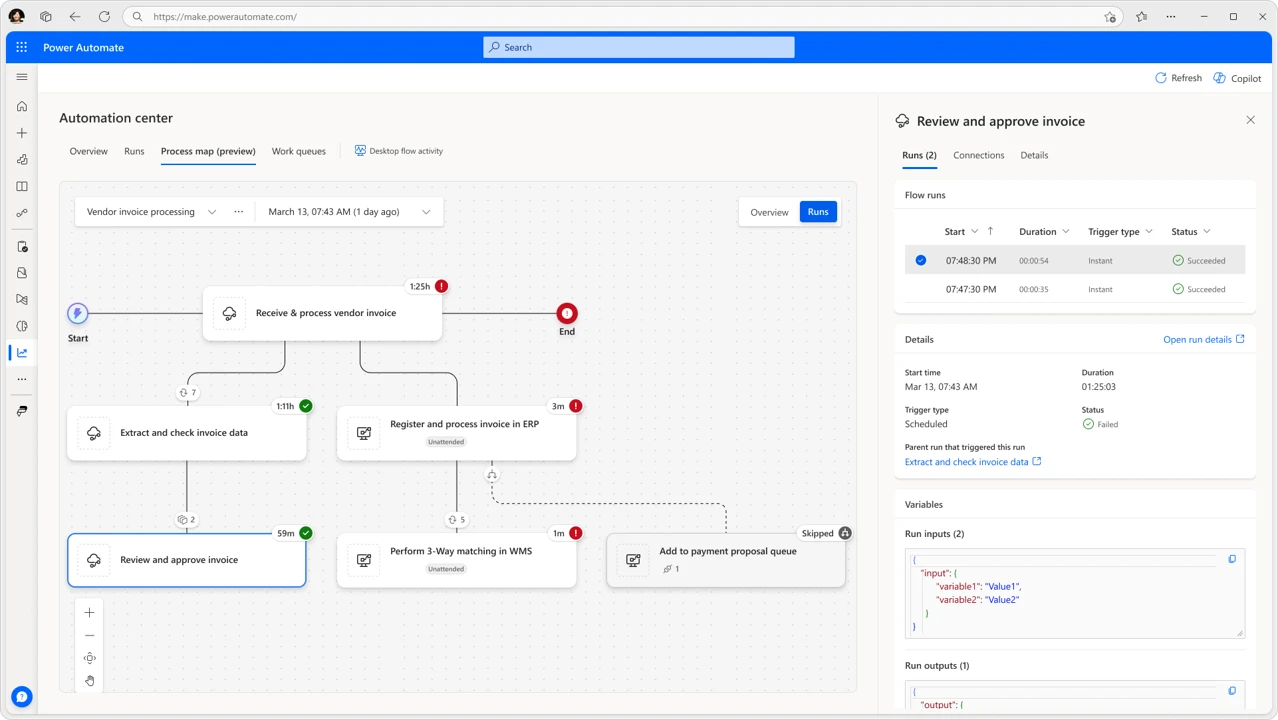
We’re thrilled to announce the public preview of Process Map in Power Automate, a significant advancement for process-centric observability at scale. This feature is seamlessly integrated into the Automation Center, your hub for end-to-end automation monitoring and management in Power Automate.
What is the Process Map?
The Process Map is designed to enhance process-centric troubleshooting and monitoring in Power Automate by providing increased visibility and efficiency. It offers a detailed, end-to-end view of a process that’s managed by a parent orchestrating flow, showing all of the associated child and desktop flows. The map also recognizes structural flow elements, such as conditions, and displays flows that didn’t execute due to specific conditional logic or upstream errors. This is critical for understanding how a problem in one part of the process can affect other parts and assists in taking appropriate countermeasures to address issues.
Key benefits:
Accelerated troubleshooting: Quickly identify and resolve issues with an end-to-end, process-centric view that includes contextual information on runs, connections, and design-time aspects.
Comprehensive visibility: Gain full transparency into your automation processes, including flows that were skipped or missed due to conditional logic or upstream issues.
Enhanced impact analysis: Understand and analyze how issues affect the entire process, facilitating faster recovery and implement effective countermeasures.
Stronger collaboration: End-to-end process visibility enables faster, context-rich communication with impacted teams, accelerating recovery and driving continuous improvement.
Key features
Runsview: Displays the main flow run that orchestrates the process and its child runs, enabling users to track execution, identify issues, and optimize processes.
Overviewview: Provides a design-time process hierarchy view with connected subprocesses, offering quick insights and serving as the future home for aggregated process data and configurations.
Runs tab integration: We’ve enhanced the flow runs page with new run row hover options. New icons let you create or view process maps for the selected process run and its child runs.
How to get started
This feature is being rolled-out now and you can test it today in the US preview region. Further details are available in the Process Map documentation.
Power Automate continues to evolve, bringing new security features to help organizations protect their data and automate intelligent processes more securely by design. Here are some of the latest enhancements:
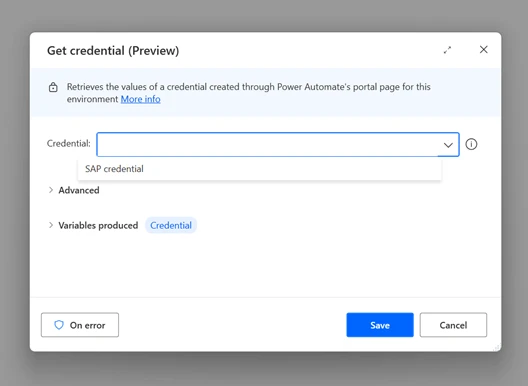
Protect Identities and Secrets with credential management
Desktop flow connection credentials with Azure key vault and CyberArk secrets: Power Automate now supports storing connection credentials securely in Azure Key Vault (AKV) or CyberArk. This ensures that passwords are encrypted and managed securely, reducing the risk of unauthorized access. This feature includes support for automatic connection updates at runtime (like when a password rotation occurs).
Certificate-Based Authentication with MFA (Public preview): To further enhance security, Power Automate now supports certificate-based authentication in desktop flow connections. This passwordless solution adds an extra layer of security, meeting multi-factor authentication (MFA) requirements for attended as well as unattended scenarios. This feature is available from Power Automate for Desktop Build 2410.
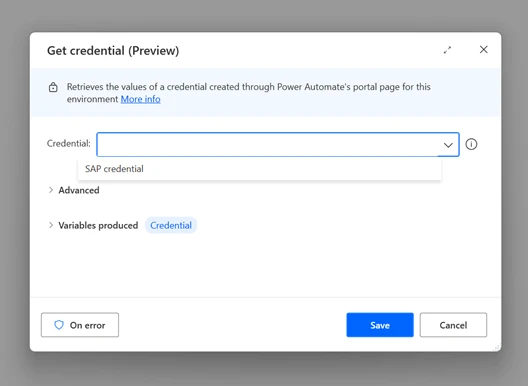
Credentials for Desktop flow actions (Public preview): For desktop flows, Power Automate allows the use of credentials directly within flow actions. This ensures sensitive information is handled securely, not stored in scripts or logs, and accessible only to authorized users. This feature is available from Power Automate for Desktop Build 2411.
Network isolated, private environments with customized network security measures, such as Network Security Groups and firewalls, to control and monitor traffic.
Integration with on-premises networks through VPN or ExpressRoute where access to on-premises resources is necessary for RPA workloads.
Network Level Authentication (NLA) is a security measure that mandates user authentication prior to the establishment of a remote desktop connection. This feature assists organizations in mitigating the risk of unauthorized access by ensuring that only authenticated users can initiate a remote session, thereby protecting against vulnerabilities associated with the authentication process.
This feature is now supported when running unattended workload using a MS Entra ID account on a Microsoft Entra joined or hybrid device.
These new security features make Power Automate an even more robust tool for automating intelligent processes while maintaining a high level of security. By protecting identities and secrets, safeguarding networks, and monitoring for threats, organizations can confidently leverage Power Automate to drive efficiency with hypermation.
In today’s business environment, streamlined workflows and reduced manual tasks are essential. Microsoft AI Builder brings the power of advanced automation to routine processes like email handling, document processing, and image management, helping businesses run smarter and more efficiently. With new capabilities, including multi-modal content processing, structured JSON outputs, flexible model selection, Dataverse grounding, and an extensive prompt library, AI Builder elevates agents, apps and automation to the next level of business impact.
Next generation document and image processing with GPT
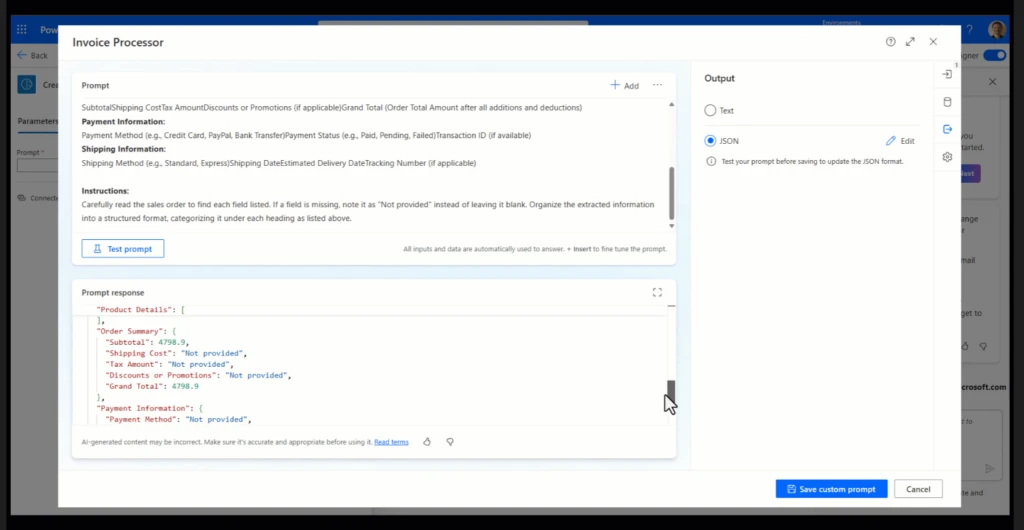
One of the most game-changing updates in AI Builder is the new multi-modal content processing capability, which allows businesses to handle various data types —including text, document, and images—within a single natural language instruction. This integration greatly simplifies the process of crafting AI actions for intelligent document processing. Unlike traditional machine learning models that require extensive training and expertise, AI Builder’s multi-modal processing can be set up using natural language, and without training data.
Structured JSON outputs now generally available
With AI Builder’s new structured JSON output feature, businesses gain a more deterministic and reliable way to handle generated content. Unlike traditional outputs that might vary in format and structure, JSON outputs are now generated with a consistent predefined schema that you define at design time, ensuring that every result aligns precisely with expected data formats. This determinism in content generation means your automated workflows will produce predictable, structured data every time, and those results will be readily integrated as variables in your Power Automate workflow for downstream processing. This feature is especially beneficial when integrating AI Builder outputs into other systems, as it reduces the need for additional data cleaning or transformation. Whether feeding data into a CRM, database, or custom application, you can ensure that data is generated in a structured and predictable way.
Dataverse grounding is now generally available
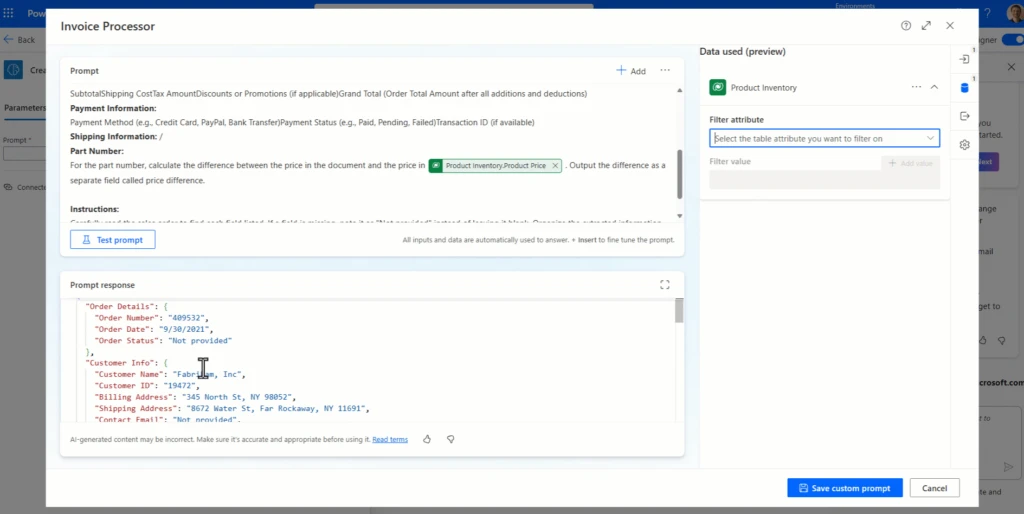
The new Dataverse grounding capability empowers Generative AI models with up-to-date, contextually relevant information from your organization’s own data. By employing Retrieval-Augmented Generation (RAG), AI Builder integrates directly with Dataverse to pull in real-time, business-specific knowledge, giving models a deeper understanding of your unique context.
This RAG-enhanced approach allows AI models to dynamically retrieve and incorporate relevant data from Dataverse during processing, enabling Q&A scenarios with accurate responses that are also highly contextualized to your organization. For instance, models can instantly access customer histories, product information, and up-to-the-minute operational data, enriching outputs with knowledge directly grounded in your business reality.
As part of this feature becoming generally available, the capability has been enhanced to support multiple tables, including tables with large amounts of data records.
Model selection: GPT-4o and GPT-4o Mini
AI Builder offers flexibility in model selection, allowing users to choose between the powerful GPT-4o and the cost-effective GPT-4o Mini. This adaptability enables customization based on specific project requirements and resource considerations.
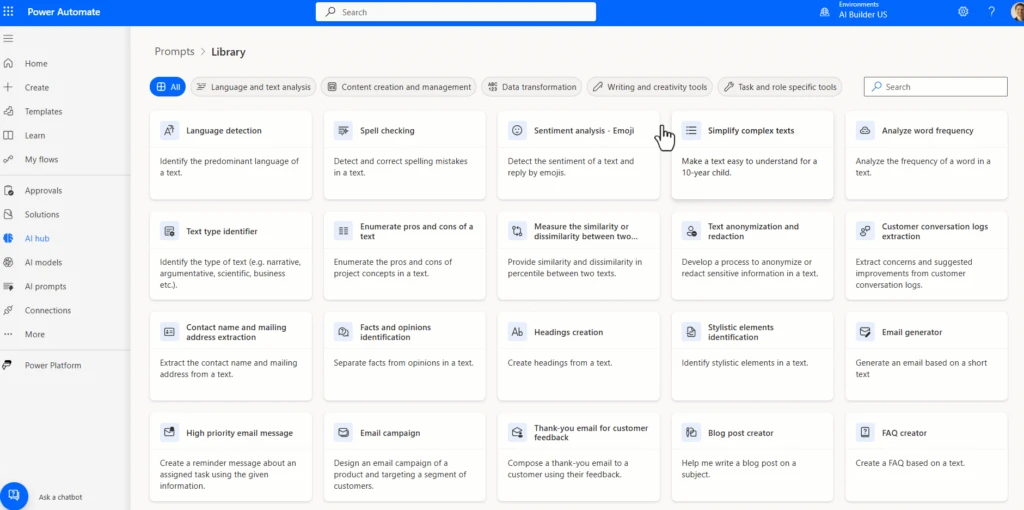
Prompt library
The prompt library feature provides a collection of pre-designed prompts, serving as templates to expedite the creation of AI models. This resource accelerates development and ensures best practices are followed in prompt engineering. Users can modify templates to suit specific needs, adjusting language, tone, and detail to match organizational standards and requirements. The templates cover key areas like document extraction, data transformation, and content generation, making it easy for users to find the right starting point for their intelligent automation goals.
Use cases to get started
With AI Builder, you don’t need to be a coding expert to leverage the power of AI in your daily operations. By creating prompts that can extract information from documents, classify emails, and even analyze images, you can empower your team to work smarter, not harder. AI Builder works hand-in-hand with other Power Platform tools like Power Automate, Copilot Studio and Power Apps, enabling users to create intelligent workflows and applications that are customized to meet the needs of any business.
For example, let’s say your team frequently processes customer inquiries. Using AI Builder and Power Automate, you can design a workflow that analyzes the content of incoming emails, categorizes them by urgency or topic, and even suggests responses. This not only saves time but also keeps communication consistent and efficient. By setting up this automated flow, businesses can stay on top of customer interactions and ensure timely responses.
Are you ready to bring AI to your organization?
The AI Builder Documentation provides a comprehensive guide on setting up AI Builder, configuring models, and integrating it with tools like Power Automate and Power Apps. For step-by-step tutorials, the Microsoft Learn AI Builder Learning Path is an excellent place to start. It covers everything from foundational concepts to advanced use cases, helping users of all levels become proficient in leveraging AI Builder to automate and optimize workflows.
The latest AI experiences in Power Automate are redefining the boundaries of what is possible in enterprise automation—transforming how we optimize and manage business processes to achieve more. Developers can now create advanced automation faster, business analysts can quickly extract, analyze, and optimize critical processes, and IT administrators can seamlessly manage and govern automation at scale. Copilot in Power Automate makes it faster to build solutions that save valuable time and reduce costs, thereby achieving business outcomes. Step into the future with the Power Automate advanced, enterprise-grade intelligent automation solutions.
Build advanced, reliable automations faster with AI
Developers are key to business process innovation. In Power Automate, it is now possible to build automations that utilize AI within cloud flows using generative actions, easily use natural language to create expressions for flows with Copilot for expressions, and incorporate document processing into workflows with next-generation document processing. These features enhance developers’ ability to deliver solutions efficiently and effectively.
Introducing next-generation document processing with GPT
Efficient document management is vital for smooth operations and timely decisions, but traditional AI models require lengthy training and frequent updates. With GPT-4-powered document processing, now available in public preview, you can use natural language to extract and process unstructured data from documents like invoices, medical results, or emails. This next-gen tool handles multi-modal content, automating email, document, and image processing for improved productivity. For makers who want to blend in pro-code or gain greater control, we’ve added the ability to structure outputs using JavaScript Object Notation (JSON) directly inline. Makers can combine multi-modal content with enterprise knowledge from Microsoft Dataverse in their prompts. This feature enables makers to quickly deploy document and image processing directly into existing workflows using natural language instructions.
Transform your automation processes with generative actions
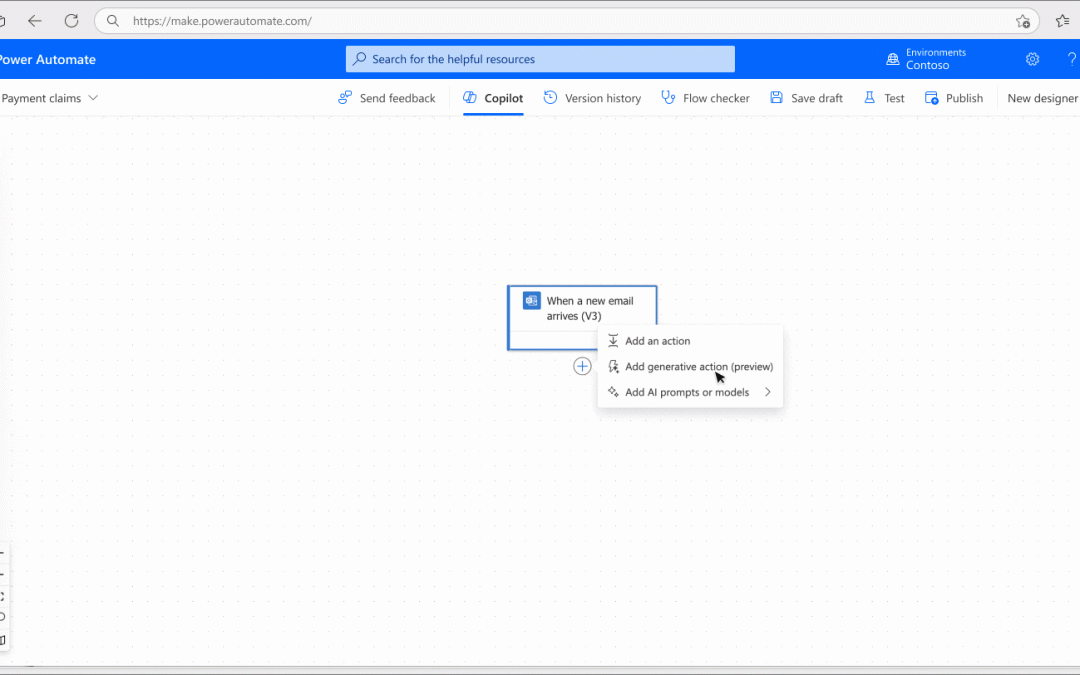
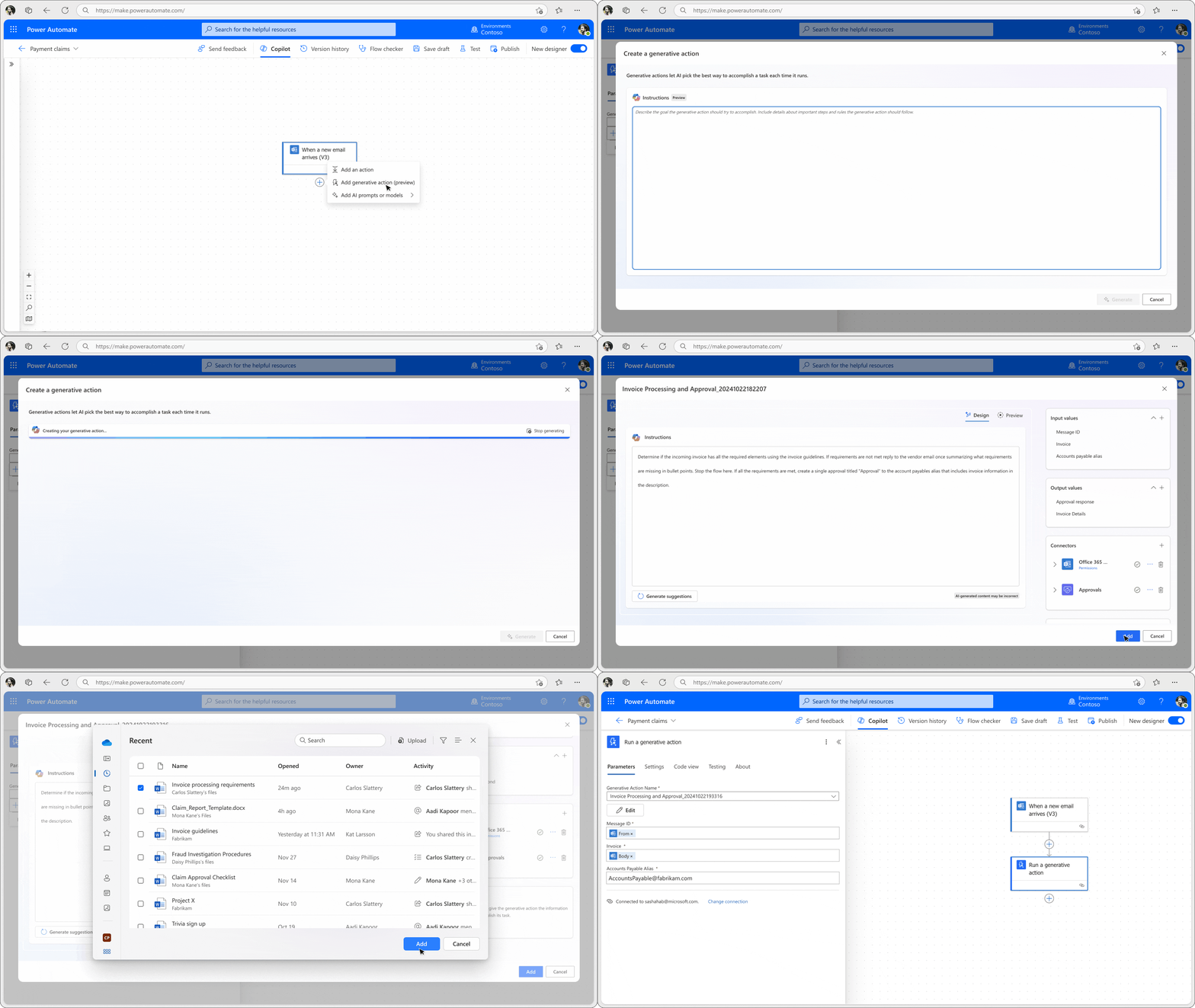
Generative actions allow you to add AI-powered steps to your cloud flows, letting AI reason over enterprise guardrails provided in unstructured content format such as documents and PDFs, and decide the best course of action for complex tasks. For example, with generative actions you can automate conditional approvals based on the content of incoming emails and company policies. This feature, currently in the Early Access Program, is coming soon to public preview, when you will be able to create, edit, test, and run generative actions all from within the cloud flow designer.
Create and edit expressions faster with Copilot
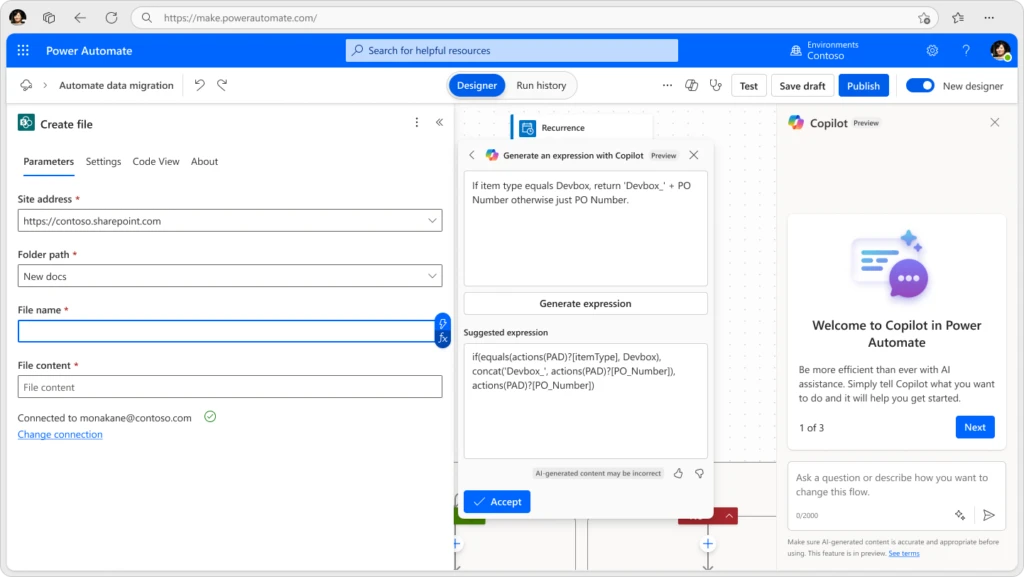
Copilot for expressions, now in public preview, is designed to assist developers and makers in creating or editing complex expressions using natural language. By simply describing what you want to build and referencing the dynamic data in the flow, Copilot translates your prompts into specific expressions in your Power Automate flow, speeding up development and reducing manual coding time.
Monitor and manage at scale with new automation center
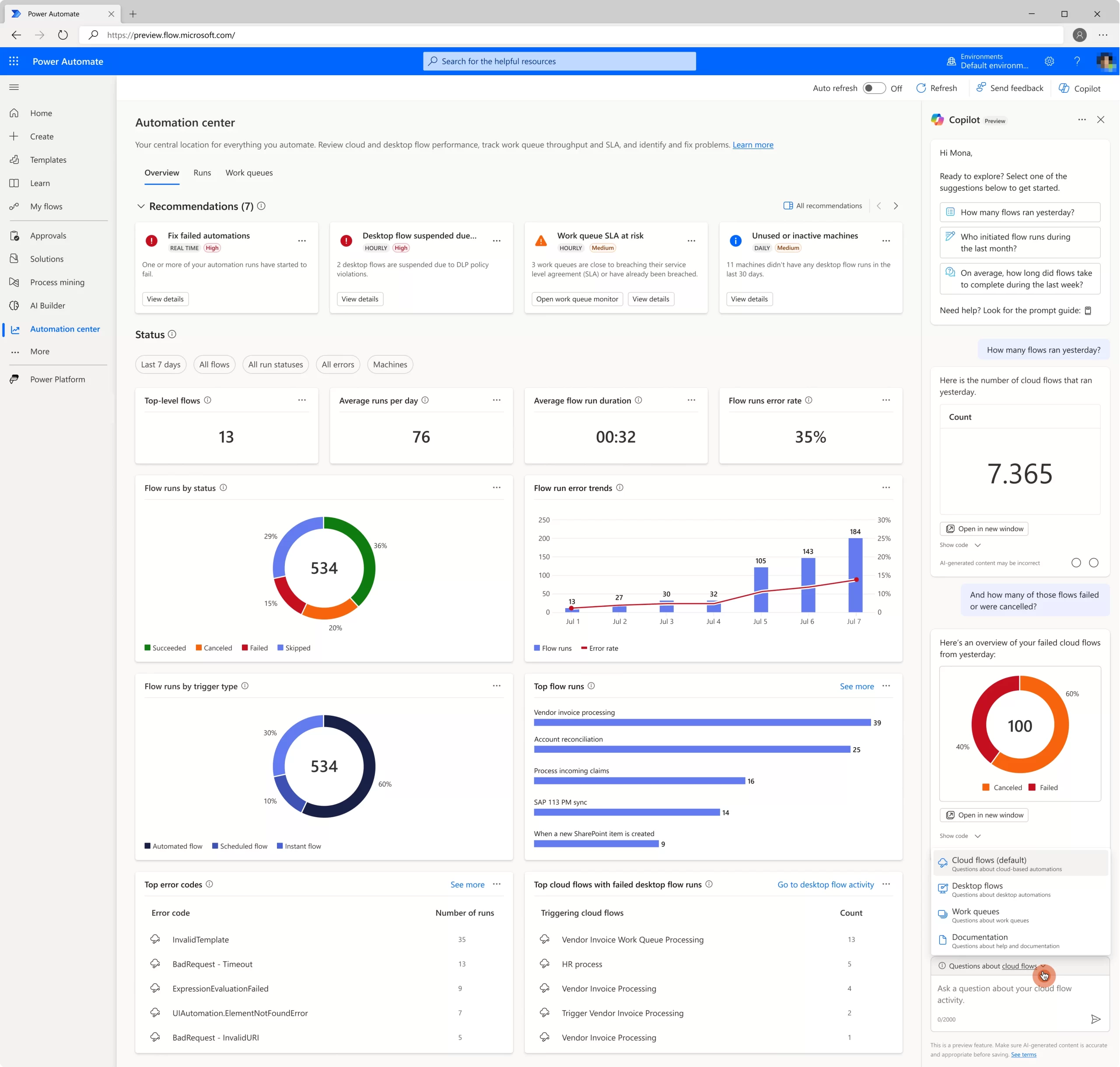
Automation center, now generally available, is a central hub for efficient monitoring and troubleshooting experiences for automation processes across Power Automate at scale. The automation center provides comprehensive visualizations that enable you to monitor the health of your automations, quickly detect issues or trends, and troubleshoot problems more efficiently.
Whether you’re a developer, operator, Center of Excellence team member, or business analyst, the automation center provides a centralized view of all automation activities. Now generally available, it features a user-friendly interface with dashboards that show recommendations, the health status of work queues, and desktop flow activity. Additionally, new views for execution logs, performance metrics, and integrated agents are now available in public preview.
To learn more and to get started, read our Automation center documentation.
Improve robotic process automation (RPA) reliability using repair with Copilot
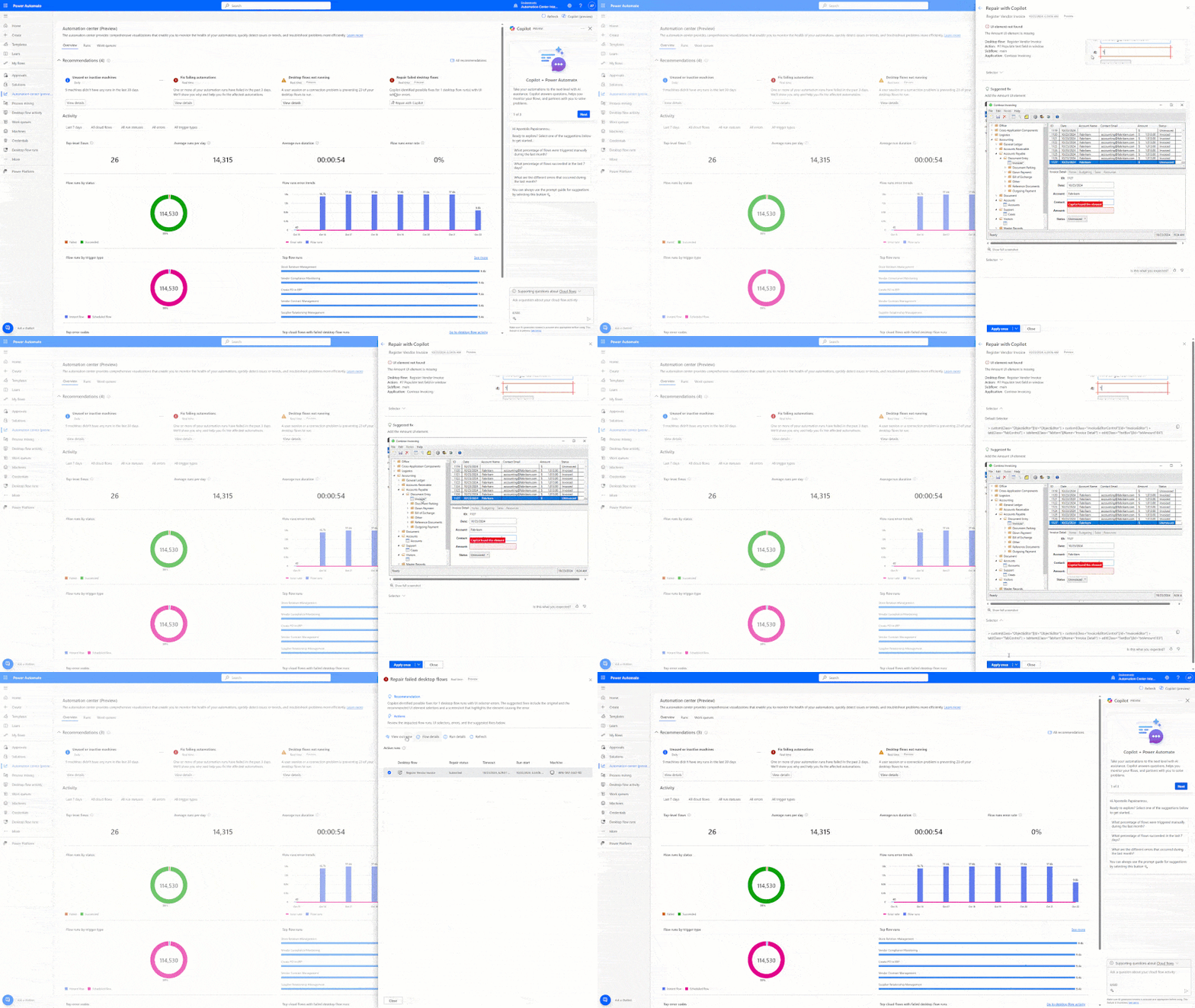
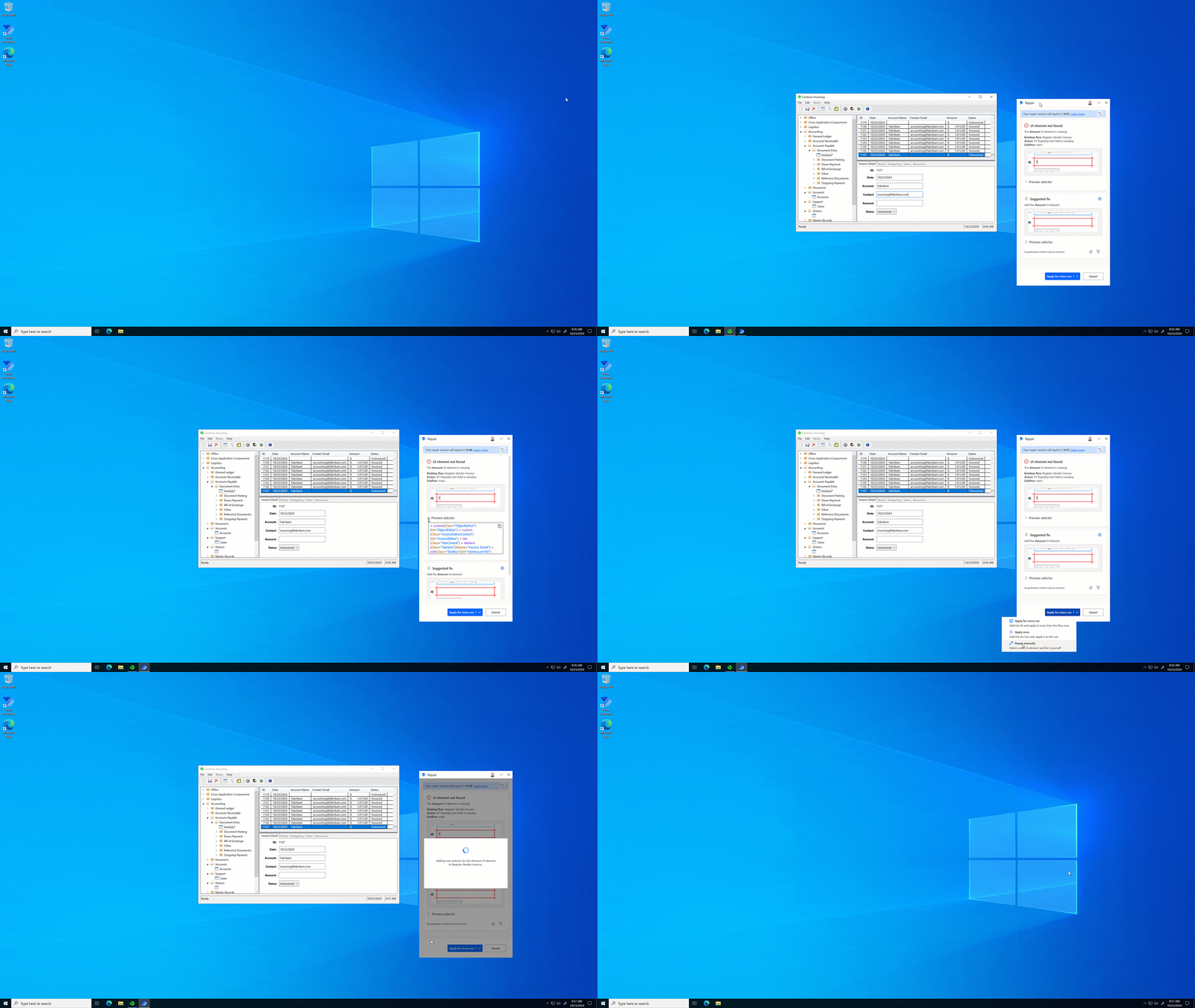
Repair with Copilot, now in public preview, simplifies resolving user interface (UI) control issues in both attended and unattended RPA with Power Automate for desktop. By proactively providing solutions to common automation issues, such as notifying the right person in the automation center, repair with Copilot reduces downtime for RPA scenarios.
Example of using repair with Copilot for unattended RPA:
Example of using repair with Copilot for attended RPA:
Start your journey into a new era of automation and AI
Are you ready to bring your organization into the future with the latest AI capabilities in Power Automate? Get started with a free trial or compare plans, join our sessions below at Microsoft Ignite 2024, and read about other exciting announcements for Microsoft Power Platform.
Power Automate
Find the right low-code automation plan for your business.
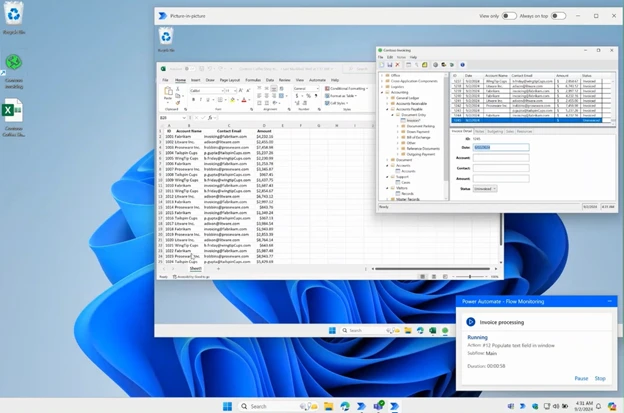
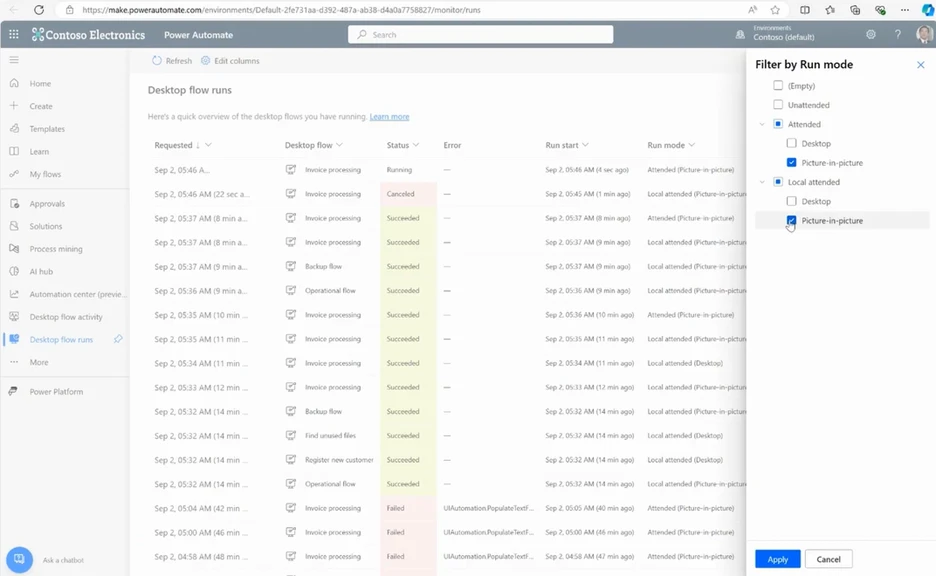
Traditionally, attended automation takes over users’ mouse, keyboard, and screen, halting their current activity. Picture-in-Picture in Power Automate for desktop lets you run attended desktop flows within a virtual window that mirrors your desktop. It allows multitasking, improves user experience, and increases productivity.
You no longer need to wait for the flow to finish before continuing your work!
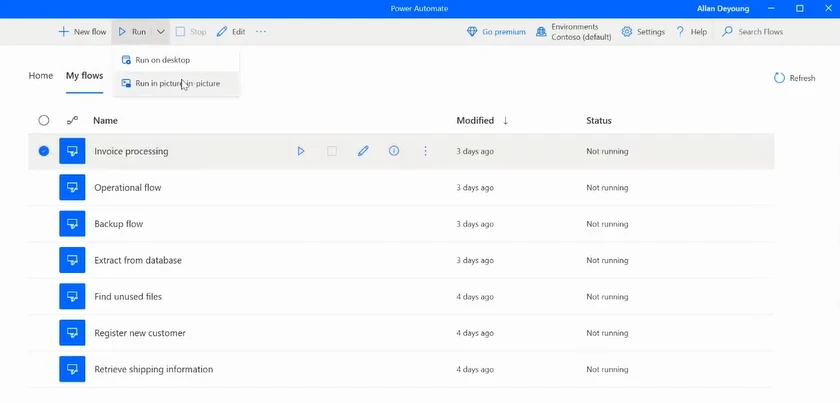
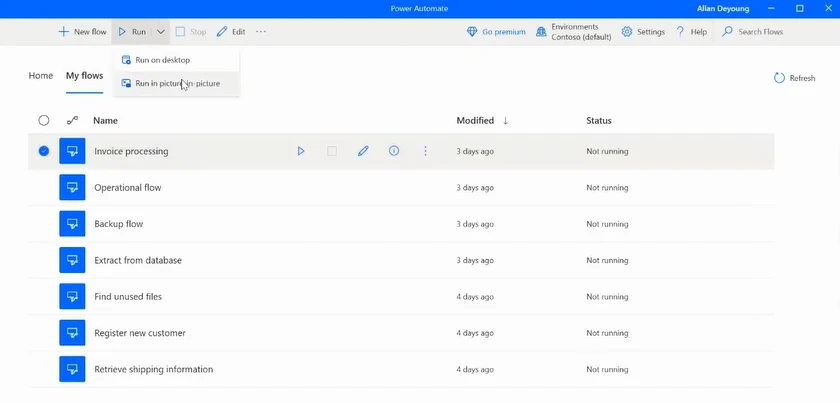
To execute in picture-in-picture mode from the Power Automate console, select your flow, open the command bar, and click on Run in picture-in-picture.
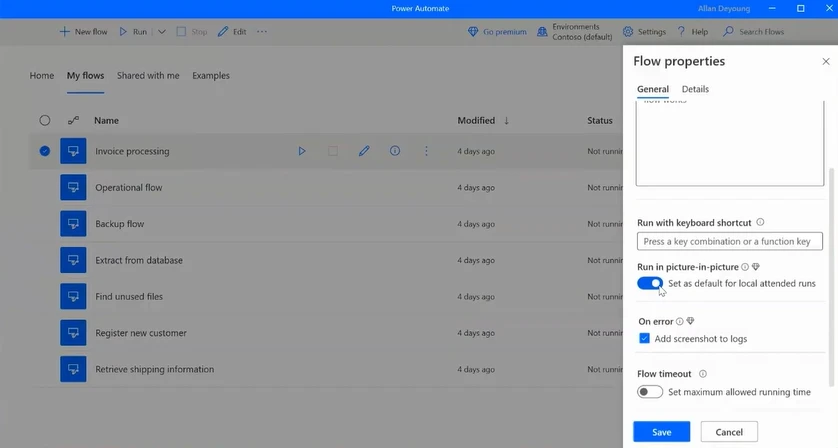
Alternatively, enable the Run in picture-in-picture flow property to ensure your flow always operates in this mode when initiated locally via the console or its Run URL.
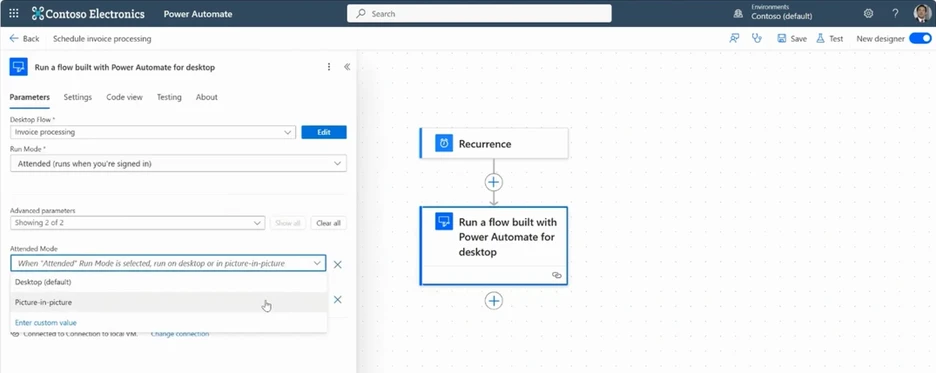
Initiate a desktop flow from a cloud flow using picture-in-picture mode. Use the Run a flow built with Power Automate for desktop cloud action, set Run Mode to Attended, and in the Advanced parameters, choose Attended Mode as Picture-in-picture.
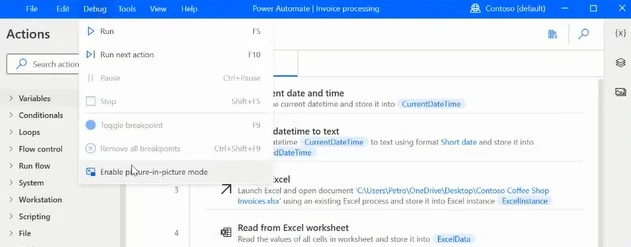
To troubleshoot a desktop flow with picture-in-picture, enable this option in the designer and run your tests. This helps confirm the flow will work seamlessly in production.
To supervise the flow executions in picture-in-picture mode, navigate to desktop flow runs in the portal and apply a filter by run mode.
In an earlier blog, we showed you how the Microsoft Customer and Partner Solutions (MCAPS) organization is optimizing internal processes using Copilot for automation and process mining in Microsoft Power Automate. In this blog, we explore how another Microsoft division is using the same tools to get similar results.
Streamlining security access requests
Microsoft Customer Experience & Success (CE&S) is one of the largest customer support teams in the world. With over 17,000 employees worldwide, CE&S is responsible for shaping the strategy, design, and implementation of Microsoft’s end-to-end customer experience.
For one of their projects, CE&S focused on their Just in Time (JIT) security process used to grant access to resources. “Leveraging the process mining capabilities in Power Automate, we wanted to explore ways to improve our responsiveness – without compromising on security,” says Kirk McNesby, Senior Business Process Manager at Microsoft.
In just one week, CE&S successfully deployed process mining and began gathering insights. “With process mining in Power Automate, we were able to easily input data and immediately jump behind the wheel to do meaningful exploration,” says Kirk. “We had no prior knowledge or training. We were ingesting data and learning how to use the tool – all at the same time.”
To begin using process mining, over 14GB of event log data (consisting of SR events and JIT security logs) was loaded into the tool. The team was particularly impressed with the easy-to-use interface. “We liked the out of the box presentations. Variances were presented in a clear, visual format and filtering worked really well with our data,” says Kirk.
The team used the filtering capabilities within process mining to quickly segment access requests by type and looked for patterns that would contribute to optimization. This strategy revealed bottlenecks in a specific access request for users acting as backup support on cases when the main support engineer was unavailable.
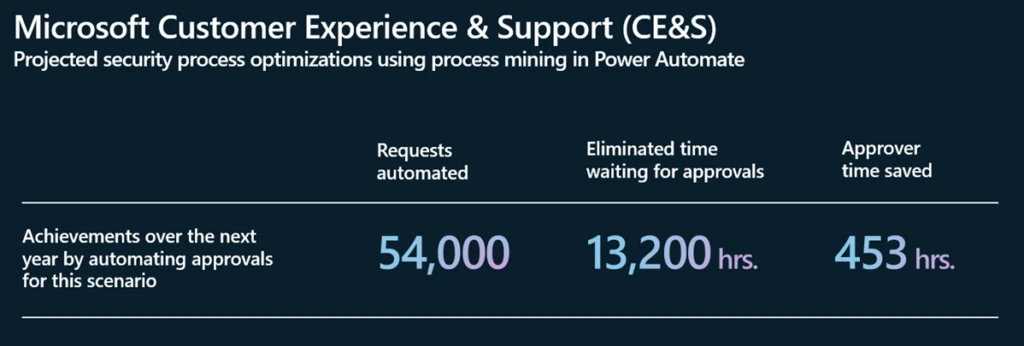
By automating approvals for this scenario, the team estimated that they could automate up to 54,000 approval requests per year, saving users 13,200 hours of wait time. As Kirk adds, “The process mining capabilities in Power Automate were critical to achieving insights this quickly.”
Continue reading to learn about new ways to automate, from outcome-based AI flows that simplify complex processes, to multi-modal AI recording that makes UI automation more natural, accessible, and resilient.